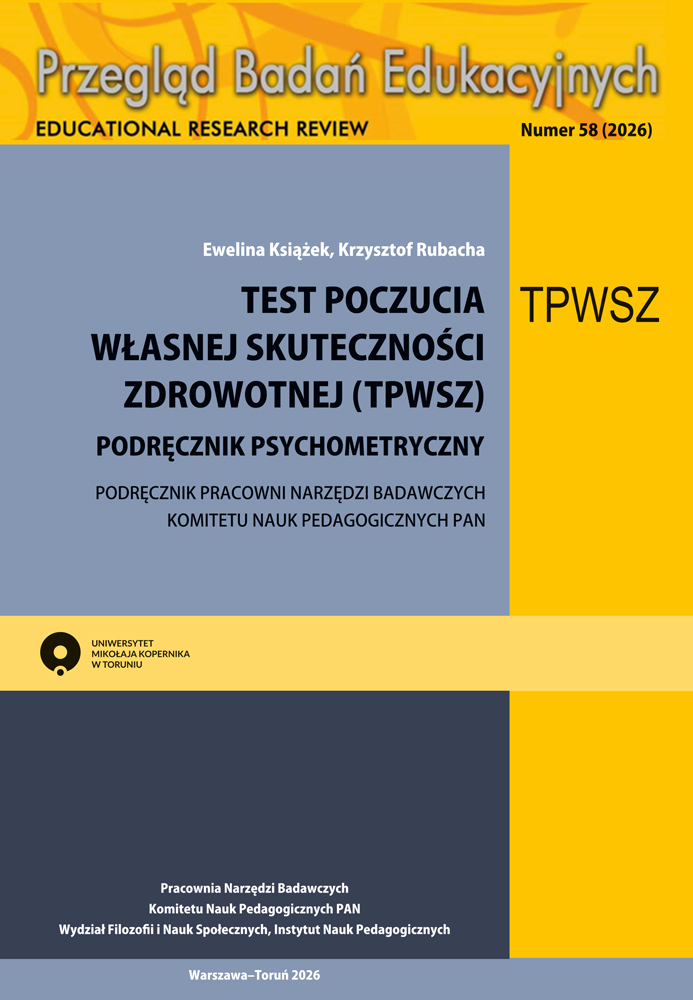
Test poczucia własnej skuteczności zdrowotnej
Podręcznik psychometryczny
DOI:
https://doi.org/10.12775/PBE.2026.001Keywords
health, prevention, self-efficacy, test, psychometric propertiesAbstract
This article presents the process of constructing and validating the Health Self-Efficacy Test (HSET). The starting point is the theory of self-efficacy, which posits that an individual’s judgment regarding their ability to meet the demands of various tasks influences motivation and action. The authors define health self-efficacy as their judgment regarding their ability to implement preventive actions that promote health. The construct addresses the prevention of five groups of diseases: hypertension, obesity, lipid disorders, type 2 diabetes, and depression. The developed test comprises 19 items assessing readiness for health-promoting actions. Psychometric analyses indicate the tool’s high reliability, single-factor structure, and satisfactory diagnostic accuracy. Norms were also eveloped to facilitate the interpretation of results.
References
Bandura, A. (1977). Self-efficacy: Toward a Unifying Theory of Behavioral Change. Psychological Review, 84(2), 191–215.
Bandura, A. (1986). Social Foundations of Thought and Action: A Social Cognitive Theory. Prentice-Hall.
Bandura, A. (1997). Self-efficacy: The Exercise of Control. W.H. Freeman.
Bandura, A. (2000). Exercise of Human Agency Through Collective Efficacy. Current Directions in Psychological Science, 9(3), 75–78.
Bandura, A. (2009). Cultivate Self-efficacy for Personal and Organizational Effectiveness. W: E.A. Locke (Ed.), Handbook of Principles of Organizational Behavior (2nd ed., ss. 179–200). Wiley.
Chomczyńska-Rubacha, M., Rubacha, K. (2013). Test poczucia skuteczności. Opracowanie teoretyczne i psychometryczne Pracowni Narzędzi Badawczych Komitetu Nauk Pedagogicznych PAN. Przegląd Badań Edukacyjnych, 16, 5–20.
Locke, E.A., Latham, G. P. (1990). A Theory of Goal Setting and Task Performance. Prentice-Hall.
Locke, E.A., Latham, G.P. (2002). Building a Practically Useful Theory of Goal Setting and Task Motivation. American Psychologist, 57(9), 705–717.
Nowakowska, M. (1970). Polska adaptacja 16-czynnikowego kwestionariusza osobowości R.B. Cattella. Psychologia Wychowawcza, 13, 478–500.
Rubacha, K., Książek, E. (2025). Contribution of Physical Activity Experience to Variation in Sense of Health Efficacy. Przegląd Badań Edukacyjnych, 47, 227–235.
Schwarzer, R., Jerusalem, M. (1995). Generalized Self-efficacy Scale. W: J. Weinman, S. Wright, M. Johnston (Eds.), Measures in Health Psychology: A User’s Portfolio. Causal and Control Beliefs (ss. 35–37). NFER-Nelson.
Wojtyniak, B., Smaga, A. (red.). (2025). Sytuacja zdrowotna ludności Polski i jej uwarunkowania. Narodowy Instytut Zdrowia Publicznego – PZH.
Downloads
Published
How to Cite
Issue
Section
License
Copyright (c) 2026 Krzysztof Rubacha, Ewelina Książek

This work is licensed under a Creative Commons Attribution-NoDerivatives 4.0 International License.
Stats
Number of views and downloads: 178
Number of citations: 0


