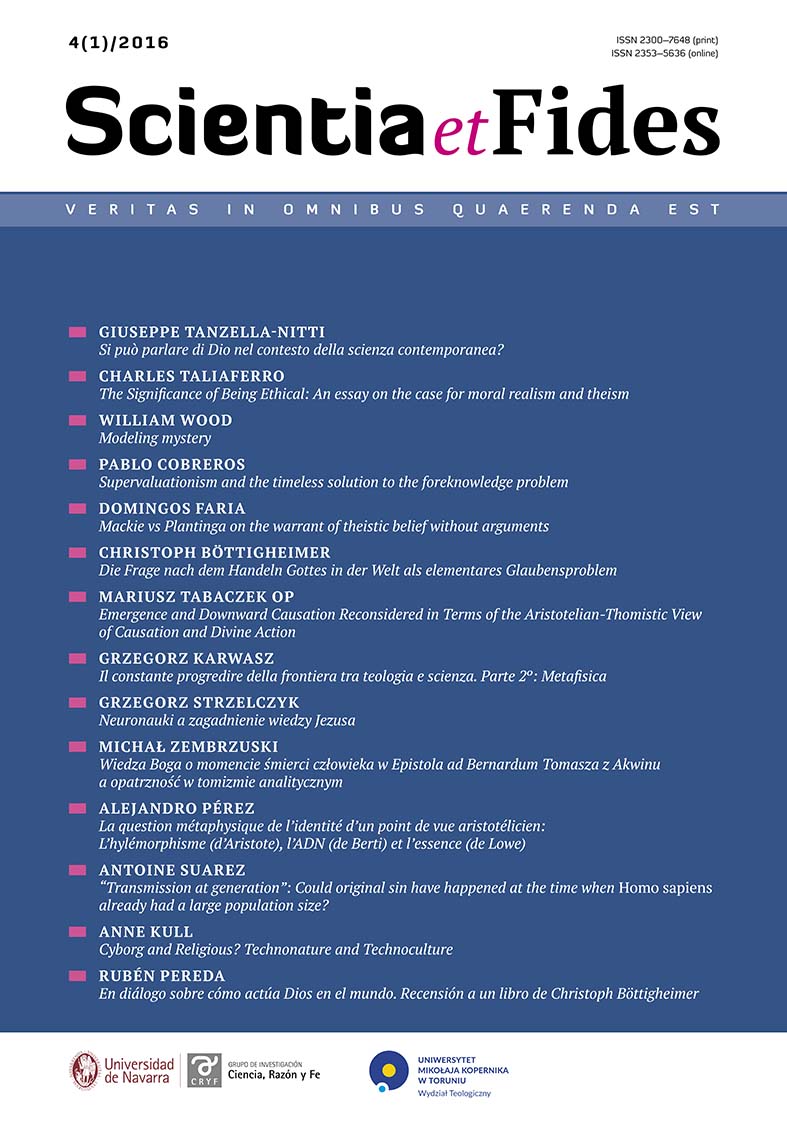
The Significance of Being Ethical: An essay on the case for moral realism and theism
Słowa kluczowe
moral realism, moral anti-realism, objective moral facts, theism, William Irwin, Michael Ruse, E.O. WilsonAbstrakt
William Irwin defends a form of moral anti-realism, according to which there are no objective moral facts. He contends that moral realism is objectionable because of its being more complex or not as simple as anti-realism; moral realism is in conflict with science; moral realism is also challenged by the fact that our moral judgements would differ if we were subject to a different biology or evolutionary past. Irwin also argues that insofar as moral realism is supportable evidentially by experience this would lead to the absurdity of thinking theism may be supported evidentially by religious experience. In response, it is argued that there are many truths (about logic and mathematics) and practices (such as science itself) that are not intelligible if there are no objective, normative truths and that objective moral truths are no more dispensable or odd than epistemic norms. It is further argued that Irwin's account of the evolution of morality is not able to escape presupposing objective moral facts (about harm and benefaction). Finally, the appeal to moral and religious experience is defended in making the case for moral realism and theism.
Bibliografia
Irwin, William. The Free Market Existentialist (Oxford: Wiley Blackwell, 2015).
Hospers, John. An Introduction to Philosophical Analysis. (Englewood New Jersey: Prentice-Hall, 1967).
Kwan, K. The Rainbow of Experience, Critical Trust, and God. (New York: Continuum, 2011).
Ruse, Michael. Taking Darwin Seriously (Oxford: Blackwell, 1986).
Ruse, Michael and E.O. Wilson. “Moral Philosophy as Applied Science,” in Elliott Sober (ed) Conceptual Issues in Evolutionary Biology, 2nd edition (Cambridge: Cambridge University Press, 1994).
Taliaferro, Charles. “The Ordinary is Extraordinary: the Wonder of the Mundane Physical World,” Scientia et Fides 3 (2) 2015.
Wielenberg, Erik. “In Defense of Non-Natural, Non-Theistic Moral Realism,” Faith and Philosophy 26 (2009).
Pobrania
Opublikowane
Jak cytować
Numer
Dział
Licencja
CC BY ND 4.0. Posiadaczem prawa autorskiego (Licencjodawcą) jest Autor, który na mocy umowy licencyjnej udziela nieodpłatnie prawa do eksploatacji dzieła na polach wskazanych w umowie.
- Licencjodawca udziela Licencjobiorcy licencji niewyłącznej na korzystanie z Utworu/przedmiotu prawa pokrewnego w następujących polach eksploatacji: a) utrwalanie Utworu/przedmiotu prawa pokrewnego; b) reprodukowanie (zwielokrotnienie) Utworu/przedmiotu prawa pokrewnego drukiem i techniką cyfrową (e-book, audiobook); c) wprowadzania do obrotu egzemplarzy zwielokrotnionego Utworu/przedmiotu prawa pokrewnego; d) wprowadzenie Utworu/przedmiotu prawa pokrewnego do pamięci komputera; e) rozpowszechnianie utworu w wersji elektronicznej w formule open access na licencji Creative Commons (CC BY-ND 3.0) poprzez platformę cyfrową Wydawnictwa Naukowego UMK oraz repozytorium UMK.
- Korzystanie przez Licencjobiorcę z utrwalonego Utworu ww. polach nie jest ograniczone czasowo ilościowo i terytorialnie.
- Licencjodawca udziela Licencjobiorcy licencji do Utworu/przedmiotu prawa pokrewnego nieodpłatnie na czas nieokreślony
PEŁEN TEKST UMOWY LICENCYJNEJ >>
Statystyki
Liczba wyświetleń i pobrań: 845
Liczba cytowań: 0


