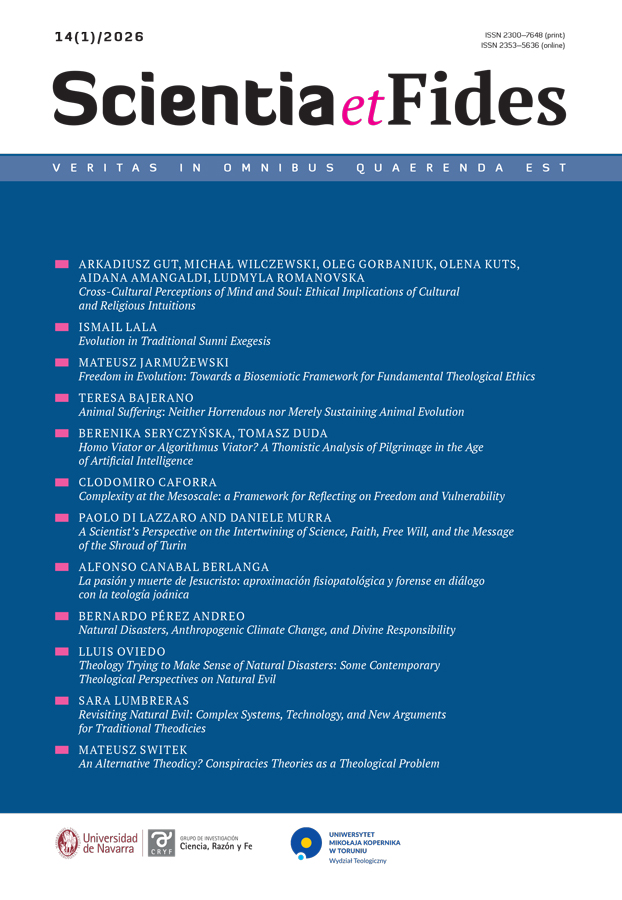
Theology Trying to Make Sense of Natural Disasters
Some Contemporary Theological Perspectives on Natural Evil
DOI:
https://doi.org/10.12775/SetF.2026.010Słowa kluczowe
theodicy, religious coping, function of religion, believing, religious evolution, theology of crossAbstrakt
Natural disasters present a significant challenge to engaged theology, particularly following the decline of traditional explanations that relied on the model of divine punishment. The ongoing occurrence of such catastrophes has become a scandal and is frequently used as a critique of divine providence and goodness. In response, theology has moved beyond earlier models to develop more nuanced answers, drawing on alternative frameworks that offer greater flexibility and depth, after considering merits and flaws of available theodicies. This article reviews contemporary theological approaches to the problem of natural disasters and explores new opportunities provided by research on the function of religion, religious coping mechanisms, and the processes of belief.
Bibliografia
Abbott, Roger Philip. 2019. “‘I Will Show You My Faith by My Works’: Addressing the Nexus between Philosophical Theodicy and Human Suffering and Loss in Contexts of ‘Natural’ Disaster.” Religions 10 (3): 213. https://doi.org/10.3390/rel1003021.
Alimonti, G., and Mariani, L. 2023. “Is the number of global natural disasters increasing?” Environmental Hazards 23 (2): 186–202. https://doi.org/10.1080/17477891.2023.2239807.
Armstrong, Karen. 2022. Sacred Nature: How We Can Recover Our Bond with the Natural World. London: The Bodley Head.
Betenson, Toby. 2016. “Anti-Theodicy.” Philosophy Compass 11 (1): 56–65.
Chester, David K. 2005. “Theology and Disaster Studies: The Need for Dialogue.” Journal of Volcanology and Geothermal Research 146 (4): 319–28.
Chester, David K., and Angus M. Duncan. 2009. “Responding to Disasters within the Christian Tradition, with Reference to Volcanic Eruptions and Earthquakes.” Religion 40 (2): 85–95.
Entwistle, David N., Scott K. Moroney, and Julie Aten. 2018. “Integrative Reflections on Disasters, Suffering, and the Practice of Spiritual and Emotional Care.” Journal of Psychology and Theology 46 (1): 67–81. https://doi.org/10.1177/0091647117750658.
Garssen, B., Visser, A., & Pool, G. 2020. “Does spirituality or religion positively affect mental health? Meta-analysis of longitudinal studies”. The International Journal for the Psychology of Religion 31 (1): 4–20. https://doi.org/10.1080/10508619.2020.1729570.
Gregersen, Niels Henrik. 2015. “Theology and Disaster Studies: From 'Acts of God' to Divine Presence.” In Disaster Research: Multidisciplinary and International Perspectives, edited by Rasmus Dahlberg, Olivier Rubin, and Morten Thanning Vendelø, 34–48. London: Routledge.
Gregersen, Niels Henrik. 2017. “Positive Loss and Tragic Memory: On the Preservation of Community.” Dialog 56: 361–72. https://doi.org/10.1111/dial.12356.
Hardwick, Joseph, and Randall Stephens. 2020. “Acts of God: Continuities and Change in Christian Responses to Extreme Weather Events from Early Modernity to the Present.” Wiley Interdisciplinary Reviews: Climate Change 11 (2): e631.
Hart, David Bentley. 2005. The Doors of the Sea: Where Was God in the Tsunami? Grand Rapids, Michigan: W.B. Eerdmans.
Hick, John. 1985. Evil and the God of Love. London: Macmillan.
Koenig, Harold G. 2008. In the Wake of Disaster: Religious Responses to Terrorism and Catastrophe. Templeton Foundation Press.
Luhmann, Niklas. 1977. Funktion der Religion. Frankfurt am Main: Suhrkamp.
Lumbreras, Sara, Lluis Oviedo and Peter Jeavons. 2026. “The Design Argument Revisited through Evolutionary Computation: Imperfection, Robustness and Creative Emergence.” Zygon: Journal of Religion and Science 61 (1): 221–39. https://doi.org/10.16995/zygon.24840.
Moltmann, Jürgen. 1974. The Crucified God: The Cross of Christ as the Foundation and Criticism of Christian Theology. New York: Harper & Row.
Murphy, Nancey. 2007. “Science and the Problem of Evil: Suffering as a By-Product of a Finely Turned Cosmos.” In Physics and Cosmology: Scientific Perspectives on the Problem of Natural Evil, edited by Robert John Russell and William R. Stoeger, 131–52. Vatican City; Berkeley, California: Vatican Observatory; Center for Theology and the Natural Sciences.
O'Mathúna, Dónal P. 2018. “Christian Theology and Disasters: Where Is God in All This?” In Disasters: Core Concepts and Ethical Theories, edited by Dónal P. O'Mathúna et al., Advancing Global Bioethics 11.
Oord, Thomas Jay. 2009. “An Open Theology Doctrine of Creation and Solution to the Problem of Evil.” Creation Made Free: Open Theology Engaging Science, 28–52.
Oviedo, Lluis. 2024. “Theology and Cultural Evolution.” In St Andrews Encyclopaedia of Theology, edited by Brendan N. Wolfe et al. https://www.saet.ac.uk/Christianity/TheologyandCulturalEvolution.
Oviedo, Lluis. 2025. “Comments to the Article ‘The Gods as Latent Causes: A Statistical Inference Theory of Religion,’ by Francesco Rigoli and Jack Lennon.” The International Journal for the Psychology of Religion, 1–5. https://doi.org/10.1080/10508619.2025.2491889.
Pargament, K. I. 1997. The psychology of religion and coping: Theory, research, and practice. New York: Guilford Press.
Phillips, Dewi Zephaniah. 2004, The Problem of Evil and the Problem of God. London: SCM Press.
Plantinga, Alvin. 1977. God, Freedom, and Evil. Grand Rapids, Michigan: Wm. B. Eerdmans.
Rigoli, Francesco, and Jack Lennon. 2024. “The Gods as Latent Causes: A Statistical Inference Theory of Religion.” The International Journal for the Psychology of Religion, 1–26.
Ritchie, Hannah and Pablo Rosado. 2024. “Is the number of natural disasters increasing?” Published online at OurWorldinData.org. Retrieved from: https://ourworldindata.org/disaster-database-limitations.
Sawada, Yasuyuki, and Yoshito Takasaki. 2017. “Natural disaster, poverty, and development: An introduction.” World Development, 94: 2–15.
Sollereder, Bethany N. 2021. “Compassionate Theodicy: A Suggested Truce Between Intellectual and Practical Theodicy.” Modern Theology 3 (2): 382–95.
Southgate, Christopher. 2008. The Groaning of Creation: God, Evolution, and the Problem of Sin. London: Westminster John Knox Press.
Southgate, Christopher. 2018. Theology in a Suffering World: Glory and Longing. Cambridge: Cambridge University Press.
Swinburne, Richard. 1988. “Does theism need a theodicy?” Canadian journal of philosophy 18 (2): 287–311.
Swinton, John. 2007. Raging with Compassion: Pastoral Responses to the Problem of Evil. Grand Rapids: Eerdmans.
Tilley, Terrence W. 1991. The Evils of Theodicy. Washington: Georgetown University Press.
Trakakis, Nick. 2008. “Theodicy: The Solution to the Problem of Evil, or Part of the Problem?” Sophia 47: 161–91.
White, Robert S. 2014. Who Is to Blame?: Disasters, Nature and Acts of God. Oxford: Monarch Books.
Pobrania
Opublikowane
Jak cytować
Numer
Dział
Licencja
Prawa autorskie (c) 2026 Lluis Oviedo Oviedo

Utwór dostępny jest na licencji Creative Commons Uznanie autorstwa – Bez utworów zależnych 4.0 Międzynarodowe.
CC BY ND 4.0. Posiadaczem prawa autorskiego (Licencjodawcą) jest Autor, który na mocy umowy licencyjnej udziela nieodpłatnie prawa do eksploatacji dzieła na polach wskazanych w umowie.
- Licencjodawca udziela Licencjobiorcy licencji niewyłącznej na korzystanie z Utworu/przedmiotu prawa pokrewnego w następujących polach eksploatacji: a) utrwalanie Utworu/przedmiotu prawa pokrewnego; b) reprodukowanie (zwielokrotnienie) Utworu/przedmiotu prawa pokrewnego drukiem i techniką cyfrową (e-book, audiobook); c) wprowadzania do obrotu egzemplarzy zwielokrotnionego Utworu/przedmiotu prawa pokrewnego; d) wprowadzenie Utworu/przedmiotu prawa pokrewnego do pamięci komputera; e) rozpowszechnianie utworu w wersji elektronicznej w formule open access na licencji Creative Commons (CC BY-ND 3.0) poprzez platformę cyfrową Wydawnictwa Naukowego UMK oraz repozytorium UMK.
- Korzystanie przez Licencjobiorcę z utrwalonego Utworu ww. polach nie jest ograniczone czasowo ilościowo i terytorialnie.
- Licencjodawca udziela Licencjobiorcy licencji do Utworu/przedmiotu prawa pokrewnego nieodpłatnie na czas nieokreślony
PEŁEN TEKST UMOWY LICENCYJNEJ >>
Statystyki
Liczba wyświetleń i pobrań: 476
Liczba cytowań: 0


