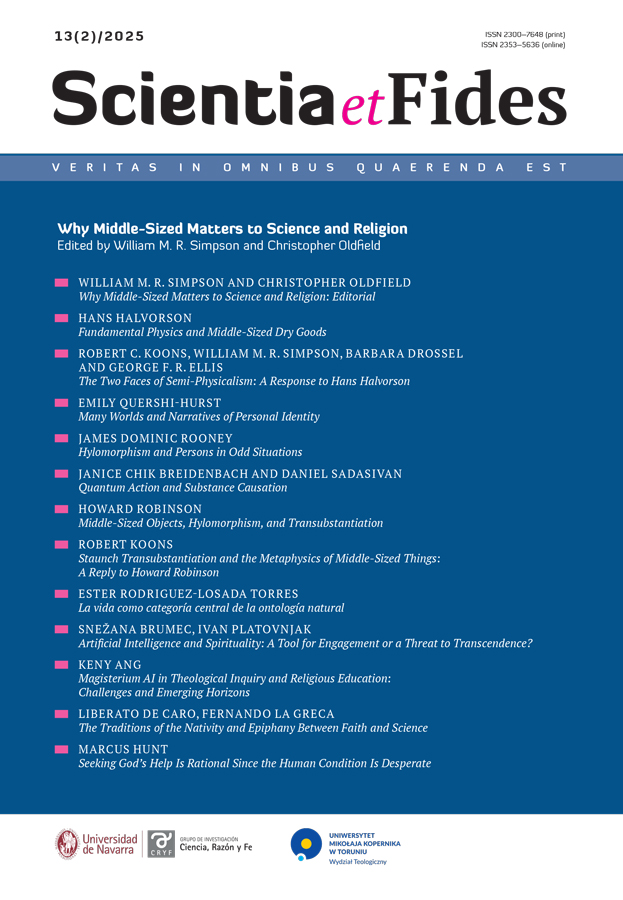
The Traditions of the Nativity and Epiphany Between Faith and Science
DOI:
https://doi.org/10.12775/SetF.2025.025Słowa kluczowe
Birth of Jesus, Epiphany, Eastern and Western Christian Traditions, HanukkahAbstrakt
In Western tradition, the Nativity of Jesus is placed on December 25, 1 BC, according to the calculation made by Dionysius Exiguus in the sixth century. In Eastern tradition, January 6 is associated with both the birth of Jesus and the Epiphany (visit of the Magi). The historicity of events related to the Star of Bethlehem and the accuracy of tradition in determining the beginning of the Christian era have long been debated. This study, conducted through astronomy and the reconstruction of ancient calendars, has shed new light on this longstanding issue. In fact, an ancient fourth-century source, the Apostolic Constitutions, indicates that the Nativity of Jesus occurred on the 25th of Kislev, the first day of the Jewish festival of Hanukkah. The same source places the Epiphany of Magi on the 6th of Tevet. The astronomical-calendar analysis shows that, under certain assumptions, the 25th of Kislev and the 6th of Tevet can exactly coincide with the dates of the Eastern tradition for both the Nativity and the Epiphany, i. e. January 6 , precisely at the beginning of the Christian era, according to the calculation made by Dionysius Exiguus. The probability that this is coincidental is so low that it implies these traditions must necessarily have a historical origin, demonstrating the reasonableness of the faith passed down to us by the early Christians.
Bibliografia
Chilton, Bruce. 2006. “Jesus and Hanukkah: John 10: 22–39.” In The Quest for Context and Meaning: Studies in Biblical Intertextuality in Honor of James A. Sanderse, edited by Peter W. Flint, & James M. Scott, 125–44. Leiden: Brill.
De Caro, Liberato, Fernando La Greca, and Emilio Matricciani. 2021. “The Beginning of the Christian Era Revisited: New Findings.” Histories 1: 145–68.
De Caro, Liberato, Fernando La Greca, and Emilio Matricciani. 2022. “Dating the Birth of Jesus Christ on Hanukkah.” Open J. of Social Science 10: 304–17.
Doggett, Leroy E., and Bradley E. Schaefer. 1994. “Lunar Crescent Visibility.” Icarus 107: 388–403.
Finegan, John. 1998. Biblical Chronology, Principles of time reckoning in the ancient world and problems of chronology in the Bible. Peabody: Hendrickson Publishers.
Förster, Hans. 2007. Die Anfänge von Weihnachten und Epiphanias: Eine Anfrage an die Entstehungshypothesen. Tübingen: Mohr Siebeck.
La Greca, Fernando, and Liberato De Caro. 2017. “Nuovi studi sulla datazione della crocifissione nell’anno 34 e della nascita di Gesù il 25 dicembre dell’1 a.C.” Annales Theologici 31: 11–52.
Martindale, Cyril 1909. “Epiphany.” In The Catholic Encyclopedia. New York: Robert Appleton Company.
Metzger, Marcel. 1986. Les Constitutions Apostoliques (Tome II, Livres III–VI). Introduction, texte critique, traduction et notes par Metzger M. Paris: Les éditions du Cerf.
Nothaf, C. Philipp. 2012. Dating the Passion: The Life of Jesus and the Emergence of Scientific Chronology (200–1600). Leiden–Boston: Brill.
Parker, Richard A., and Waldo H. Dubberstein. 1956. Babylonian Chronology 620 BC – AD 75. Providence: Brown University Press.
Schürer, Emil. 1896. A History of the Jewish People in the Time of Jesus Christ, Vol. I. New York: Scribner.
Wallis, Faith. 1999. Bede: The Reckoning of time. Liverpool: Liverpool University Press.
Pobrania
Opublikowane
Jak cytować
Numer
Dział
Licencja
Prawa autorskie (c) 2025 LIBERATO DECARO, Fernando La Greca

Utwór dostępny jest na licencji Creative Commons Uznanie autorstwa – Bez utworów zależnych 4.0 Międzynarodowe.
CC BY ND 4.0. Posiadaczem prawa autorskiego (Licencjodawcą) jest Autor, który na mocy umowy licencyjnej udziela nieodpłatnie prawa do eksploatacji dzieła na polach wskazanych w umowie.
- Licencjodawca udziela Licencjobiorcy licencji niewyłącznej na korzystanie z Utworu/przedmiotu prawa pokrewnego w następujących polach eksploatacji: a) utrwalanie Utworu/przedmiotu prawa pokrewnego; b) reprodukowanie (zwielokrotnienie) Utworu/przedmiotu prawa pokrewnego drukiem i techniką cyfrową (e-book, audiobook); c) wprowadzania do obrotu egzemplarzy zwielokrotnionego Utworu/przedmiotu prawa pokrewnego; d) wprowadzenie Utworu/przedmiotu prawa pokrewnego do pamięci komputera; e) rozpowszechnianie utworu w wersji elektronicznej w formule open access na licencji Creative Commons (CC BY-ND 3.0) poprzez platformę cyfrową Wydawnictwa Naukowego UMK oraz repozytorium UMK.
- Korzystanie przez Licencjobiorcę z utrwalonego Utworu ww. polach nie jest ograniczone czasowo ilościowo i terytorialnie.
- Licencjodawca udziela Licencjobiorcy licencji do Utworu/przedmiotu prawa pokrewnego nieodpłatnie na czas nieokreślony
PEŁEN TEKST UMOWY LICENCYJNEJ >>
Statystyki
Liczba wyświetleń i pobrań: 1485
Liczba cytowań: 0


