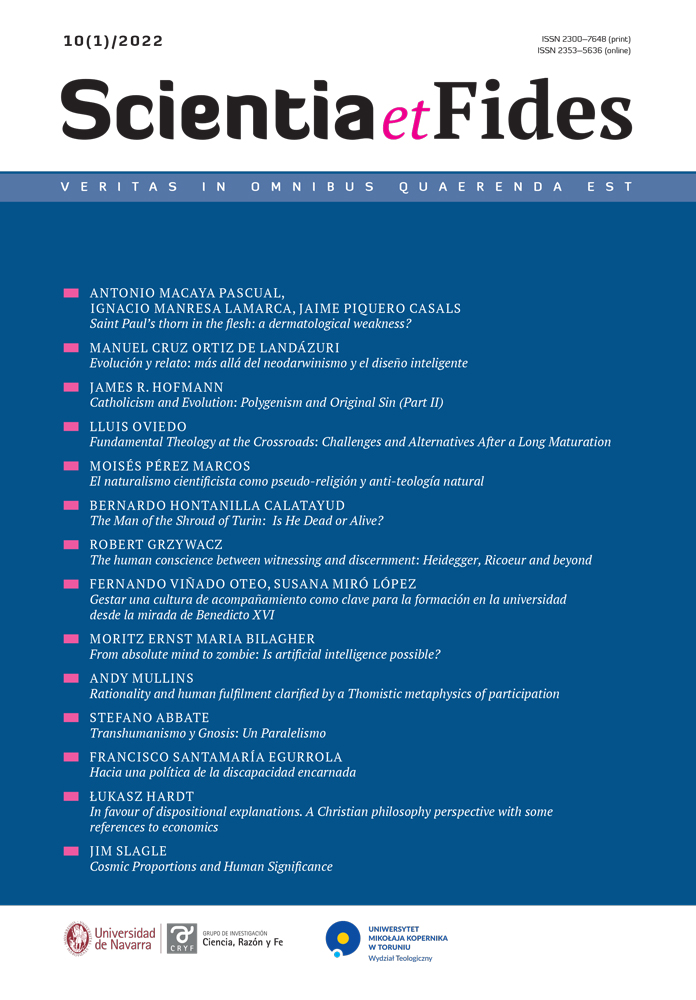
From Absolute Mind to Zombie: Is Artificial Intelligence Possible?
DOI:
https://doi.org/10.12775/SetF.2022.008Parole chiave
computing, religion, consciousness, mythology, intelligenceAbstract
The dream of achieving artificial intelligence (AI) and, in particular, artificial consciousness (‘strong AI’), is reflected in mythologies and popular culture as utopia and dystopia. This article discusses its conceptual possibility. It first relates the desire to realise strong AI to a self-perception of humanity as opposed to nature, metaphorically represented as gods or God. The realisation of strong AI is perceived as an ultimate victory on nature or God because it represents the crown of creation or evolution: conscious intelligence. The paper proceeds to summarise two debates relevant to AI: one educational and one technological. The technological debate, almost invariably presupposing a materialist framework, is related to the mind–body problem of philosophy; the educational one to understanding the concept of intelligence. By proposing a definition of intelligence linked to an idealist conception of reality, postulating mind as participation in Absolute Mind, I attempt a convergence of these debates, rejecting the possibility of strong AI.
Riferimenti bibliografici
Akass, C. 2007. “The Zombie enigma.” PC World, November: 20–21.
American Psychological Association. 1996. APA task force examines the knowns and unknowns of intelligence. Retrieved 28 July 2020 from: http://web.archive.org/web/20041130090438/http://www.apa.org/releases/intell.html
Argonov, V. 2014. “Experimental methods for unraveling the Mind–Body Problem: The phenomenal judgment approach.” Journal of Mind and Behavior 35, No. 1 and 2: 51–70.
Arvey, R.D. et al. 1994. “Mainstream science on intelligence.” Wall Street Journal 13 December: A 18.
Augustine, A. 2007. De stad van God (The city of God). Transl. G. Wijdeveld. Amsterdam: Ambo.
Aydede, M. & Güzeldere, G. 2000. “Consciousness, intentionality and intelligence: some foundational issues for artificial intelligence.” Journal of Experimental & Theoretical Artificial Intelligence 12: 263–277.
Baader, F. von. 1851. Fermenta cognitionis. Leipzig: Publisher unknown.
Bishop, J.M. 2018. “Is anyone home? A way to find out if AI has become self-aware.” Frontiers in Robotics and AI 5, No. 17: pp. 1–2.
Bloom, B. et al. 1971. Taxonomy of educational objectives. Ann Arbor: Edward Bros.
Brooke, J.H. 2006. “Contributions from the history of science and religion.” In Oxford handbook of science and religion. Oxford: Oxford University Press.
Chalmers, D. 1995. “Facing up to the problem of consciousness.” Journal of Consciousness Studies 2, No. 3: 200–219.
Darwin, C. 1958. The autobiography of Charles Darwin 1809–1882. [With original omissions restored. Edited with Appendix and Notes by his grand-daughter Nora Ballow.]. London: Collins.
Dembski, W.A. 2002. “Kurzweil’s impoverished spirituality.” In Are we spiritual machines: Ray Kurzweil vs. the critics of strong AI, edited by J.W. Richards. Seattle: Discovery Institute Press.
Diamond, A., Knight, R., Devereux, D. & Holland, O. (2012). “Anthropomimetic Robots: Concept, Construction and Modelling.” International Journal of Advanced Robotic Systems 9: 1–14.
Dobzhansky, T. 1969. The biology of ultimate concern. London: Rapp & Whiting.
Dostoyevsky, F. 1958. De gebroeders Karamazow (The brothers Karamazov). Transl. J. van der Eng. Amsterdam: G.A. van Oorschot.
Fjelland, R. 2020. “Why general artificial intelligence will not be realized.” Humanities and Social Sciences Communications 7, No. 10: 1–9.
Freud, S. 1991. Zelfportret. De weerstanden tegen de psychoanalyse. Het vraagstuk van de lekenanalyse. (Self-portrait. The refutations of psychoanalysis. The question of lay analysis). Meppel / Amsterdam: Boom.
Fromm, E. 1984. The fear of freedom. London: Routledge Classics.
Gardner, H. 1993. Frames of mind. London: Fontana.
Graziano, M.S.A. & Kastner, S. 2011. “Human consciousness and its relationship to social neuroscience: A novel hypothesis.” Cognitive Neuroscience 2, No. 2: 98–113.
Halal, W.E. 2009. “The automation of thought: Information technology holds the key to global maturity.” Technology Analysis & Strategic Management 21, No. 2: 277–280.
Heinisch, K.J. 1960. Der Utopische Staat (The utopian state). Reinbek bei Hamburg: Rowohlt.
Hunt-Grubbe, C. 2007. “The elementary DNA of dear Dr. Watson.” Times Online 14 October. Retrieved 28 July 2020 from: https://library.wur.nl/WebQuery/file/cogem/cogem_t49203c8e_001.pdf
Jung, C.G. 1982. Psychologie en religie (Psychology and religion). Rotterdam: Lemniscaat.
Jung, C.G. 1950. Gestaltungen des Unbewußten (Representations of the unconscious). Zürich: Rascher.
Kant, I. 1990. Critique of pure reason. Amherst: Prometheus books.
Kant, I. 1996. Kritik der praktischen Vernunft. Grundlegung zur Metaphysik der Sitten (Critique of practical reason. Groundwork of the metaphysics of morals). Frankfurt am Main: Suhrkamp.
Kurzweil, R. 2001. One half of an argument. Retrieved 28 July 2020 from: http://www.edge.org/3rd_culture/kurzweil/kurzweil_print.html
Kwa, C. 2005. De ontdekking van het weten (The discovery of knowledge). Amsterdam: Boom.
Kwa, C. 1991. “Wetten en verhalen (Laws and stories).” Kennis en Methode 1: 105–120.
MacGregor, N. 2008. “Foreword.” In: The Greek myths: Origins of the gods. Supplement to The Guardian.
Manuel, F. & Manuel, F. 1982. Utopian thought in the Western world. Cambridge, Mass.: Belknap / Harvard University Press.
Marcus, G. 2019. DeepMind’s losses and the future of artificial intelligence. Wired, 14 August. Retrieved 28 July 2020 from: https://www.wired.com/story/deepminds-losses-future-artificial-intelligence/
Marx, K. 1909. Capital (Vol. III), edited by F. Engels. Chicago: Charles H. Kerr.
Mumford, L. 1959. The story of utopias. Gloucester Massachusetts: Peter Smith.
Paracelsus 1537. De natura rerum, Book I.
Plato. 1995a. Sokrates’ leven en dood (Socrates’ life and death). Transl. G. Koolschijn. Amsterdam: Athenaeum / Polak & Van Gennep.
Plato. 1995b. Constitutie (The Republic). Transl. G. Koolschijn. Amsterdam: Athenaeum – Polak & Van Gennep.
Reggia, J.A. 2013. “The rise of machine consciousness: Studying consciousness with computational models.” Neural Networks 44: 112–131.
Rorty, R. 1980. Philosophy and the mirror of nature. Oxford: Basil Blackwell.
Russell, B. 2007. The history of Western philosophy. London: Routledge.
Schopenhauer, A. 1996. Die Welt als Wille und Vorstellung (The world as will and representation). Frankfurt am Main / Leipzig: Insel Verlag.
Searle, J.R. 1991. Mind, brains and science: the 1984 Reith lectures. London: Penguin.
Searle, J.R. 1980. “Minds, brains, and programs.” Behavioral and Brain Sciences 3, 3: 417–457.
Shelley, M. 1818. Frankenstein; or, the Modern Prometheus. London: Lackington, Hughes, Harding, Mavor & Jones.
Spinoza, B. 1862. Tractatus theologico-politicus. London: Trübner & Co.
Turing, A.M. 1950. “Computing machinery and intelligence.” Mind 59: 433–460.
Warnick, B. 2004. “Rehabilitating AI: argument loci and the case for Artificial Intelligence.” Argumentation 18: 149–170.
Warwick, K. 2002. “Alien encounters.” In Views into the Chinese Room, edited by J. Preston and J. M. Bishop. Oxford, UK: Clarendon Press.
Downloads
Pubblicato
Come citare
Fascicolo
Sezione
Licenza
Copyright (c) 2022 Scientia et Fides

Questo lavoro è fornito con la licenza Creative Commons Attribuzione - Non opere derivate 4.0 Internazionale.
CC BY ND 4.0. The Creator/Contributor is the Licensor, who grants the Licensee a non-exclusive license to use the Work on the fields indicated in the License Agreement.
- The Licensor grants the Licensee a non-exclusive license to use the Work/related rights item specified in § 1 within the following fields: a) recording of Work/related rights item; b) reproduction (multiplication) of Work/related rights item in print and digital technology (e-book, audiobook); c) placing the copies of the multiplied Work/related rights item on the market; d) entering the Work/related rights item to computer memory; e) distribution of the work in electronic version in the open access form on the basis of Creative Commons license (CC BY-ND 3.0) via the digital platform of the Nicolaus Copernicus University Press and file repository of the Nicolaus Copernicus University.
- Usage of the recorded Work by the Licensee within the above fields is not restricted by time, numbers or territory.
- The Licensor grants the license for the Work/related rights item to the Licensee free of charge and for an unspecified period of time.
FULL TEXT License Agreement
Stats
Number of views and downloads: 2416
Number of citations: 0


