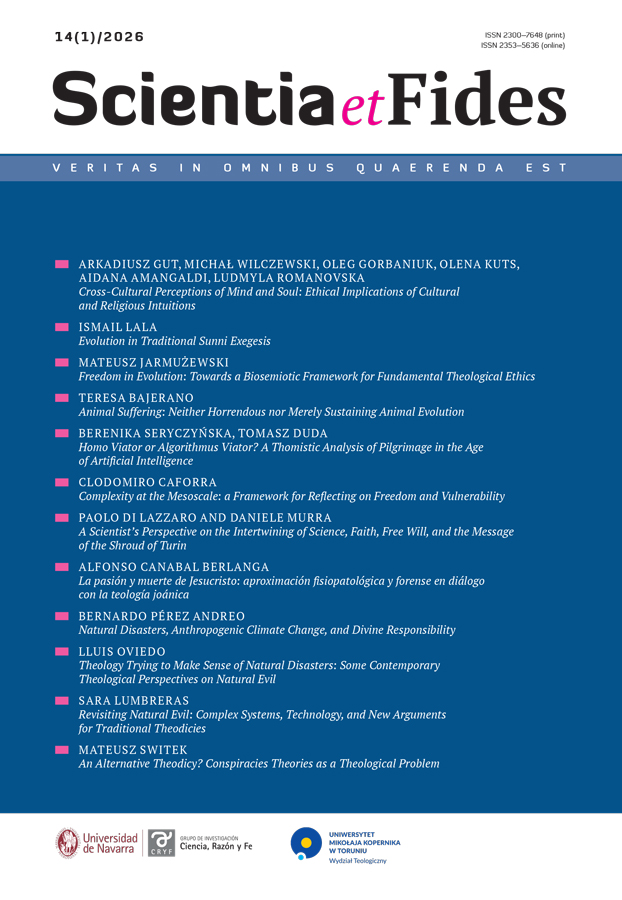
La pasión y muerte de Jesucristo: aproximación fisiopatológica y forense en diálogo con la teología joánica
DOI:
https://doi.org/10.12775/SetF.2026.008Schlagworte
Crucifixión, Shock hipovolémico, Asfixia, Fisiopatología del sufrimiento, Medicina forense, Síndone de Turín, Antropología teológicaAbstract
La pasión y muerte de Jesucristo constituyen un acontecimiento central de la fe cristiana y, al mismo tiempo, un hecho histórico susceptible de análisis médico y forense. El presente artículo propone una lectura integrada que articula la fisiopatología del sufrimiento extremo, la medicina forense de la crucifixión romana y la reflexión teológica, tomando como eje hermenéutico el Evangelio de Juan. A partir del análisis de la flagelación, la crucifixión y la herida del costado, se examinan los principales mecanismos fisiopatológicos implicados en la muerte de Jesús: shock hipovolémico, insuficiencia respiratoria, colapso metabólico, lesión pulmonar y posible cardiopatía de estrés inducida por una descarga catecolaminérgica extrema. Estos datos se ponen en diálogo con la literatura médico-forense contemporánea y con los hallazgos procedentes del estudio de la Síndone de Turín y del Sudario de Oviedo, cuya coherencia con los relatos evangélicos ha sido ampliamente discutida en el ámbito científico. Finalmente, el trabajo ofrece una reflexión teológica y antropológica sobre el sufrimiento corporal de Cristo, mostrando cómo la vulnerabilidad extrema del cuerpo crucificado no es un mero dato biológico, sino el lugar teológico donde se revela el sentido redentor del sufrimiento humano. De este modo, el artículo pretende contribuir al diálogo entre ciencia y fe, mostrando la fecundidad de una aproximación interdisciplinar rigurosa y respetuosa de los distintos niveles de conocimiento.
Literaturhinweise
Barbet, Pierre. La crucifixión de Nuestro Señor Jesucristo. Barcelona: Ed. O.C., 1969.
Bergeron, John W. 2012. “The Crucifixion of Jesus: Review of Hypothesized Mechanisms of Death and Implications of Shock and Trauma-Induced Coagulopathy.” Journal of Forensic and Legal Medicine 19 (3): 113–116. https://doi.org/10.1016/j.jflm.2011.06.001
Beutler, Johannes. 2018. “La muerte de Jesús y su exaltación.” Revista de Cultura Teológica 92: 143–157. https://doi.org/10.23925/rct.i92.39747
Biblia de Jerusalén. 2009. Biblia de Jerusalén. 5.ª ed. Bilbao: Desclée de Brouwer.
Castillo Gutiérrez, Gabriela, Ernesto Deloya Tomas, María G. Olvera Ramos, Jorge López Fermín, José Antonio Meade-Aguilar, Jorge D. Carrión Moya, Manuel A. Guerrero-Gutiérrez, Éder I. Zamarrón-López y Orlando R. Pérez Nieto. 2024. “Lesión pulmonar autoinducida por el paciente (P-SILI).” Critical Care & Emergency Medicine 3: 1–12. https://doi.org/10.58281/ccem23120701
Edwards, William D., Wesley J. Gabel, y Floyd E. Hosmer. 1986. “On the Physical Death of Jesus Christ.” Journal of the American Medical Association 255 (11): 1455–1463. https://doi.org/10.1001/jama.1986.03370110077025
Gómez-Pallete, Manuel, SJ. 1947. “Cruz y crucifixión (Notas para una exégesis de Mc 15,25).” Estudios Eclesiásticos 20–21: 5–38.
Guerrero Ramos, Daniel. 2005. “¿Qué podemos saber de la muerte de Jesús? Las fuentes y los datos históricos.” Proyección. Teología y Mundo Actual 217: 175–205.
Habermas, Gary R., Joseph Kopel, y Benjamin C. F. Shaw. 2021. “Medical Views on the Death by Crucifixion of Jesus Christ.” Baylor University Medical Center Proceedings 34 (6): 748–752. https://doi.org/10.1080/08998280.2021.1970846
Juan Pablo II. 1984. Salvifici Doloris. Ciudad del Vaticano: Libreria Editrice Vaticana.
Karapanagiotis, Ioannis. 2025. “The Shroud of Turin: An Overview of the Archaeological Scientific Studies.” Textiles 5 (1): 8. https://doi.org/10.3390/textiles5010008
Londoño Betancur, Juan E. 2024. “La muerte de Jesús: una constelación de metáforas.” Franciscanum 66 (181).
Mangione S. Did Jesus Die of Takotsubo Cardiomyopathy? A Medical Revisiting of the Gospels. J Gen Intern Med. 2024 Dec;39(16):3342-3343. doi: 10.1007/s11606-024-09042-9. Epub 2024 Sep 19. PMID: 39299976; PMCID: PMC11618558.
Maslen, Matthew W., y Piers D. Mitchell. 2006. “Medical Theories on the Cause of Death in Crucifixion.” Journal of the Royal Society of Medicine 99 (4): 185–188. https://doi.org/10.1258/jrsm.99.4.185
Mateo-Seco, Lucas F. 1981. “Muerte de Cristo y teología de la cruz.” En Actas del III Simposio Internacional de Teología, 113–132. Pamplona: Universidad de Navarra.
Real Academia Europea de Doctores. s. f. Estudio fisiopatológico de la muerte de Cristo. Barcelona. Acceso el 18 de enero de 2026. https://raed.academy/estudio-fisiopatologico-de-la-muerte-de-cristo/
Retief, Francois P., y Louise Cilliers. 2003. “The History and Pathology of Crucifixion.” South African Medical Journal 93 (12): 938–941.
Santoro, Stefano, Piergiuseppe Colivicchi, y Davide Basilico. 2024. “Did Jesus Die of Takotsubo Cardiomyopathy? A Medical Revisiting of the Gospels.” Journal of General Internal Medicine 39 (16): 3342–3343. https://doi.org/10.1007/s11606-024-09042-9
Vergara Hoyos, Juan V. 2016. “Lenguaje teológico: Cruces y sufrimientos.” Franciscanum 58 (166): 271–293. https://doi.org/10.21500/01201468.2524
Zugibe, Frederick T. 2005. The Cross and the Shroud: A Medical Inquiry into the Crucifixion. New York: Paragon House.
Downloads
Veröffentlicht
Zitationsvorschlag
Ausgabe
Rubrik
Lizenz
Copyright (c) 2026 Alfonso Canabal Berlanga

Dieses Werk steht unter der Lizenz Creative Commons Namensnennung - Keine Bearbeitungen 4.0 International.
CC BY ND 4.0. The Creator/Contributor is the Licensor, who grants the Licensee a non-exclusive license to use the Work on the fields indicated in the License Agreement.
- The Licensor grants the Licensee a non-exclusive license to use the Work/related rights item specified in § 1 within the following fields: a) recording of Work/related rights item; b) reproduction (multiplication) of Work/related rights item in print and digital technology (e-book, audiobook); c) placing the copies of the multiplied Work/related rights item on the market; d) entering the Work/related rights item to computer memory; e) distribution of the work in electronic version in the open access form on the basis of Creative Commons license (CC BY-ND 3.0) via the digital platform of the Nicolaus Copernicus University Press and file repository of the Nicolaus Copernicus University.
- Usage of the recorded Work by the Licensee within the above fields is not restricted by time, numbers or territory.
- The Licensor grants the license for the Work/related rights item to the Licensee free of charge and for an unspecified period of time.
FULL TEXT License Agreement
Stats
Number of views and downloads: 284
Number of citations: 0


