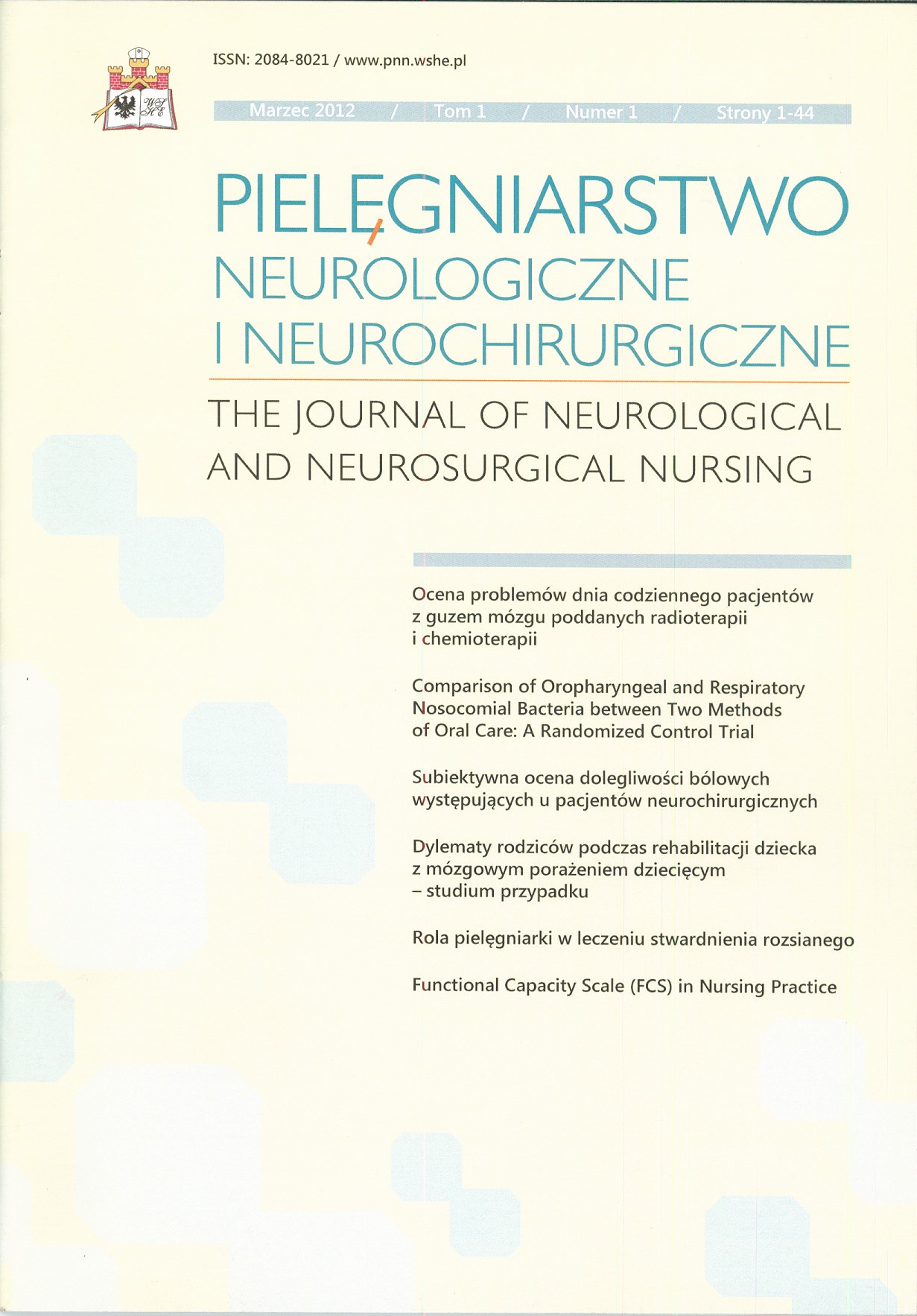
Functional Capacity Scale (FCS) in Nursing Practice
Keywords
functional capacity scale, neurosurgery, nursingAbstract
In the medical practice of a neurological and neurosurgical nurse, the scoring scales are used for measuring the degree of damage (neurological deficit), for the functional assessment of a patient (motor abilities) and for the assessment of the patient’s comfort (the effects the illness may have on psyche and the patient’s social life). Recent studies (in the field of neurological and neurosurgical nursing), assessing patient’s condition during hospitalization, tend to focus on determining patient’s functional capacity in the scope of self care. Self care is related to functional capacity which is patient’s ability to act independently in satisfying basic life needs. Based on rich experience of the Neurosurgery and Neurotraumatology Clinic in Bydgoszcz in the field of assessment of functional capacity in patients with nervous system disorders (subarachnoid hemorrhage, intracranial aneurysm, brain tumour and low back pain), a new scale (FCS) for assessment of these patients was developed.
(PNN 2012;1(1):35-40)
References
Masur H., Papke K. Scales and scores in neurology: quantification of neurological deficits in research and practice. Thieme, 2004.
Adamczyk K. Self-mangement in the selected nursing models form the point of view of nursing (in Polish). Medical Academy, Lublin 2000.
Książkiewicz B. Clinical method of general body motorics in assessment of ischaemic cerebral stroke (in Polish). Medical Academy, Bydgoszcz 1996.
Opara J. The analysis of practical aspects of scoring scales in examining rehabilitation results in patients with partial paresis (in Polish). ŚAM, Katowice 1996.
Opara J. Clinimetrics in stroke (in Polish). AWF, Katowice 2010.
Mahoney F.I., Barthel D.W. Functional evaluation: The Barthel Index. Maryland State Medical Journal. 1965;14:56-61.
Rankin J. Cerebral vascular accidents in patients over the age of 60. II. Prognosis. Scottish Medical Journal. 1957;5:200-215.
Greebe P., Rinkel G.J., Hop J.W., Visser-Meily J.M., Algra A. Functional outcome and quality of life 5 and 12.5 years after aneurysmal subarachnoid haemorrhage. Journal of Neurology. 2010;257:2059-2064.
Saciri B.M., Kos N. Aneurysmal subarachnoid haemorrhage: outcomes of early rehabilitation after surgical repair of ruptured intracranial aneurysms. Journal of Neurology, Neurosurgery and Psychiatry. 2002;72(3):334-337.
Kara B., Yozbatiran N., Arda M.N. Functional Results of Physiotherapy Programme On Patients With Aneurysmal Subarachnoid Hemorrhage. Turkish Neurosurgery. 2007;17(2):83-90.
Jennett B., Bond M. Assessment of outcome after severe brain damage: a practical scale. Lancet. 1975;1:480-484.
Koivis T., Vanninen R., Hurskainen H., Saari T., Hernesniemi J., Vapalahti M. Outcomes of early endovascular versus surgical treatment of ruptured cerebral aneurysms. A prospective randomized study. Stroke. 2000;31:2369-2377.
Dikmen S., Machamer J., Miller B., Doctor J., Temkin N. Functional status examination. A new instrument for assessing outcome in traumatic brain injury. Journal of Neurotrauma. 2001;18:127-140.
Wilson J.T.L., Pettigrew L.E.L., Teasdale G.M. Emotional and cognitive consequences of head injury in relation to the Glasgow Outcome Scale. Journal of Neurology, Neurosurgery and Psychiatry. 2000;69:204-209.
Wilson J.T., Pettigrew L.E., Teasdale G.M. Structured interviews for the Glasgow Outcome Scale and the extended Glasgow Outcome Scale: guidelines for their use. Journal of Neurotrauma. 1998;15:573-585.
Wilson J.T., Edwards P., Fiddes H., Stewart E., Teasdale G.M. Reliability of postal questionnaires for the Glasgow Outcome Scale. Journal of Neurotrauma. 2002;19(9):999-1005.
Karnofsky D.A. Meaningful clinical classification of therapeutic responses to anticancer drugs. Clinical Pharmacology and Therapeutics. 1961;2:709-712.
Ślusarz R., Beuth W., Książkiewicz B. Functional Capacity Scale as a Suggested Nursing Tool for Assessing Patient Condition with Aneurysmal Subarachnoid Hemorrhage – Part II. Advances in Clinical and Experimental Medicine. 2006;4:741-746.
Ślusarz R. Selected standards and procedures in neurosurgical nursing (in Polish). NIPiP, Warszawa 2008.
Ślusarz R., Beuth W., Kasprzak H.A. Psychometric features of the Functional Capacity Scale (in Polish). Valetudinaria. 2003;3-4:100-104.
Ślusarz R., Beuth W., Kasprzak H.A. Clinimetrics in Assessment of Patients with SAH (in Polish). Advances in Clinical and Experimental Medicine. 2005;4:739-745.
Teasdale G., Jennett B. Assessment of coma and impaired consciousness: a practical scale. Lancet. 1974; 2:81-83.
Hunt W.E., Hess R.M. Surgical risk as related to time of intervention in the repair of intracranial aneurysms. Journal of Neurosurgery. 1968;28:14-20.
Ślusarz R., Beuth W., Ksiazkiewicz B. Postsurgical examination of functional outcome of patients having undergone surgical treatment of intracranial aneurysm. Scandinavian Journal of Caring Sciences. 2009;23(1):130-139.
Ślusarz R., Beuth W., Kasprzak H.A. Śniegocki M. Early postoperative outcomes in patients with brain tumours and intracranial aneurysms (in Polish). Polska Medycyna Rodzinna. 2004;6(1):402-409.
Frost K. Ocena funkcjonalna chorych ze schorzeniami kręgosłupa (in Polish). Praca magisterska. Toruń 2006 (promotor Ślusarz R.).
Heinemann A.W., Linacre J.M., Wright B.D., Granger C.V. Relationships between impairment and physical disability as measured by the Functional Independence Measure. Archives of Physical Medicine and Rehabilitation. 1993;74:566-573.
Fairbank J.C., Couper J., Davies J.B., O’Brien J.P. The Oswestry low back pain disability questionnaire. Physiotherapy. 1980;66(8):271-273.
Ślusarz R. Early Assessment of Functional Capacity in Patients After Brain Neoplasm Surgery. Advances in Clinical and Experimental Medicine. 2007;16(5):663-667.
Ślusarz R., Beuth W., Śniegocki M., Książkiewicz B. Assessment of functional capacity of patients in the early period after the embolization of cerebrovascular malformations – preliminary findings.
Downloads
Published
How to Cite
Issue
Section
License

This work is licensed under a Creative Commons Attribution-NoDerivatives 4.0 International License.
Stats
Number of views and downloads: 853
Number of citations: 0