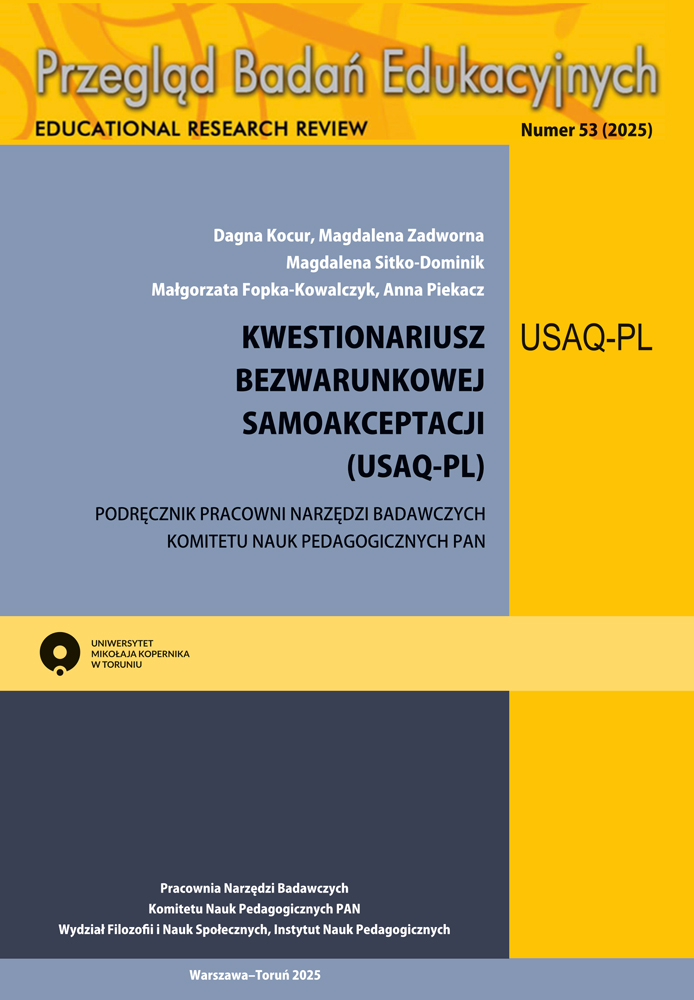
Kwestionariusz Bezwarunkowej Samoakceptacji (USAQ-PL)
DOI:
https://doi.org/10.12775/PBE.2025.022Keywords
Unconditional Self-Acceptance Questionnaire, USAQ-PL, unconditional self-acceptance, cultural adaptation, psychometric validationAbstract
The aim of the project was to adapt the Unconditional Self-Acceptance Questionnaire (USAQ), developed by John Chamberlain and David Haaga, for use in the Polish context. The adaptation process consisted of two main stages: cultural validation and psychometric evaluation. The study utilized the original version of the USAQ as well as a set of standardized psychological instruments, including the Rosenberg Self-Esteem Scale (SES), the Satisfaction With Life Scale (SWLS), the Depression, Anxiety, and Stress Scale (DASS-21), the Mental Health Continuum – Short Form (MHC-SF), and the Self-Compassion Scale (SCS-PL). The research sample consisted of 531 adult residents of Poland. Statistical analyses (EFA and CFA) confirmed a two-factor structure of the tool (Unconditional Self-Acceptance and Conditional Self-Acceptance) and demonstrated its satisfactory psychometric properties. The Polish version – USAQ-PL – showed acceptable reliability and convergent validity. The scale allows for the assessment of unconditional self-acceptance and can be successfully used in both psychological practice and scientific research. The tool is especially useful in work with adults, including psychological support, diagnostics, and the design of educational and therapeutic programs aimed at developing a healthier relationship with oneself.
References
Akün, E. (2017). Relations Among Adults’ Remembrances of Parental Acceptance-Rejection in Childhood, Self-Reported Psychological Adjustment, and Adult Psychopathology. Comprehensive Psychiatry, 77, 27–37, https://doi.org/10.1016/j.comppsych.2017.05.002.
Arıcak, O.T., Dündar, Ş., Saldańa, M. (2015). Mediating Effect of Self-Acceptance Between Values and Offline/Online Identity Expressions Among College Students. Computers in Human Behavior, 49, 362–374, https://doi.org/10.1016/j.chb.2015.03.025.
Baumeister, R.F., Smart, L., Boden, J.M. (1996). Relation of Threatened Egotism to Violence and Aggression: The Dark Side of Self-Esteem. Psychological Review, 103, 5–33.
Birkeland, M.S., Breivik, K., Wold, B. (2014). Peer Acceptance Protects Global Self- Esteem from Negative Effects of Low Closeness to Parents During Adolescence and Early Adulthood. Journal of Youth and Adolescence, 43, 70–80, https://doi.org/10.1007/s10964-013-9929-1.
Bradburn, N.M. (1969). The Structure of Psychological Well-Being. Chicago: Aldine. Broder, M.S. (2013). Self-Acceptance and Successful Relationships. W: M. Bernard (red.), The Strength of Self-Acceptance: Theory, Practice and Research (ss. 215–227). New York: Springer.
Bushman, B.J., Baumeister, R.F. (1998). Threatened Egotism, Narcissism, Self-Esteem, and Direct and Displaced Aggression: Does Self-Love or Self-Hate Lead to Violence? Journal of Personality and Social Psychology, 75(1), 219–229, https://doi.org/10.1037/0022-3514.75.1.219.
Byrne, B.M. (2013). Structural Equation Modeling with Mplus: Basic Concepts, Applications, and Programming. New York: Routledge.
Camp, J., Vitoratou, S., Rimes, K.A. (2020). LGBQ+ Self-Acceptance and Its Relationship with Minority Stressors and Mental Health: A Systematic Literature Review. Archives of Sexual Behavior, 49, 2353–2373, https://doi.org/10.1007/s10508-020-01755-2.
Carson, S.H., Langer, E.J. (2006). Mindfulness and Self-Acceptance. Journal of Rational-Emotive and Cognitive-Behavior Therapy, 24, 29–43, https://doi.org/10.1007/s10942-006-0022-5.
Chamberlain, J.M., Haaga, D.A. (2001a). Unconditional Self-Acceptance and Psychological Health. Journal of Rational-Emotive and Cognitive-Behavior Therapy, 19, 163–176.
Chamberlain, J.M., Haaga, D.A. (2001b). Unconditional Self-Acceptance and Responses to Negative Feedback. Journal of Rational-Emotive and Cognitive-Behavior Therapy, 19, 177–189.
Chamberlin, C.M., Zhang, N. (2009). Workaholism, Health, and Self-Acceptance. Journal of Counseling & Development, 87(2), 159–169, https://doi.org/10.1002/j.1556-6678.2009.tb00563.x.
Chełminiak, L., Górska, A., Mącik, D. (2024). Perfekcjonizm i samoakceptacja a jakość relacji interpersonalnych. Annales Universitatis Mariae Curie-Skłodowska, Sectio J: Paedagogia-Psychologia, 36(4), 221–242, https://doi.org/10.17951/j.2023.36.4.221-242.
Comrey, A.L., Lee, H.B. (1992). A First Course in Factor Analysis. New York: Psychology Press.
Cordaro, D.T., Bai, Y., Bradley, C.M., Zhu, F., Han, R., Keltner, D., Gatchpazian, A., Zhao, Y. (2024). Contentment and Self-Acceptance: Wellbeing Beyond Happiness. Journal of Happiness Studies, 25, 15, https://doi.org/10.1007/s10902-024-00.
Cournoyer, D.E., Sethi, R., Cordero, A. (2005). Perceptions of Parental Acceptance-Rejection and Self-Concepts Among Ukrainian University Students. Ethos, 33(3), 335–346, https://doi.org/10.1525/eth.2005.33.3.335.
Crisan, S., Canache, M., Buksa, D., Nechita, D. (2023). A Comparison Between Self-Compassion and Unconditional Self-Acceptance: Interventions on Self-Blame, Empathy, Shame, Guilt-Proneness, and Performance. Journal of Rational-Emotive & Cognitive-Behavior Therapy, 41, 64–80, https://doi.org/10.1007/s10942-022-00451-5.
Dakowicz, L., Dakowicz, A. (2019). Postawy rodzicielskie małżonków o wyższym i niższym poziomie samoakceptacji. Pedagogika Społeczna, 18(1), 147–160, https://doi.org/10.35464/1642-672X.PS.2019.1.09.
David, D., Lynn, S.J., Das, L.S. (2013). Self-Acceptance in Buddhism and Psychotherapy. W: The Strength of Self-Acceptance: Theory, Practice and Research (ss. 19–38). New York, NY: Springer.
David, D., Lynn, S.J., Ellis, A. (2010). Rational and Irrational Beliefs: Research, Theory, and Clinical Practice. New York: Oxford University Press.
Davies, M.F. (2006). Irrational Beliefs and Unconditional Self-Acceptance. I. Correlational Evidence Linking Two Key Features of REBT. Journal of Rational-Emotive & Cognitive-Behavior Therapy, 24, 113–124, https://doi.org/10.1007/s10942-006-0027-0.
De Vries, D.A., Kühne, R. (2015). Facebook and Self-Perception: Individual Susceptibility to Negative Social Comparison on Facebook. Personality and Individual Differences, 86, 217–221.
Diener, E., Emmons, R.A., Larsen, R.J., Griffin, S. (1985). The Satisfaction with Life Scale. Journal of Personality Assessment, 49, 71–75.
Dixon, L.J., Earl, K.A., Lutz-Zois, C.J., Goodnight, J.A., Peatee, J.J. (2014). Explaining the Link Between Perfectionism and Self-Forgiveness: The Mediating Roles of Unconditional Self-Acceptance and Rumination. Individual Differences Research, 12(3), 101–111.
Dryden, W. (2003). Managing Low Self-Esteem. London: Whurr.
Dryden, W. (2013). Unconditional Self-Acceptance and Self-Compassion. W: The Strength of Self-Acceptance: Theory, Practice and Research (ss. 107–120). New York, NY: Springer.
Eastman, D. (1958). Self-Acceptance and Marital Happiness. Journal of Consulting Psychology, 22(2), 95–99, https://doi.org/10.1037/h0045569.
Ellis, A. (1962). Reason and Emotion in Psychotherapy. Secaucus, NJ: Lyle Stuart.
Ellis, A. (1977). Psychotherapy and the Value of a Human Being. W: A. Ellis, R. Grieger (red.), Handbook of Rational-Emotive Therapy (ss. 99–112). New York: Springer.
Ellis, A. (1996). How I Learned to Help Clients Feel Better and Get Better. Psychotherapy: Theory, Research, Practice, Training, 33(1), 149.
Ellis, A. (2004). Rational Emotive Behavior Therapy: It Works for Me – It Can Work for You. Buffalo: Prometheus Books.
Ellis, A. (2005). The Myth of Self-Esteem. Amherst, NY: Prometheus.
Ellis, A., Dryden, W. (1997). The Practice of Rational Emotive Behavior Therapy. 2nd ed. New York: Springer Publishing Company.
Enderwitz, M., Morgan, V.R., Roberson, A.J., Schanding Jr., G.T. (2024). Perceived Parental Rejection as a Predictor of Psychological Distress in LGBQ+ Adults and the Moderating Effects of Self-Acceptance of Sexuality. LGBTQ+ Family: An Interdisciplinary Journal, 1–19, https://doi.org/10.1080/27703371.2024.2306305.
Epli, H., Batık, M.V., Çabuker, N.D., Çelik, S.B. (2023). Relationship Between Psychological Resilience and Parental Acceptance-Rejection: The Mediating Role of Self-Compassion. Current Psychology, 42, 2167–2175, https://doi.org/10.1007/s12144-021-01822-4.
Falconer, C.J., King, J.A., Brewin, C.R. (2015). Demonstrating Mood Repair with a Situation-Based Measure of Self-Compassion and Self-Criticism. Psychology and Psychotherapy: Theory, Research and Practice, 88(4), 351–365, https://doi.org/10.1111/papt.12056.
Falkenstein, M.J., Haaga, D.A.F. (2013). Measuring and Characterizing Unconditional Self-Acceptance. W: M.E. Bernard (red.), The Strength of Self-Acceptance: Theory, Practice and Research (ss. 139–151). New York: Springer.
Faustino, B., Vasco, A.B., Haaga, D.A., Chamberlain, J.M., Farinha-Fernandes, A., Delgado, J. (2023). Exploring Factor and Correlational Analysis of the Portuguese Version of the Unconditional Self-Acceptance Questionnaire-Revised. Journal of Rational-Emotive & Cognitive-Behavior Therapy, 26(2), 1–12.
Faustino, B., Vasco, A.B., Silva, A.N., Marques, T. (2020). Relationships Between Emotional Schemas, Mindfulness, Self-Compassion and Unconditional Self-Acceptance on the Regulation of Psychological Needs. Research in Psychotherapy: Psychopathology, Process, and Outcome, 23(2), 442, https://doi.org/10.4081/ripppo.2020.442.
Field, A. (2005). Discovering Statistics Using SPSS. London: SAGE Publications, https://doi.org/10.1348/000709906X100611.
Finzi-Dottan, R., Schiff, M. (2022). Couple Relationship Satisfaction: The Role of Recollection of Parental Acceptance, Self-Differentiation, and Spousal Caregiving. Journal of Social and Personal Relationships, 39(2), 179–197, https://doi.org/10.1177/02654075211033029.
Flett, G.L., Besser, A., Davis, R.A., Hewitt, P.L. (2003). Dimensions of Perfectionism, Unconditional Self-Acceptance, and Depression. Journal of Rational-Emotive and Cognitive-Behavior Therapy, 21, 119–138.
Garcia, D., Al Nima, A., Kjell, O.N. (2014). The Affective Profiles, Psychological Well-Being, and Harmony: Environmental Mastery and Self-Acceptance Predict the Sense of a Harmonious Life. PeerJ, 2, e259, https://doi.org/10.7717/peerj.259.
Gilbert, P., McEwan, K., Gibbons, L., Chotai, S., Duarte, J., Matos, M. (2012). Fears of Compassion and Happiness in Relation to Alexithymia, Mindfulness, and SelfCriticism. Psychology and Psychotherapy: Theory, Research and Practice, 85(4), 374–390.
Guszkowska, M., Pater, B. (2010). Ocena własnego ciała, samoakceptacja i stan zdrowia psychicznego osób niepełnosprawnych ruchowo uprawiających sport i nietrenujących. Postępy Rehabilitacji, 2, 37–43.
Hair, J.F., Black, W.C., Babin, B.J., Anderson, R.E. (2014). Multivariate Data Analysis: Pearson New International Edition. Essex: Pearson Education Limited.
Hall, H.K., Hill, A.P., Appleton, P.R., Kozub, S.A. (2009). The Mediating Influence of Unconditional Self-Acceptance and Labile Self-Esteem on the Relationship Between Multidimensional Perfectionism and Exercise Dependence. Psychology of Sport and Exercise, 10(1), 35–44, https://doi.org/10.1016/j.psychsport.2008.05.003.
Hancock, G.R., Mueller, R.O. (2011). The Reliability Paradox in Assessing Structural Relations Within Covariance Structure Models. Educational and Psychological Measurement, 71(2), 306–324, https://doi.org/10.1177/0013164410384856.
Huang, Y.T., Luo, H., Ko, N.Y., Yen, C.F. (2020). Perceived Attitudes Toward Lesbian, Gay, and Bisexual (LGB) Issues and Mental Health Among Taiwanese LGB Adults: The Mediating Role of Self-Acceptance. Archives of Sexual Behavior, 49, 1671–1682, https://doi.org/10.1007/s10508-020-01686-y.
Jankowski, K.S. (2015). Is the Shift in Chronotype Associated with an Alteration in Well-Being? Biological Rhythm Research, 46, 237–248.
Jibeen, T. (2017). Unconditional Self-Acceptance and Self Esteem in Relation to Frustration Intolerance Beliefs and Psychological Distress. Journal of Rational-Emotive & Cognitive-Behavior Therapy, 35, 207–221, https://doi.org/10.1007/s10942-016-0251-1.
Juang, H.L., Chang, Y.Y.C., Tseng, B.L., Chang, C.C., Shiah, Y.J. (2021). Role of Psychological Acceptance Between Personality and Happiness. Current Psychology, 40, 1048–1055, https://doi.org/10.1007/s12144-018-0026-1.
Kam, S.Y., Prihadi, K.D. (2021). Why Students Tend to Compare Themselves with Each Other? The Role of Mattering and Unconditional Self-Acceptance. International Journal of Evaluation and Research in Education, 10(2), 441–447.
Kapıkıran, N.A., Kapıkıran, Ş. (2010). Koşulsuz kendini kabul ölçeğinin Türk üniversite öğrencileri için geçerliği ve güvenirliği. Kriz Dergisi, 18(1), 33–44.
Karaś, D., Cieciuch, J., Keyes, C.L.M. (2014). The Polish Adaptation of the Mental Health Continuum-Short Form (MHC-SF). Personality and Individual Differences, 69, 104–109, https://doi.org/10.1016/j.paid.2014.05.011.
Kernis, M.H. (2005). Measuring Self-Esteem in Context: The Importance of Stability of Self-Esteem in Psychological Functioning. Journal of Personality, 73(6), 1569–1605.
Keyes, C.L.M. (1998). Social Well-Being. Social Psychology Quarterly, 61, 121–140.
Keyes, C.L. (2002). The Mental Health Continuum: From Languishing to Flourishing in Life. Journal of Health and Social Behavior, 43, 207–222.
Kivity, Y., Tamir, M., Huppert, J.D. (2016). Self-Acceptance of Negative Emotions: The Positive Relationship with Effective Cognitive Reappraisal. International Journal of Cognitive Therapy, 9, 4, https://doi.org/10.1521/ijct_2016_09_10.
Kocur, D., Flakus, M., Fopka-Kowalczyk, M. (2022). Skala Współczucia dla Samego Siebie (SCS-PL). Przegląd Badań Edukacyjnych, 37, https://doi.org/10.12775/PBE.2022.013.
Kuyumcu, B., Rohner, R.P. (2018). The Relation Between Remembered Parental Acceptance in Childhood and Self-Acceptance Among Young Turkish Adults. International Journal of Psychology, 53(2), 126–132, https://doi.org/10.1002/ijop.12277.
Kwok, S.Y., Gu, M., Synchaisuksawat, P., Wong, W.W. (2020). The Relationship Between Parent-Child Triangulation and Early Adolescent Depression in Hong Kong: The Mediating Roles of Self-Acceptance, Positive Relations and Personal Growth. Children and Youth Services Review, 109, 104676, https://doi.org/10.1016/j.childyouth.2019.104676.
Leary, M.R., Tate, E.B., Adams, C.E., Batts Allen, A., Hancock, J. (2007). Self-Compassion and Reactions to Unpleasant Self-Relevant Events: The Implications of Treating Oneself Kindly. Journal of Personality and Social Psychology, 92, 887–904, https://doi.org/10.1037/0022-3514.92.5.887.
Lee, J., Yu, H., Choi, S. (2012). The Influences of Parental Acceptance and Parental Control on School Adjustment and Academic Achievement for South Korean Children: The Mediation Role of Self-Regulation. Asia Pacific Education Review, 13, 227–237, https://doi.org/10.1007/s12564-011-9186-5.
Lehane, C.M., Nielsen, T., Wittich, W., Langer, S., Dammeyer, J. (2018). Couples Coping with Sensory Loss: A Dyadic Study of the Roles of Self-and Perceived Partner Acceptance. British Journal of Health Psychology, 23(3), 646–664, https://doi.org/10.1111/bjhp.12309.
Li, X., Meier, J. (2017). Father Love and Mother Love: Contributions of Parental Acceptance to Children’s Psychological Adjustment. Journal of Family Theory & Review, 9(4), 459–490, https://doi.org/10.1111/jftr.12227.
Liu, Q.Q., Zhou, Z.K., Yang, X.J., Niu, G.F., Tian, Y., Fan, C. Y. (2017). Upward Social Comparison on Social Network Sites and Depressive Symptoms: A Moderated Mediation Model of Self-Esteem and Optimism. Personality and Individual Differences, 113, 223–228.
Lu, Q., Wang, B., Zhang, R., Wang, J., Sun, F., Zou, G. (2022). Relationship Between Emotional Intelligence, Self-Acceptance, and Positive Coping Styles Among Chinese Psychiatric Nurses in Shandong. Frontiers in Psychology, 13, 837917, https://doi.org/10.3389/fpsyg.2022.837917.
Ma, Y., Siu, A.F.Y. (2020). Dispositional Mindfulness and Mental Health in Hong Kong College Students: The Mediating Roles of Decentering and Self-Acceptance. Australian Journal of Psychology, 72(2), 156–164, https://doi.org/10.1111/ajpy.12269.
MacInnes, D.L. (2006). Self-Esteem and Self-Acceptance: An Examination Into Their Relationship and Their Effect on Psychological Health. Journal of Psychiatric and Mental Health Nursing, 13(5), 483–489, https://doi.org/10.1111/j.1365-2850.2006.00959.x.
Makara-Studzińska, M., Tyburski, E., Załuski, M., Adamczyk, K., Mesterhazy, J., Mesterhazy, A. (2022). Confirmatory Factor Analysis of Three Versions of the Depression Anxiety Stress Scale (DASS-42, DASS-21, and DASS-12) in Polish Adults. Frontiers in Psychiatry, 12, 770532, https://doi.org/10.3389/fpsyt.2021.770532.
Murray, S.L., Griffin, D.W., Rose, P., Bellavia, G. (2006). For Better or Worse? Self- Esteem and the Contingencies of Acceptance in Marriage. Personality and Social Psychology Bulletin, 32(7), 866–880, https://doi.org/10.1177/0146167206286756.
Neff, K.D. (2003a). Self-Compassion: An Alternative Conceptualization of a Healthy Attitude Toward Oneself. Self and Identity, 2(2), 85–101, https://doi.org/10.1080/15298860309032.
Neff, K.D. (2003b). The Development and Validation of a Scale to Measure Self-Compassion. Self and Identity, 2, 223–250, https://doi.org/10.1080/15298860309027.
Neff, K.D. (2011). Self-Compassion, Self-Esteem, and Well-Being. Social and Personality Psychology Compass, 5(1), 1–12.
Neff, K.D., Vonk, R. (2009). Self-Compassion Versus Global Self-Esteem: Two Different Ways of Relating to Oneself. Journal of Personality, 77(1), 23–50.
Ng, R., Allore, H.G., Levy, B.R. (2020). Self-Acceptance and Interdependence Promote Longevity: Evidence from a 20-year Prospective Cohort Study. International Journal of Environmental Research and Public Health, 17(16), 5980, https://doi.org/10.3390/ijerph17165980.
Ohannessian, C.M., Lerner, R.M., Lerner, J.V., Von Eye, A. (1998). Perceived Parental Acceptance and Early Adolescent Self-Sompetence. American Journal of Orthopsychiatry, 68(4), 621–629, https://doi.org/10.1037/h0080370.
Paloș, R., Vîșcu, L. (2014). Anxiety, Automatic Negative Thoughts, and Unconditional Self-Acceptance in Rheumatoid Arthritis: A Preliminary Study. International Scholarly Research Notices Rheumatology, 317259, https://doi.org/10.1155/2014/317259.
Pinto, A., Veríssimo, M., Gatinho, A., Santos, A.J., Vaughn, B.E. (2015). Direct and Indirect Relations Between Parent–Child Attachments, Peer Acceptance, and Self-Esteem for Preschool Children. Attachment & Human Development, 17(6), 586–598, https://doi.org/10.1080/14616734.2015.1093009.
Popov, S. (2019). When is Unconditional Self-Acceptance a Better Predictor of Mental Health Than Self-Esteem? Journal of Rational-Emotive & Cognitive-Behavior Therapy, 37, 251–261, https://doi.org/10.1007/s10942-018-0310-x.
Popov, S., Jakovljev, I., Radanović, J., Biro, M. (2020). The Effect of Unconditional Self-Acceptance and Explicit Self-Esteem on Personal Explanatory Style. Journal of Cognitive Therapy, 13, 271–286, https://doi.org/10.1007/s41811-020-00082-7.
Popov, S., Sokić, J. (2022). Psychometric Characteristics of a Serbian Translation of the Unconditional Self-Acceptance Questionnaire and the Development of a Short Form. Psihologija, 55(1), 107–122.
Potocka, A., Turczyn-Jablońska, K., Merecz, D. (2009). Psychological Correlates of Quality of Life in Dermatology Patients: The Role of Mental Health and Self-Acceptance. Acta Dermatoven APA, 18(2), 53–62.
Richter, J., Richter, G., Eisemann, M., Seering, B., Bartsch, M. (1995). Depression, Perceived Parental Rearing and Self-Acceptance. European Psychiatry, 10(6), 290–296, https://doi.org/10.1016/0924-9338(96)80310-5.
Rohner, R.P., Khaleque, A., Cournoyer, D.E. (2005). Parental Acceptance-Rejection: Theory, Methods, Cross-Cultural Evidence, and Implications. Ethos, 33(3), 299–334, https://doi.org/10.1525/eth.2005.33.3.299.
Romano, K.A., Heron, K.E., Ebener, D. (2021). Associations Among Weight Suppression, Self-Acceptance, Negative Body Image, and Eating Disorder Behaviors Among Women with Eating Disorder Symptoms. Women & Health, 61(8), 791–799, https://doi.org/10.1080/03630242.2021.1970082.
Ryff, C.D. (1989). Happiness Is Everything, or Is It? Explorations on the Meaning of Psychological Well-Being. Journal of Personality and Social Psychology, 57, 1069–1081, https://doi.org/10.1037/0022-3514.57.6.1069.
Ryff, C.D., Heidrich, S.M. (1997). Experience and Well-Being: Explorations on Domains of Life and How They Matter. International Journal of Behavioral Development, 20(2), 193–206, https://doi.org/10.1080/01650259738528.
Sahana, U., Velayudhan, A. (2018). Influence of Achievement Goal Orientation on Psychological Well-Being: Mediating Role of Unconditional Self-Acceptance Among College Students. IAHRW International Journal of Social Sciences Review, 6(6), 1093–1097.
Sanghvi, D.E., Zainal, N.H., Newman, M.G. (2023). Trait Self-Acceptance Mediates Parental Childhood Abuse Predicting Depression and Anxiety Symptoms in Adulthood. Journal of Anxiety Disorders, 94, 102673, https://doi.org/10.1016/j.janxdis.2023.102673.
Sansinenea, E., Asla, N., Agirrezabal, A., Fuster-Ruiz-de-Apodaca, M.J., Muela, A., Garaigordobil, M. (2020). Being Yourself and Mental Health: Goal Motives, Positive Affect and Self-Acceptance Protect People with HIV from Depressive Symptoms. Journal of Happiness Studies, 21, 593–612, https://doi.org/10.1007/s10902-019-00098-7.
Scott, J. (2007). The Effect of Perfectionism and Unconditional Self-Acceptance on Depression. Journal of Rational-Emotive & Cognitive-Behavior Therapy, 25, 35–64, https://doi.org/10.1007/s10942-006-0032-3.
Sousa, V.D, Rojjanasrirat, W. (2011). Translation, Adaptation and Validation of Instruments or Scales for Use in Cross-Cultural Health Care Research: A Clear and User-Friendly Guideline. Journal of Evaluation and Clinical Practice, 17, 268–274.
Szczęsna, H. (2005). Z badan nad akceptacją siebie i innych ludzi przez młodzież – uwarunkowania rodzinne. Psychologia Rozwojowa, 10, 139–149.
Tabachnick, B.G., Fidell, L. (2019). Using Multivariate Statistics. 7th ed. New York, NY: Pearson.
Thompson, B.L., Waltz, J.A. (2008). Mindfulness, Self-Esteem, and Unconditional SelfAcceptance. Journal of Rational-Emotive & Cognitive-Behavior Therapy, 26, 119–126, https://doi.org/10.1007/s10942-007-0059-0.
Tibubos, A.N., Köber, C., Habermas, T., Rohrmann, S. (2019). Does Self-Acceptance Captured by Life Narratives and Self-Report Predict Mental Health? A Longitudinal Multi-Method Approach. Journal of Research in Personality, 79, 13–23, https://doi.org/10.1016/j.jrp.2019.01.003.
Tiggemann, M., Hayden, S., Brown, Z., Veldhuis, J. (2018). The Effect of Instagram “Likes” on Women’s Social Comparison and Body Dissatisfaction. Body Image, 26, 90–97.
Tsang, K.K.Y., Lam, S.F. (2023). Parental Unconditional Acceptance: An Antidote to Parental Conditional Regard. Social Development, 32(4), 1192–1207, https://doi.org/10.1111/sode.12683.
Vasile, C. (2013). An Evaluation of Self-Acceptance in Adults. Procedia-Social and Behavioral Sciences, 78, 605–609, https://doi.org/10.1016/j.sbspro.2013.04.360.
Wang, J., Guo, M., Day, J., Kirby, J.N. (2023). Self-Acceptance Mediates the Relationship Between Perceived Parenting Behaviors and Fears of Compassion. Journal of Child and Family Studies, 32, 744–755, https://doi.org/10.1007/s10826-022-02522-8.
Wild, D., Grove, A., Martin, M., Eremenco, S., McElroy, S., Verjee-Lorenz, A., Erikson, P. (2005). Principles of Good Practice for the Translation and Cultural Adaptation Process for Patient-Reported Outcomes (PRO) Measures: Report of the ISPOR Task Force for Translation and Cultural Adaptation. Value in Health, 8, 94–104.
Williams, L.R., Hickle, K.E. (2010). “I Know What Love Means”: Qualitative Descriptions from Mexican American and White Adolescents. Journal of Human Behavior in the Social Environment, 20(5), 581–600, https://doi.org/10.1080/10911351003673278.
Zhao, Y., Zhang, K., Zhou, X., Xu, M. (2024). The Effects of Negative Body Image, Self-Acceptance, and Resilience on Depression in Chinese Adolescents: Testing a Moderated Mediation Model. Current Psychology, 43, 11704–11713, https://doi.org/10.1007/s12144-023-05288-4.
Zhou, Y., Xu, W. (2019). The Mediator Effect of Meaning in Life in the Relationship Between Self-Acceptance and Psychological Wellbeing Among Gastrointestinal Cancer Patients. Psychology, Health & Medicine, 24(6), 725–731, https://doi.org/10.1080/13548506.2018.1554252.
Downloads
Published
How to Cite
Issue
Section
License
Copyright (c) 2025 Dagna Kocur, Magdalena Zadworna, Magdalena Sitko-Dominik, Małgorzata Fopka-Kowalczyk, Anna Piekacz

This work is licensed under a Creative Commons Attribution-NoDerivatives 4.0 International License.
Stats
Number of views and downloads: 1424
Number of citations: 0


