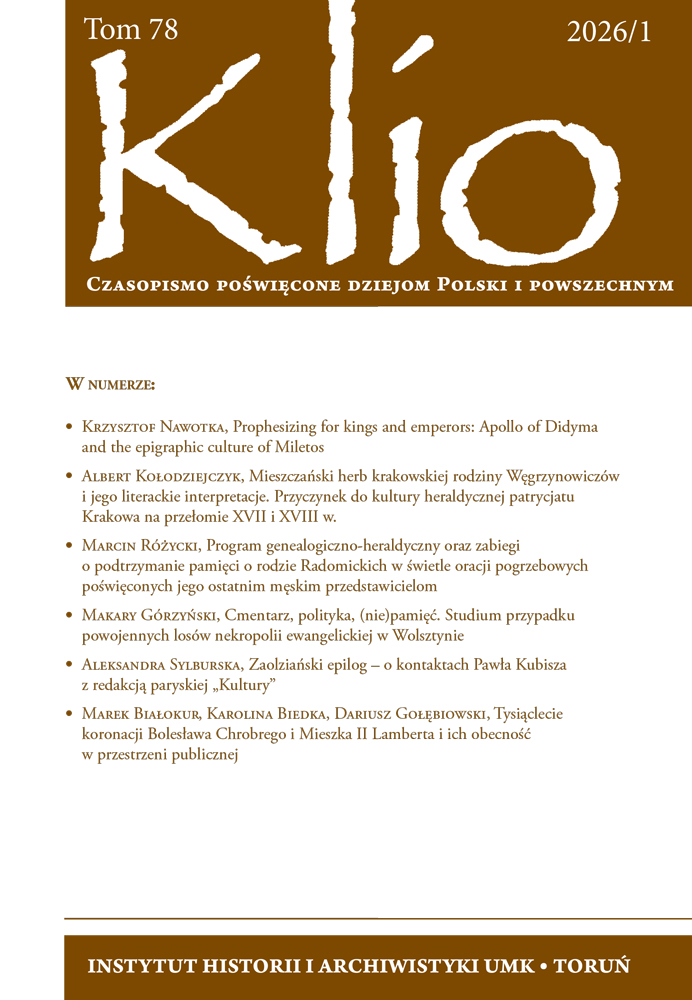
Prorokowanie dla królów i cesarzy: Apollo z Didymy a kultura epigraficzna Miletu
DOI :
https://doi.org/10.12775/KLIO.2026.001Mots-clés
Didyma, oracle, Miletos, Seleukos I, Octavian Augustus, Trajan, Emperor Julian, epigraphic curveRésumé
This paper deals with Apollo’s Oracle at Didyma in the Hellenistic and Roman age when it fully belonged to the polis of Miletos. Authors bring information on Didyma’s oracles to Alexander the Great, Seleukos I, Nikomedes II, Diocletian and Licinius. Inscriptions refer to oracles to other Seleukid kings. Indirect evidence points to oracles for Augustus, Trajan, and Julian. These oracles correlate with periods of strong local activity attested by the epigraphic curve for Miletos. Sometimes an oracle set off a chain of events leading to material and political gains for Miletos. Didyma’s prophesizing for kings and Emperors contributed enormously towards building Miletos’ prestige and position in the Hellenistic and Roman age.
Références
Barnes, T.D. 2010. Early Christian Hagiography and Roman History (Tübingen).
Bellinger, A.R. 1957. ‘The Immortality of Alexander and Augustus’, YCS 15, 91–100.
Bevan, E.R. 1902. The House of Seleucus (London).
Bosworth, A.B. 1999. ‘Augustus, the Res Gestae and Hellenistic theories of apotheosis’, JRS 89, 1–18.
Boulay, T. and A.-V. Pont, 2014. Chalkètôr en Carie (Paris).
Busine, A. 2005. Paroles d’Apollon. Pratiques et traditions oraculaires dans l’Antiquité tardive (IIe-VIe siècles) (Leiden).
Cohen, G.M. 1978. The Seleucid Colonies: Studies in Founding, Administration and Organization (Wiesbaden).
Debord, O. 1982. Aspects sociaux et économiques de la vie religieuse dans l’Anatolie gréco-romaine (Leiden 1982).
Eck, W. 2002. ‘Traian – Der Weg zum Kaisertum’, in A. Nünnerich-Asmus (ed.), Traian. Ein Kaiser der Superlative am Beginn einer Umbruchzeit? (Mainz), 7–20.
Ehrhardt, N. and P. Weiss. 2011. ‘Eine monumentale Dankesgabe: Trajans Neubau der Heiligen Straße von Milet nach Didyma’, Chiron 41, (2011) 217–262.
Erickson, K. 2019. The Early Seleukids, their Gods and their Coins (London).
Fischer, J. 2022. Folia ventis turbata. Sibyllinische Orakel und der Gott Apollon zwischen später Republik und augusteischem Principat (Göttingen).
Fontenrose, J. 1978. The Delphic Oracle: Its Responses and Operations, with a Catalogue of Responses (Berkeley).
Fontenrose, J. 1988. Didyma: Apollo’s Oracle, Cult, and Companions (Berkeley).
Grégoire, H. 1913. ‘Les chrétiens et l’oracle de Didymes’, in Mélanges Holleaux. Recueil de mémoires concernant l’antiquité grecque offert à Maurice Holleaux en souvenir de ses années de direction à l’École francaise d’Athènes (1904–1912) (Paris), 81–91.
Gregory, T.E. 1983. ‘Julian and the Last Oracle at Delphi’, GRBS 24, 355–366.
Günther, W. 1971. Das Orakel von Didyma in hellenistischer Zeit. Eine Interpretation von Stein-Urkunden (Tübingen).
Günther, W. 2017. Inschriften von Milet, 4: Eine Prosopographie (Milet VI.4) (Berlin).
Habicht, C. 1970. Gottmenschentum und griechische Städte2 (Munich).
Haussoullier, B. 1902. Études sur l’histoire de Milet et du Didymeion (Paris).
Hekster O. and J. Rich, ‘Octavian and the Thunderbolt: The Temple of Apollo Palatinus and Roman Traditions of Temple Building’, CQ 56, 149–168.
Herrmann, P. 1994. ‘Milet unter Augustus. C. Iulius Epikrates und die Anfänge des Kaiserkults’, MDAI(I) 44, 203–236.
Jones, C.P. 1975. ‘An oracle given to Trajan’, Chiron 5, 403–406.
Kienast, D. 1969. ‘Augustus und Alexander’, Gymnasium 76, 430–445.
Kleiner, D.E.E. 2005. ‘Semblance and Storytelling in Augustan Rome’, in K. Galinsky (ed.), The Cambridge Companion to the Age of Augustus (Cambridge), 197–233.
Kleiner, F.S. 1988. ‘The Arch in Honor of C. Octavius and the Fathers of Augustus’, Historia 37, 347–357.
Kleiner, G. 1970. Das römische Milet. Bilder aus der griechischen Stadt in römischer Zeit (Wiesbaden).
Laignoux, R. 2017. ‘Reconnaître Octavien et ses concurrents en Anatolie: les allégeances asiatique durant les guerres civiles de la fin de République’, in L. Cavalier. M.-C. Ferriès, F. Delrieux (eds.), Auguste et l’Asie Mineure (Bordeux), 205–233.
Lampinen, A. 2013. ‘Θεῷ μεμελημένε Φοίβῳ: Oracular Functionaries at Claros and Didyma in the Imperial Period’, in M. Kajava (ed.), Studies in Ancient Oracles and Divination (Rome), 49–88.
Lange, C.H. 2009. Res Publica Constituta: Actium, Apollo and the Accomplishment of the Triumviral Assignment (Leiden).
Levick, B. 2010. Augustus (Harlow).
Liegle, J. 1941. ‘Die Münzprägung Octavians nach dem Sieg von Actium und die augusteische Kunst’, JDAI 56, 91–120.
Lorsch, R.S. 1997. ‘Augustus’ Conception and the Heroic Tradition’, Latomus 56, 790–799.
Mehl, A. 1986. Seleukos Nikator und sein Reich, I: Seleukos Leben und Entwicklung seiner Machtposition (Louvain).
Millar, F. 1964. The Study of Cassius Dio (Oxford).
Millar, F. 1973, ‘Triumvirate and Principate’, JHS 63, 60–67.
Mitchell, S. 2014. ‘Trajan and the Cities of the East’, in I. Piso and R. Varga (eds.), Trajan und seine Städte. Colloquium Cluj-Napoca, 29. September – 2. Oktober 2013 (Cluj-Napoca), 225–232.
Morgan, C. 1989. ‘Divination and society at Delphi and Didyma’, Hermathena 147, 17–42.
Musti, D. 1963. ‘Sull’idea di συγγένεια in iscrizioni greche’, ASNP 32, 225–239.
Nawotka, K. 2003. ‘Freedom of Greek cities in Asia Minor in the age of Alexander the Great’, Klio 85, 15–41
Nawotka, K. 2017. The Alexander Romance by Ps.-Callisthenes: A Historical Commentary (Leiden).
Nawotka, K. 2019. ‘Apollo, the tutelary god of the Seleucids, and Demodamas of Miletus’, in Z. Archibald and J. Haywood (eds.), The Power of Individual and Community in Ancient Athens and Beyond: Essays in Honour of John K. Davies (Swansea), 261–284.
Nawotka, K. 2020. ‘Epigraphic curves in Western Asia Minor: the case studies of Miletos, Ephesos and Pergamon’, in K. Nawotka (ed.), Epigraphic Culture in the Eastern Mediterranean in Antiquity (Abingdon and New York).
Nawotka, K. 2023. The Nourisher of Apollo: Miletos from Xerxes to Diocletian (Wiesbaden).
Nawotka, K. 2023a. ‘Seleucus I and the Seleucid Dynastic Ideology: The Alexander Factor’, in T. Daryaee, R. Rollinger and M.P. Canepa (eds.), Iran and the Transformation of Ancient Near Eastern History: The Seleucids (ca. 312–150 BCE): Proceedings of the Third Payravi Conference on Ancient Iranian History, UC Irvine, February 24th–25th, 2020 (Wiesbaden), 87–100
Nawotka, K. 2025. ‘Prophetes, prophetis and the epigraphic culture of Miletos’, in A. Kubiak-Schneider and B. Schneider (eds.), Serving the Gods: Artists, Craftsmen and Ritual Specialists in the Ancient World (Wiesbaden, forthcoming).
Nissinen, M. 2017. Ancient Prophecy: Near Eastern, Biblical, and Greek Perspectives (Oxford).
Nocchi, F.R. 2016. Commento agli Epigrammata Bobiensia (Berlin).
Ogden, D. 2009. ‘Alexander, Scipio and Octavian: serpent siring in Macedon and Rome’, Syllecta Classica 20, 31–52.
Ogden, D. 2017. The Legend of Seleucus: Kingship, Narrative and Mythmaking in the Ancient World (Cambridge).
Parke, H.W. 1985. The Oracles of Apollo in Asia Minor (London).
Parker, R. 1985. ‘Greek States and Greek Oracles’, in P. Cartledge and F.D. Harvey (eds.), Crux: Essays in Greek History Presented to G.E.M. de Ste. Croix on his 75th Birthday (London), 298–326.
Pollini, J. 1990. ‘Man and God: Divine Assimilation and Imitation in the Late Republic and Early Principate’, in K.A. Raaflaub and M. Toher (eds.), Between Republic and Empire: Interpretations of Augustus and his Principate (Berkeley), 334–363.
Pont, A.-V. 2020. La fin de la cité grecque. Métamorphoses et disparition d’un modèle politique et institutionnel local en Asie Mineure, de Dèce à Constantin (Geneva).
Potter, D.S. 1994. Prophets and Emperors: Human and Divine Authority from Augustus to Theodosius (Cambridge Mass.).
Powell, J.U. 1925. Collectanea Alexandrina: Reliquiae Minores Poetarum Graecorum Aetatis Ptolemaicae, 323–146 A.C., Epicorum, Elegiacorum, Lyricorum, Ethicorum (Oxford).
Primo, A. 2009. La storiografia sui Seleucidi. Da Megastene a Eusebio de Cesarea (Pisa).
Raggi, A. 2020. ‘Triumviral Documents from the Greek East’, in F.P. Polo (ed.), The Triumviral Period: Civil War, Political Crisis and Socioeconomic Transformations (Zaragoza), 431–449
Robert, L. 1938, Études épigraphiques et philologiues (Paris).
Saba, S. 2020. Isopoliteia in Hellenistic Times (Leiden).
Scheid, J. 2005. ‘Augustus and Roman Religion: Continuity, Conservatism, and Innovation’, in K. Galinsky (ed.), The Cambridge Companion to the Age of Augustus (Cambridge), 175–194.
Sherk, R.K. 1993. ‘The Eponymous Officials of Greek Cities V: The Register: Part VI: Sicily’, ZPE 96, 267–295.
Shin, M.S. 2018. The Great Persecution: A Historical Re-Examination (Turnhout).
Slawisch, A. and T.C. Wilkinson. 2018. ‘Processions, propaganda and pixels: reconstructing the Sacred Way between Miletos and Didyma’, AJA 122, 114–122.
Stähelin, F. 1923. ‘Seleukos. 2’, RE IIA (Stuttgart), 1208–1234.
Stoneman, R. 2011. The Ancient Oracles: Making the Gods Speak (New Haven).
Struck, P.T. 2002. ‘Speech Acts and the Stakes of Hellenism in Late Antiquity’, in P. Mirecki and M. Meyer (eds.), Magic and Ritual in the Ancient World (Leiden), 387–403.
Taylor, L.R. 1931. The Divinity of the Roman Emperor (Middletown).
Vanderspoel, J. 2006. ‘The enigma of the last oracle’, Topoi Suppl. 7, 53–61.
Vatin, C. 1962. ‘Les empereurs du IVe siècle à Delphes’, BCH 86, 229–241.
Walbank, F.W. 1967. ‘The Scipionic legend’, PCPS 13, 54–69.
Weber, G. 2000. Kaiser, Träume und Visionen in Prinzipat und Spätantike (Stuttgart).
Wiemer, H.-U. 2020. ‘Revival and Reform: The Religious Policy of Julian’, in S. Rebenich and H.-U. Wiemer, A Companion to Julian the Apostate (Leiden and Boston), 207–244.
Zanker, P. 1983. ‘Der Apollontempel auf dem Palatin’, in: Cittá e architettura nella Roma imperiale (AnalRom Suppl. 10) (Odense), 21–40.
Zanker, P. 1988. The Power of Images in the Age of Augustus (Ann Arbor).
Téléchargements
Publiée
Comment citer
Numéro
Rubrique
Licence
© Krzysztof Nawotka 2026

Ce travail est disponible sous licence Creative Commons Attribution - Pas de Modification 4.0 International.
Stats
Number of views and downloads: 491
Number of citations: 0


