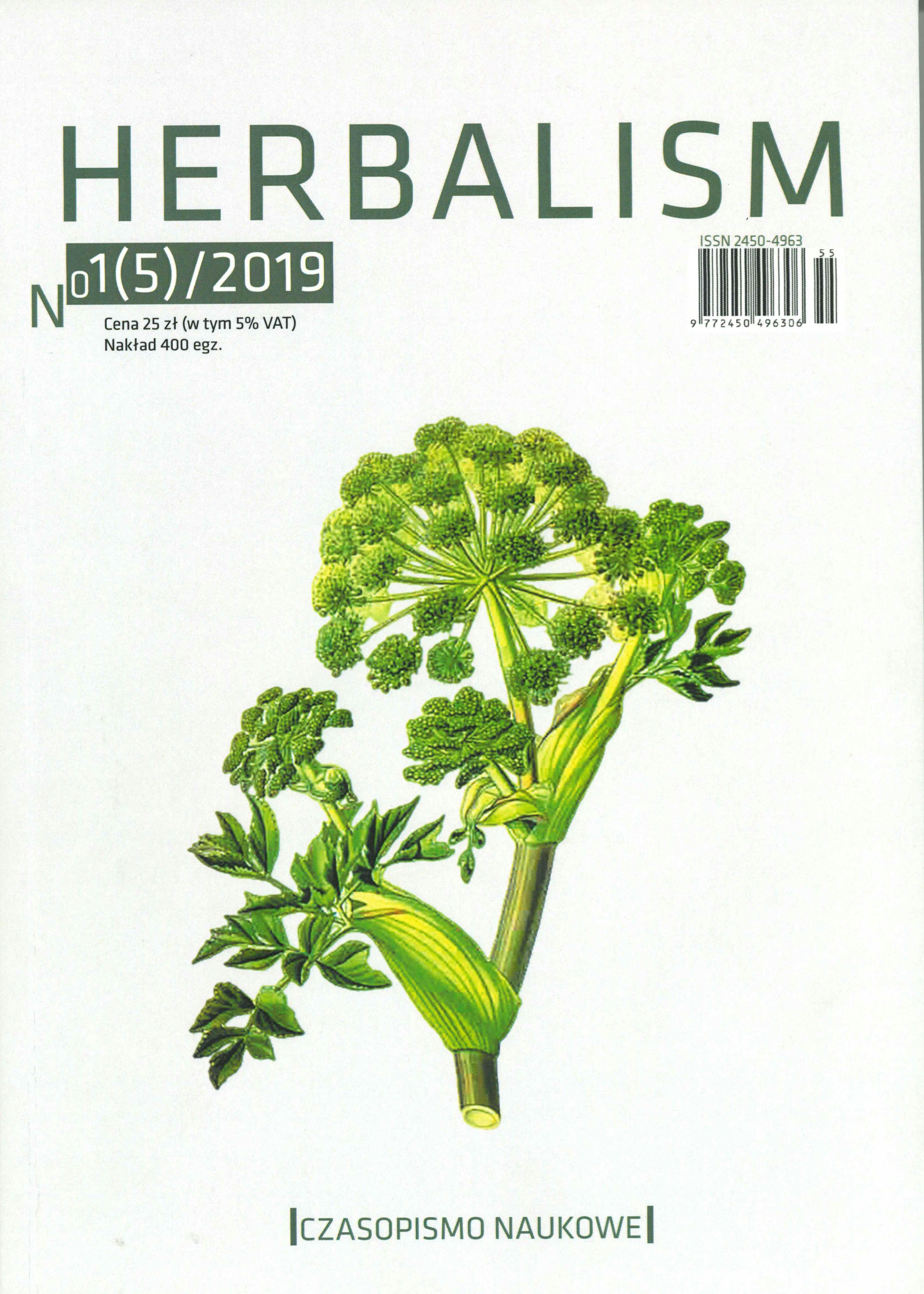
Garden (Norwegian) angelica – properties and application
Abstract
Angelica archangelica (Angelica archangelica L.) is a plant of the north, extremely resistant to the frost. In the past, it was consumed by the Scandinavian people as a vegetable which allowed to survive the winter. In the Middle Ages and later, it saved people from the „mighty air”. e pharmacopoeial material is the rhizome with roots and the essential oil obtained from both the rhizomes and the seeds. Over 120 chemical compounds have been marked in it - the most important are terpenes, coumarins and furanocoumarins. Due to the content of bergapten and xantotoxin, it belongs to phototoxic plants. It has a rich spectrum of activity on the human body - it stimulates the digestive system, enhances the secretion of body uids, toning on the nervous system. It is used in oncology and treatment of dementia, asthma and prophylaxis of osteoporosis. e essential oil is used in the perfumery industry - it contains exaltolide which is an odor stabilizer. Angelica is also an ingredient in many tinctures.
References
Rutkowski L., Klucz do oznaczania roślin naczyniowych Polski niżowej, Wyd. PWN, Warszawa 2016.
Uprawa ziół poradnik dla plantatorów, red. Kołodziej B., Wyd. PWRiL, Warszawa 2010.
Lis A., Najcenniejsze olejki eteryczne II, Monograe Politechniki Łódzkiej, Łódź 2013.
Kohlmünzer S., Farmakognozja, Wyd. lekarskie PZWL, Warszawa 2007.
Pathak S., Wanjari M.M., Jain S.K., Tripathi M., Evaluation of Antiseizure Activity of Essential Oil from Roots of Angelica archangelica L. in Mice, Indian Journal of Pharmaceutical Sciences, 2010, 72(3), s. 371–375.
Kumar D., Bhat Z.A., Kumar V., Shah M.Y., Coumarins from Angelica archangelica L. and their eects on anxiety-like behavior, Progress in Neuro-Psychopharmacology & Biological Psychiatry, 2013, 10(40), s. 180–186.
Kimura T., Hayashida H., Murata M., Takamatsu J., Eect of ferulic acid and Angelica archangelica extract on behavioral and psychological symptoms of dementia in frontotemporal lobar degeneration and dementia with Lewy bodies, Geriatics & Gerontology
International, 2011, 11(3), s. 309–314.
Wang F., Li J., Li R., Pan G., Bai M., Huang Q., Angelicin inhibits liver cancer growth in vitro and in vivo, Molecular Medicine Reports, 2017, 16(4), s. 5441–5449.
Li G., He Y., Yao J., Huang C., Song X., Deng Y., Xie S., Ren J., Jin M., Liu H., Angelicin inhibits human lung carcinoma A549 cell growth and migration through regulating JNK and ERK pathways, Oncology Reports, 2016, 36(6), s. 3504–3512.
Fraternale D., Flamini G., Ricci D., Essential oil composition and antimicrobial activity of Angelica archangelica L. (Apiaceae) roots, Journal of Medicinal Food, 2014, 17(9), s. 1043–1047.
Głowniak K., Widelski J., Badania tochemiczne Archangelica o_cinalis Hom, Panacea,
, 1(18), s. 22–24.
Rajtar B., Skalicka-Woźniak K., Świątek Ł., Stec A., Boguszewska A., Polz-Dacewicz M., Antiviral eect of compounds derived from Angelica archangelica L. on Herpes simplex virus-1 and Coxsackievirus B3 infections, Food and Chemical Toxicology, 2017, 109(Pt2), s. 1026–1031.
Luthra P., Liang J., Pietzsch C.A., Khadka S., Edwards M.R., Wei S., De S., Posner B., Bukreyev A., Ready J.M., Basler C.F., A high throughput screen identies benzoquinoline compounds as inhibitors of Ebola virus replication, Antiviral Research, 2018, 150,
s. 193–201.
Sun Z., Hwang E., Park S.Y., Zhang M., Gao W., Lin P., Yi T.H., Angelica archangelia Prevented Collagen Degradation by Blocking Production of Matrix Metalloproteinases in UVB-exposed Dermal Fibroblasts, Photochemistry and Photobiology, 2016, 92(4),
s. 604–610.
Lampronti I., Manzione M.G., Sacchetti G., Ferrari D., Spisani S., Bezzerri V., Finotti A., Borgatti M., Dechecchi M.C., Miolo G., Marzaro G., Cabrini G., Gambari R., Chilin A., Dierential Eects of Angelicin Analogues on NF-κB Activity and IL-8 Gene Expression in Cystic Fibrosis IB3-1 Cells, Mediators of Inammation, 2017, 2, s. 1–11.
Mazerant-Leszkowska A., Mała księga ziół. Rady i porady, Instytut Wydawniczy Związków Zawodowych, Warszawa 1990.
Lamer-Zarawska E., Kowal-Gierczak B., Niedworok J., Fitoterapia i leki roślinne, Wyd. Lekarskie. PZWL, Warszawa 2014.
Ożarowski A., Jaroniewski W., Rośliny lecznicze i ich praktyczne zastosowanie, Instytut Wydawniczy Związków Zawodowych, Warszawa 1987.
Skarżyński A., Zioła czynią cuda, Agencja Wydawnicza Comes, Warszawa 1994.
Klimuszko A., Wróćmy do ziół leczniczych, Ocyna Wydawnicza Rytm Warszawa 1995.
Kaczmarczyk-Sedlak I., Ciołkowski A., Zioła w medycynie: choroby układu pokarmowego, Wyd. PZWL, Warszawa 2017.
Różański H., Korzeń arcydzięgla – RadixArchangelicae w praktycznej toterapii, http://rozanski.li/355/korzen-arcydziega-radix-archangelicae-w-praktycznej-toterapii/(dostęp 15 czerwca 2018).
Herbalpedia, https://www.herbalpedia.com/ (dostęp: 4 stycznia 2018).
Głowniak K., Widelski J., Archangelica – roślina polecana przez anioły, Panacea, 2006, 4(17), s. 16–17.
Szymanderska H., Z łąki na talerz, Wyd. Świat Książki, Warszawa 2014.
Padovani F., Sekrety klasztornej kuchni i udanego życia, Wyd. Jedność, Kielce 2014.
Prakash B., Singh P., Goni R., Raina A.K., Dubey N.K., Ecacy of Angelica archangelica essential oil, phenyl ethyl alcohol and α- terpineol against isolated molds from walnut and their antiaatoxigenic and antioxidant activity, Journal of Food Science
and Technology, 2015, 52(4), s. 2220–2228.
Ściborowicz A., Uprawa, właściwości i wykorzystanie arcydzięgla lekarskiego (Angelica archangelica L.), Praca podyplomowa, Krosno 2018.
Downloads
The publisher's shop:
Published
How to Cite
Issue
Section
License

This work is licensed under a Creative Commons Attribution-NoDerivatives 4.0 International License.
Stats
Number of views and downloads: 2771
Number of citations: 0


