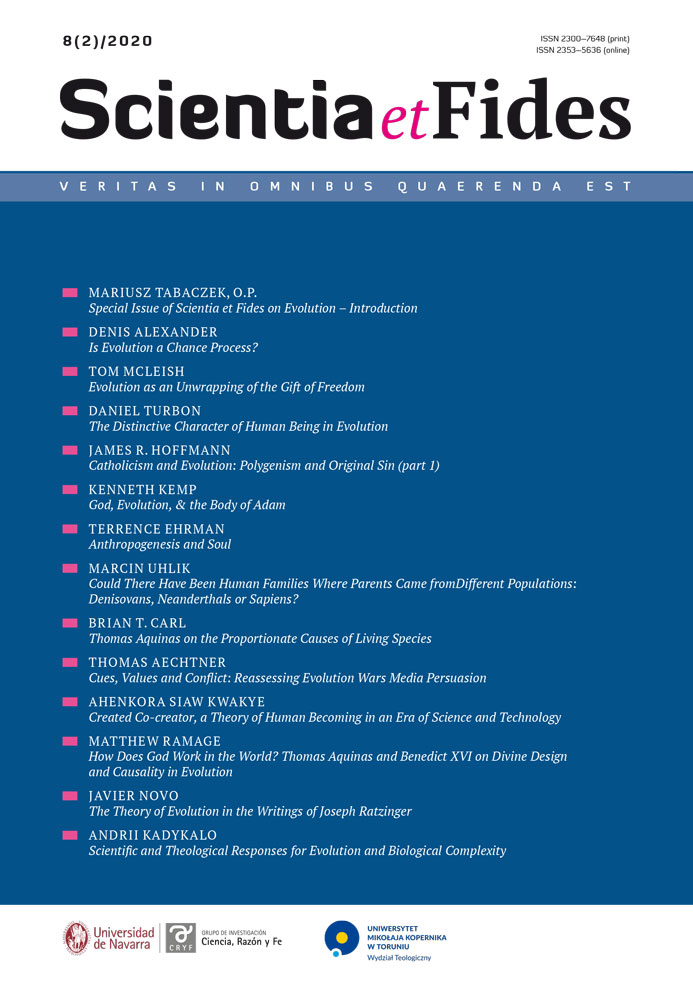
Evolution as an Unwrapping of the Gift of Freedom
DOI:
https://doi.org/10.12775/SetF.2020.014Słowa kluczowe
theistic evolution, Wisdom, genotype-phenotype map, statistical mechanics, emergence, theodicyAbstrakt
Extending the approach to a ‘theology of science’ developed in Faith and Wisdom in Science (McLeish 2014), I expand its theme of the tension between chaos and emergent order, within the arc of the Biblical story of creation, towards a theology of evolutionary science. In addition to the material in Job, the book of Wisdomprovides a remarkable account of transmutation of species, within a recapitulation of the Exodus theme, that I juxtapose with a modern genotype-phenotype theory of evolutionary dynamics, exploiting analogies with statistical mechanics. The dual and connected structures of microscopic and macroscopic provide a locus for the Joban tensions of chaos and emergent order, and provide an interpretative narrative for the emergent directionality of evolution, and a theology that situates within a creation of freedom to explore the potential of the created order.
Bibliografia
Ayala, Francisco J. (2007)Darwin's Gift to Science and Religion, Washington, DC: Joseph Henry Press
Barton N. H., Coe J. B. (2009) On the application of statistical physics to evolutionary biology. J. Theor. Biol. 259, 317 – 324.
Barton S.C. and Wilkinson D. (eds.) (2009) Reading Genesis After Darwin. Oxford: Oxford University Press
Batchelor, G. K. (1967), An Introduction to Fluid Dynamics, Cambridge: Cambridge University Press
Brooke, J. H. (1991) Science and Religion – Some Historical Perspectives. Cambridge: Cambridge University Press
Conway Morris, Simon (2003), Life’s Solution: Inevitable Humans in a Lonely Universe. Cambridge: Cambridge University Press.
Darwin, Charles R. (1856) letter to Joseph D. Hooker, available at http://www.darwinproject.ac.uk/entry-1924.
Deane-Drummond, Celia (2009) Christ and Evolution: Wonder and Wisdom. Minneapolis: Fortress Press.
Edwards, Denis (1999) The God of Evolution: A Trinitarian Theology. New York: Paulist Press.
Engelhardt, D., & Shakhnovich, E. I. (2019). Mutation rate variability as a driving force in adaptive evolution. Physical review. E, 99(2-1), 022424.
Habel, N. C. (2001), ‘ “Is the Wild Ox Willing to Serve You?” Challenging the Mandate to Dominate’ in The Earth Story in Wisdom Traditions eds. N. C. Habel and S. Wurst. Sheffield: Sheffield Academic Press
Harrison, P. (2015), The Territories of Science and Religion. Chicago: University of Chicago Press.
Lewontin, R. C. (1974) The Genetic Basis of Evolutionary Change. New York: Columbia University Press
Martincorena I. et al. (2012) ‘Evidence of non-random mutation rates suggests an evolutionary risk management strategy’, Nature, 485, 95-9
McLeish, Tom (2014) Faith and Wisdom in Science. Oxford: Oxford University Press
McLeish T. C.B., Lancaster T. and Pexton, M. (2019)' Emergence and Topological Order in Classical and Quantum Systems’, Studies Hist. Phil. Mod. Physics, 66, 155-169
Moore, Aubrey (1891) "The Christian doctrine of God," in Charles Gore, ed., Lux Mundi, London: John Murray
Neiman, S. (2016), The Rationality of the World: A Philosophical Reading of the Book of Job, https://www.abc.net.au/religion/philosophical-reading-of-the-book-of-job/11054038 (accessed 20.3.2020).
Ricoeur, Paul (1991) ‘Hermeneutics and the Critique of Ideology’ in From Text to Action: Essays in Hermeneutics II, trans. Kathleen Blamey and John B. Thompson, Evanston: Northwestern University Press.
Russell, Robert John (2013), "Recent theological interpretations of evolution," Theology and Science, 11, 169-184.
Schaper S, Louis AA (2014) ‘The Arrival of the Frequent: How Bias in Genotype-Phenotype Maps Can Steer Populations to Local Optima.’ PLoS ONE 9(2): e86635.
Southgate, Christopher (2008), The Groaning of Creation, Louisville: John Knox Press
van Kampen, N.G. (1981), Stochastic Processes in Physics and Chemistry, Amsterdam: North‐Holland,
Winston, D. (1971) History of Religions, Vol. 11, No. 2 (pp. 185-2020
Pobrania
Opublikowane
Jak cytować
Numer
Dział
Licencja
Prawa autorskie (c) 2020 Scientia et Fides

Utwór dostępny jest na licencji Creative Commons Uznanie autorstwa – Bez utworów zależnych 4.0 Międzynarodowe.
CC BY ND 4.0. Posiadaczem prawa autorskiego (Licencjodawcą) jest Autor, który na mocy umowy licencyjnej udziela nieodpłatnie prawa do eksploatacji dzieła na polach wskazanych w umowie.
- Licencjodawca udziela Licencjobiorcy licencji niewyłącznej na korzystanie z Utworu/przedmiotu prawa pokrewnego w następujących polach eksploatacji: a) utrwalanie Utworu/przedmiotu prawa pokrewnego; b) reprodukowanie (zwielokrotnienie) Utworu/przedmiotu prawa pokrewnego drukiem i techniką cyfrową (e-book, audiobook); c) wprowadzania do obrotu egzemplarzy zwielokrotnionego Utworu/przedmiotu prawa pokrewnego; d) wprowadzenie Utworu/przedmiotu prawa pokrewnego do pamięci komputera; e) rozpowszechnianie utworu w wersji elektronicznej w formule open access na licencji Creative Commons (CC BY-ND 3.0) poprzez platformę cyfrową Wydawnictwa Naukowego UMK oraz repozytorium UMK.
- Korzystanie przez Licencjobiorcę z utrwalonego Utworu ww. polach nie jest ograniczone czasowo ilościowo i terytorialnie.
- Licencjodawca udziela Licencjobiorcy licencji do Utworu/przedmiotu prawa pokrewnego nieodpłatnie na czas nieokreślony
PEŁEN TEKST UMOWY LICENCYJNEJ >>
Statystyki
Liczba wyświetleń i pobrań: 890
Liczba cytowań: 3


