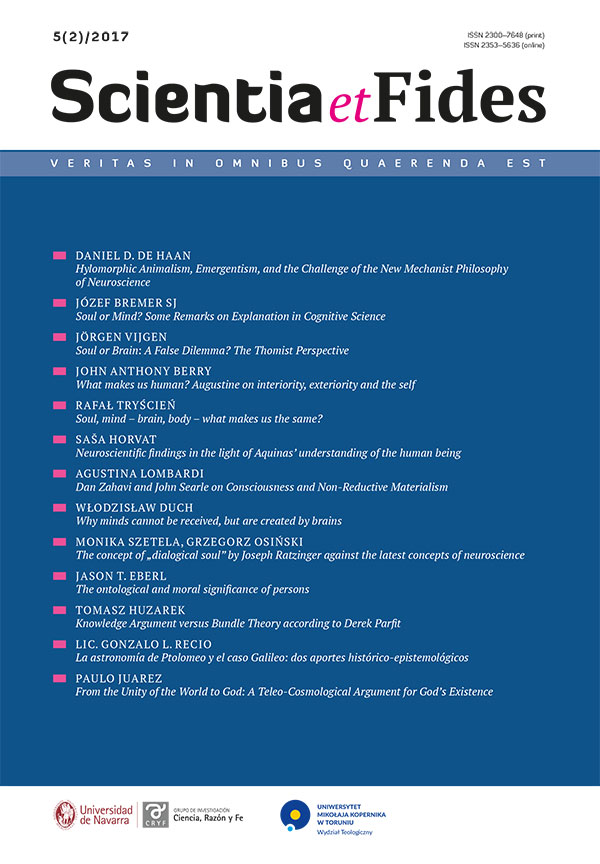
Soul, mind – brain, body – what makes us the same?
Słowa kluczowe
personal identity, soul, complex view, simple viewAbstrakt
The question whether I am the same person at different moments has brought many difficulties for a long time. The problem with identity of things through time was already known in the ancient times especially when Plutarch asked whether a ship of Theseus with exchanged elements is still the same ship as before renovation. Today, we continue these considerations asking, for instance, if things, apart from their physical parts, also have temporal parts. The number of the proposed solutions to the problem of identity and identity of persons at different times resembles wandering in a dark room with a scarf on your eyes. As a result, rather than coming closer to the light switch, we find concepts which suggest that personal identity is not important, or what is important is psychological continuity or identity which is only a matter of degree. So I can be the same person as I was in some part, in some degree. It sounds like a constitution person who likes darkness and does not need light anymore. Unfortunately, first of all, we still use successfully the concept of identity in an ordinary language, and what is more, the abandonment of the notion of personal identity results in a greater number of absurdities, so in consequence, we still do not have an idea how to treat personal identity.
Bibliografia
Ayer, A.J. 1956. The Problem of Knowledge. Cited by: Ayer, A.J. 1965. Problem poznania. Traslation E. Koning-Chwedeńczuk. Warszawa: Wydawnictwo Naukowe PWN.
Baker, L. R. 2000. Persons and Bodies A Constitution View, Cambridge University Press.
Baker, L. R. 2013. "Can Subjectivity be Naturalized?" Metodo. International Studies in Phenomenology and Philosophy, Vol. 1, n. 2.
Baker, Lynne Rudder. 2012. "Personal identity: a not-so-simple simple view." In Personal identity: Complex or Simple? Edited by George Gasser and Matthias Stefan, 179–191. Cambridge University Press.
Bremer, J. 2007. Osoba – fikcja czy rzeczywistość? Tożsamość i jedność Ja w świetle badań neurologicznych. Kraków: Wydawnictwo Aureus.
Butler, J. 1975. "Of personal identity." In Personal Identity. Perry, J. Berkeley, Los Angeles, London: Berkeley, Los Angeles, London: University of California Press.
Coleman, S. 2000. "Thought experiments and personal identity." Philosophical Studies 98: 53–69. Netherlands: Kluwer Academic Publishers.
Dennet, D. 2013. Intuition Pumps and Other Tools for Thinking. Cited by: Dennnet D. 2015. Dźwignie wyobraźni i inne narzędzia do myślenia. Translation Kurek Ł. Kraków: Copernicus Center Press.
Garret, B. 1998. Personal identity and self-consciousness. London and New York: Routledge.
Grygianiec, M. 2007. Identyczność i trwanie. Studium ontologiczne. Warszawa: Wydawnictwo Naukowe Semper.
Locke, J. 1689. An Essay Concerning Human Understanding. Cited by: Locke, J. 1955. Rozważania dotyczące rozumy ludzkiego. T. 1. Translation B. J. Gawecki. Warszawa: Wydawnictwo Naukowe PWN.
Locke, J. 1964. "The Identity of the Man and of the Person." In Mind and Death, edited by A. Flew, 155–163. London: The Macmillan Company, New York, Collier– Macmillan Ltd.
Nagel, Th. 1995. "Umysł i ciało." In Filozofia umysłu, edited by Chwedeńczuk B., 153–183. Warszawa: Fundacja Aletheia.
Noonan, Harold W. 2003. Personal Identity. London: Routledge.
Parfit, D. 1984. Reasons and Persons. Cited by: Parfit, D. 2012. Racje i osoby, Translation W. M. Hensel, M. Warchal. Warszawa: Wydawnictwo Naukowe PWN.
Robinson, J. 1988. Personal Identity and Survival. Cited by: Robinnson, J. 2001. "Tożsamość osobowa a przetrwanie." In Filozofia podmiotu, edited by Górnicka-Kalinowska J., 211–223. Warszawa: Fundacja Aletheia.
Shoemaker, Sydney S. 1959. “Personal Identity and Memory,” The Journal of Philosophy Volume 56, Issue 22. Cited by: Shoemaker S., Tożsamość osobowa a pamięć, Translation. Wieczorek R., in: Filozofia podmiotu, edited by Górnicka-Kalinowska J. Fundacja Aletheia, Warszawa 2001
Swinburne, R. 1974. Personal identity. Cited by Swinburne, R. 2001. "Identyczność osoby." In Filozofia podmiotu, edited by Górnicka-Kalinowska J., 329–345. Warszawa: Fundacja Aletheia.
Vetulani, J. 2011. Mózg: fascynacje, problemy, tajemnice. Kraków: Homini.
Pobrania
Opublikowane
Jak cytować
Numer
Dział
Licencja
CC BY ND 4.0. Posiadaczem prawa autorskiego (Licencjodawcą) jest Autor, który na mocy umowy licencyjnej udziela nieodpłatnie prawa do eksploatacji dzieła na polach wskazanych w umowie.
- Licencjodawca udziela Licencjobiorcy licencji niewyłącznej na korzystanie z Utworu/przedmiotu prawa pokrewnego w następujących polach eksploatacji: a) utrwalanie Utworu/przedmiotu prawa pokrewnego; b) reprodukowanie (zwielokrotnienie) Utworu/przedmiotu prawa pokrewnego drukiem i techniką cyfrową (e-book, audiobook); c) wprowadzania do obrotu egzemplarzy zwielokrotnionego Utworu/przedmiotu prawa pokrewnego; d) wprowadzenie Utworu/przedmiotu prawa pokrewnego do pamięci komputera; e) rozpowszechnianie utworu w wersji elektronicznej w formule open access na licencji Creative Commons (CC BY-ND 3.0) poprzez platformę cyfrową Wydawnictwa Naukowego UMK oraz repozytorium UMK.
- Korzystanie przez Licencjobiorcę z utrwalonego Utworu ww. polach nie jest ograniczone czasowo ilościowo i terytorialnie.
- Licencjodawca udziela Licencjobiorcy licencji do Utworu/przedmiotu prawa pokrewnego nieodpłatnie na czas nieokreślony
PEŁEN TEKST UMOWY LICENCYJNEJ >>
Statystyki
Liczba wyświetleń i pobrań: 1069
Liczba cytowań: 0


