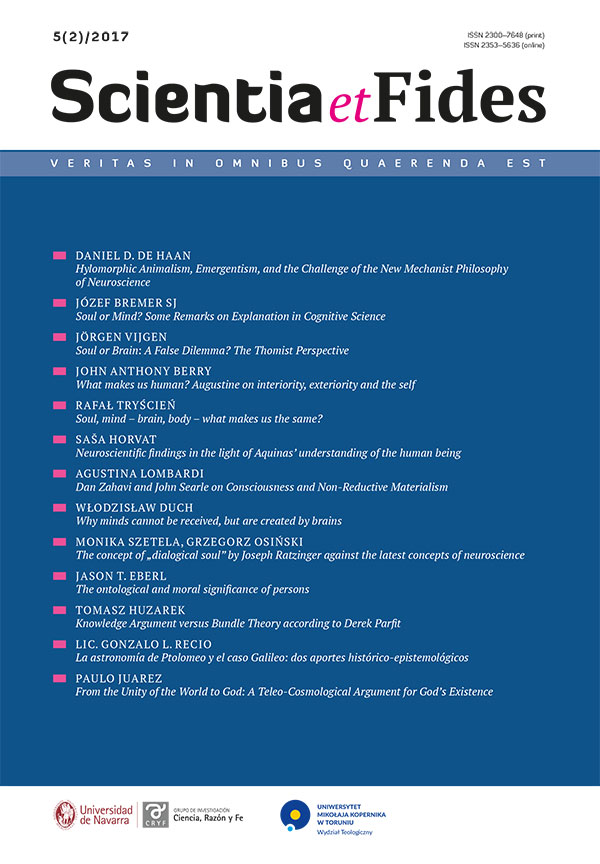
Dan Zahavi and John Searle on Consciousness and Non-Reductive Materialism
Słowa kluczowe
consciousness, mind, dualismAbstrakt
In his 1994 paper, neuroscientist Benjamin Libet affirmed that he found a way to test the interaction between the mind and the brain. He believed that this procedure would also test the reality of a non-physical mind, emerging from neural activity. In 2000 John Searle objected to Libet’s evident dualism, affirming that the mind is not a hypothesis to test but a datum to be explained. According to Searle, Libet’s problem arose from accepting the Cartesian distinction of ‘mind’ and ‘body’, obsolete categories from an old philosophy. Searle’s solution implied the rejection both of dualism and reductive materialism, suggesting a non-reductive materialism. This first-person ontology, as Searle calls it, aims at preserving, against reductive materialism, the essential features of consciousness, i.e. subjective, qualitative and unified. Searle argued, however, that the nature of consciousness remained biological. Dan Zahavi’s thesis is that a phenomenological approach to the self and consciousness can offer a complementing alternative to the contemporary comprehension of the nature of consciousness. Engaged in an open dialogue with neuroscience and cognitive science in his dealings with consciousness, Zahavi holds, nonetheless, that this notion cannot be completely understood without reference to the notion of the self. Thus, this paper will analyse Zahavi’s ideas about the self and consciousness in Subjectivity and Selfhood (2005) as to evaluate whether his phenomenological approach is able to overcome the materialist tones of Searle’s philosophy of mind, opening the possibility of a non-reductive comprehension of human beings.
Bibliografia
Gallagher, S., & Zahavi, D. 2008. The Phenomenological Mind. An Introduction to Philosophy of Mind and Cognitive Science. New York: Routledge.
Libet, B. 1994. “A Testable Field Theory of Mind-Brain Interaction.” Journal of Consciousness Studies 1(1):119–126.
Libet, B. 2001. “‘Consciousness, Free Action and the Brain’. Commentary on John Searle’s Article (with a short reply from John R. Searle).” Journal of Consciousness Studies 8, 8:59–65.
Rosenthal, D. 1993. “Higher-order Thoughts and the Appendage Theory of Consciousness.” Philosophical Psychology 6:155–166.
Searle, J. 1984. Mind, Brains and Science. Cambridge-Ma: Harvard University Press.
Searle, J. 1992. The Rediscovery of the Mind. Cambridge-Ma: The MIT Press.
Searle, J. 2000. “Consciousness, Free Action and the Brain.” Journal of Consciousness Studies 7, 10:3–22.
Searle, J. 2001. “‘Further Reply to Libet’. In Libet, B. ‘Consciousness, Free Action and the Brain’. Commentary on John Searle’s Article.” Journal of Consciousness Studies 8, 8:63–65.
Searle, J. 2001/2002. “Neither Phenomenological Description Nor Rational Desconstruction: Reply to Dreyfus.” Revue internationale de philosophie 216:277–297.
Searle, J. 2004. Mind: A Brief Introduction. New York: Oxford University Press.
Zahavi, D. 2002. “First-person thoughts and embodied self-awareness: Some reflections on the relation between recent analytical philosophy and phenomenology.” Phenomenology and the Cognitive Sciences 1:7–26.
Zahavi, D. 2004. “Introduction: Subjectivity in the Center or Back to Basics.” Phenomenology and the Cognitive Sciences 3:229–234.
Zahavi, D. 2005. Subjectivity and Selfhood. Investigating the First-Person Perspective. Massachusetts: The MIT Press.
Pobrania
Opublikowane
Jak cytować
Numer
Dział
Licencja
CC BY ND 4.0. Posiadaczem prawa autorskiego (Licencjodawcą) jest Autor, który na mocy umowy licencyjnej udziela nieodpłatnie prawa do eksploatacji dzieła na polach wskazanych w umowie.
- Licencjodawca udziela Licencjobiorcy licencji niewyłącznej na korzystanie z Utworu/przedmiotu prawa pokrewnego w następujących polach eksploatacji: a) utrwalanie Utworu/przedmiotu prawa pokrewnego; b) reprodukowanie (zwielokrotnienie) Utworu/przedmiotu prawa pokrewnego drukiem i techniką cyfrową (e-book, audiobook); c) wprowadzania do obrotu egzemplarzy zwielokrotnionego Utworu/przedmiotu prawa pokrewnego; d) wprowadzenie Utworu/przedmiotu prawa pokrewnego do pamięci komputera; e) rozpowszechnianie utworu w wersji elektronicznej w formule open access na licencji Creative Commons (CC BY-ND 3.0) poprzez platformę cyfrową Wydawnictwa Naukowego UMK oraz repozytorium UMK.
- Korzystanie przez Licencjobiorcę z utrwalonego Utworu ww. polach nie jest ograniczone czasowo ilościowo i terytorialnie.
- Licencjodawca udziela Licencjobiorcy licencji do Utworu/przedmiotu prawa pokrewnego nieodpłatnie na czas nieokreślony
PEŁEN TEKST UMOWY LICENCYJNEJ >>
Statystyki
Liczba wyświetleń i pobrań: 1418
Liczba cytowań: 0


