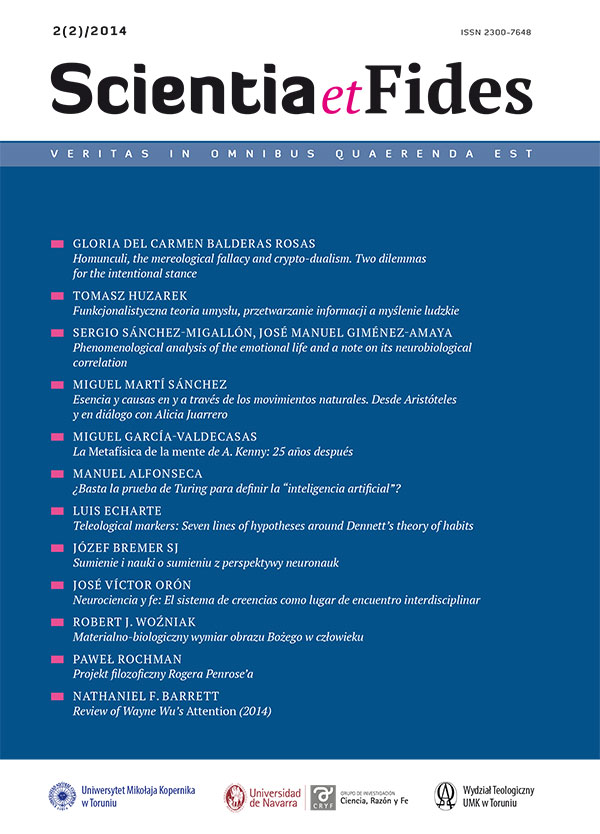
Phenomenological analysis of the emotional life and a note on its neurobiological correlation
DOI:
https://doi.org/10.12775/SetF.2014.015Keywords
feelings, pleasure, values, neurobiology of emotionAbstract
The neurobiology of affection is becoming established as a new sub-discipline that focuses on the study and understanding of human emotional experience. It is a scientific discipline that has emerged from neurosciences, on the basis that we can now only advance towards a global understanding of human emotions and of their alterations by widening the horizons and methods available to study the emotional life. Here, we present the current contrast between the phenomenological and the neuroscientific analysis of emotions. We propose that it is necessary to maintain an interdisciplinary dialogue between these two approaches and we think that this complementation will be especially beneficial for the field of clinical neuroscience and anthropology.
References
Baars, B.J., and N. Gage. 2010. Cognition, Brain, and Consciousness: Introduction to Cognitive Neuroscience. San Diego: Academic Press.
Benninghoff, A., and D. Drenckhahn. 2004. Anatomie, Makroskopische Anatomie, Embryologie und Histologie des Menschen (Band 2). München: Elsevier.
Brentano, F. 1995. Psychology from an empirical standpoint. (T. Rancurello, D. Terrell, and L. McAlister, Trans.). London: Routledge.
Cairns, D. 2000. “Reason and Emotion.” Husserl Studies 17: 21–33.
Damasio, A.R. 1999. The Feeling of What Happens: Body and Emotion in the Making of Consciousness. Orlando: Harcourt Brace.
Damasio, A.R. 2003. Looking for Spinoza. Joy, Sorrow, and the Feeling Brain. London: William Heinemann.
Damasio, A.R. 2011. “Neural basis of emotions.” Scholarpedia 6 (3): 1804.
Damasio, A.R., T.J. Grabowski, A. Bechara, H. Damasio, L.L. Ponto, J. Parvizi, and R.D. Hichwa. 2000. “Subcortical and cortical brain activity during the feeling of self-generated emotions.” Nature Neuroscience 3: 1049–1056.
Drummond, J.J. 2007. “Phenomenology: Neither auto- nor hetero- be.” Phenomenology and the Cognitive Sciences 6: 57–74.
Drummond, J.J. 2008. “Moral phenomenology and moral intentionality.” Phenomenology and the Cognitive Sciences 7: 35–49.
Frings, M.S. 1997. The Mind of Max Scheler. Milwaukee: Marquette University Press.
Fuchs, T. 2004. “Neurobiology and psychotherapy: an emerging dialogue.” Current Opinion in Psychiatry 17: 479–485.
Fuchs, T. 2006. “Ethical issues in neuroscience.” Current Opinion in Psychiatry 19: 600–607.
Gazzaniga, M.S. 2011. Who’s in Charge?: Free Will and the Science of the Brain. New York: HarperCollins.
Giménez-Amaya, J.M., and S. Sánchez-Migallón. 2010. De la neurociencia a la neuroética. Narrativa científica y reflexion filosófica. Pamplona: EUNSA.
Glazinski, R. 2001. The Role of Emotions in Psychiatric Diagnosis: Max Scheler’s Philosophy of Feelings as a Constituent Part of Kurt Schneider’s Theory of Psychopathology (Philosophy & Psychiatry). (C. Charlesworth, Trans.). Köln: R. Glazinski Publisher.
Goldie, P. 2002. “Emotions, feelings and intentionality.” Phenomenology and the Cognitive Sciences 1, 235–254.
Harrison, N.A., and H.D. Critchley. 2007. “Affective neuroscience and psychiatry.” British Journal of Psychiatry 191: 192–194.
Husserl, E. 1999. The Idea of Phenomenology (L. Hardy, Trans.). Dordrecht: Kluwer Academia Publishers/Springer.
Klages, L. 1936. Grundlegung der Wissenschaft vom Ausdruck. Leipzig: Barth.
Krahl A., and M. Schifferdecker. 1998. “Max Scheler and Kurt Schneider. Scientific influence and personal relationship.” Fortschriftte der Neurologie-Psychiatrie 66: 94–100.
Krüger, F. 1918. Die Tiefendimension und die Gegensätzlichkeit des Gefühlslebens. München: C.H. Beck.
Krüger, F. 1928. Das Wesen der Gefühle. Leipzig: Akademische Verlagsgesellschaft.
LeDoux, J.E. 1996. The Emotional Brain. The Mysterious Underpinnings of Emotional Life. New York: Simon&Schuster
Lersch, P. 1938. Der Aufbau des Charakters. Leipzig: Barth.
Lombo, J.A., and J.M. Giménez-Amaya. 2013. La unidad de la persona. Aproximación interdisciplinar desde la filosofía y la neurociencia. Pamplona: EUNSA.
McGovern, K. 2007. “Emotion.” In Cognition, Brain, and Consciousness, edited by, B.J. Baars, and N.M. Gage, 369–389. San Diego: Academic Press Elsevier.
Murillo, J.I. 2011. “Is there room for the will in neuroscientific research? Philosophical reflections on some neuroscientific approaches to emotion and behaviour.” In Moral Behaviour and Free Will. A Neurobiological and Philosophical Approach, edited by J.J. Sanguineti, A. Acerbi and J.A. Lombo, 61–79. Roma: IF Press.
Nieuwenhuys, R., J. Voogd, and C. van Huijzen. 2009. El sistema nervioso central humano (vol. 2). Madrid: Editorial Médica Panamericana.
Panksepp, J. 1998. Affective neuroscience: the foundations of human and animal emotions. New York: Oxford University Press.
Panksepp, J. 2005. “Affective consciousness: Core emotional feelings in animals and humans.” Consciousness and Cognition 14: 30–80.
Phelps, E.A., and J.E. LeDoux. 2005. “Contributions of the amygdala to emotion processing: from animal models to human behaviour.” Neuron 48: 175–187.
Potter, R. 1997. The Greatest Benefit of Mankind. A Medical History of Humanity from Antiquity to the Present. London: Fontana Press.
Price, D.D., G.N. Verne, and J.M. Schwartz. 2006. “Plasticity in brain processing and modulation of pain.” Progress in Brain Research 157: 333–352.
Purves, D., G.J. Agustine, D. Fitzpatrick, W.C. Hall, A.-S. Lamantia, J.O. McNamara, and S.M. Williams. 2004. Neuroscience. Sunderland: Sinauer Associates.
Sánchez-Migallón, S. 2005. “Die zweideutige Stellungnahme Max Schelers gegenüber der Ethik Franz Brentanos.” Brentano Studien 11: 163–197.
Sánchez-Migallón, S. 2010. “La estratificación de la vida emocional según Scheler.” In De nobis ipsis silemus. Homenaje a Juan Miguel Palacios, edited by, I. García de Leániz, 357–376. Madrid: Ediciones Encuentro.
Scheler, M. 1973. Formalism in Ethics and Non-Formal Ethics of Values. (M.S. Frings, and R.L. Funk, Trans.). Evanston: Northwestern University Press.
Scheler, M. 1970. The Nature of Sympathy. (P. Heath, Trans.) Hamden: Archon Books.
Scheler, M. 1992. The Meaning of Suffering, in Max Scheler. On Feeling Knowing, and Valuing. Selected Writings. (H.J. Bershady, Trans.). Chicago: The University of Chicago Press .
Schneider, K. 2007. Klinische Psychopatologie. Stuttgart: Thieme.
Siewert, C. 2007. “In favor of (plain) phenomenology.” Phenomenology and the Cognitive Sciences 6: 201–220.
Spiegelberg, H. 1972. Phenomenology in Psychology and Psychiatry: A Historical Introduction. Evanston: Northwestern University Press.
Tsuchiya, N., and R. Adolphs. 2007. “Emotion and consciousness.” Trends in Cognitive Sciences 11: 158–167.
Downloads
Published
How to Cite
Issue
Section
License
Copyright (c) 2014 Scientia et Fides

This work is licensed under a Creative Commons Attribution-NoDerivatives 4.0 International License.
CC BY ND 4.0. The Creator/Contributor is the Licensor, who grants the Licensee a non-exclusive license to use the Work on the fields indicated in the License Agreement.
- The Licensor grants the Licensee a non-exclusive license to use the Work/related rights item specified in § 1 within the following fields: a) recording of Work/related rights item; b) reproduction (multiplication) of Work/related rights item in print and digital technology (e-book, audiobook); c) placing the copies of the multiplied Work/related rights item on the market; d) entering the Work/related rights item to computer memory; e) distribution of the work in electronic version in the open access form on the basis of Creative Commons license (CC BY-ND 3.0) via the digital platform of the Nicolaus Copernicus University Press and file repository of the Nicolaus Copernicus University.
- Usage of the recorded Work by the Licensee within the above fields is not restricted by time, numbers or territory.
- The Licensor grants the license for the Work/related rights item to the Licensee free of charge and for an unspecified period of time.
FULL TEXT License Agreement
Stats
Number of views and downloads: 816
Number of citations: 1


