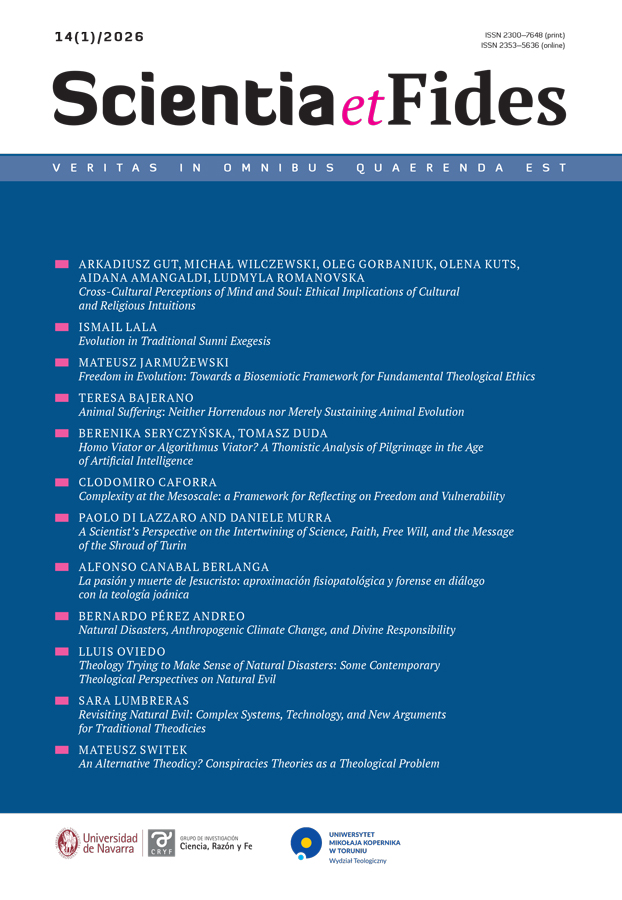
An Alternative Theodicy?
Conspiracies Theories as a Theological Problem
DOI:
https://doi.org/10.12775/SetF.2026.012Słowa kluczowe
problem of evil, conspiracism, theology, beliefs, epistemology, religion, credibility of Christian FaithAbstrakt
When religion and science lose their cultural significance, efficacy or attractivity in explaining the tragedy of natural disasters, an alternative proposal arises, that of conspiracy theories. This article seeks to interpret the contemporary popularity of conspiracy thinking as a kind of alternative theodicy and a serious challenge for Christian theology. For this purpose, the article presents an overview of current discussions regarding the relation between religion and conspiracy theories, with particular emphasis on the theological dimension of the problem. An examination of affinities and differences between science, religious explanation and conspiracy mentality helps to better understand the roots and main features of conspiracism in the contemporary world. It also allows us to revisit an old accusation that finds traditional religion culpable of susceptibility to conspiratorial thinking. This view can be contrasted with another perspectives which links the culture of conspiracy with new and esoteric spiritual movements or with modern rationalism or postmodern culture of suspicion. All these considerations show the limitations of simplified dialectics of religion and rationality and highlight some essential characteristics of a theological reflection on natural disasters and theodicy. The issues discussed bring up some ideas regarding the credibility of Christianity and point to the possible contribution of theology in the current discussion on conspiracism.
Bibliografia
Arbuckle, Gerald A. 2022. “From Gossip to Conspiracy Thinking: Analysis and Scriptural Evaluations”. Australasian Catholic Record 99 (2): 187–200.
Asprem, Egil, and Asbjørn Dyrendal. 2015. “Conspirituality Reconsidered: How Surprising and How New Is the Confluence of Spirituality and Conspiracy Theory?” Journal of Contemporary Religion 30 (3): 367–82. https://doi.org/10.1080/13537903.2015.1081339.
Asprem, Egil, and Asbjørn Dyrendal. 2018. “Close Companions? Esotericism and Conspiracy Theories”. In Handbook of Conspiracy Theory and Contemporary Religion, edited by David G. Robertson, Egil Asprem, and Asbjørn Dyrendal, 207–33. Leiden: Brill. https://doi.org/10.1163/9789004382022_002.
Aupers, Stef. 2012. “Trust no one: Modernization, Paranoia and Conspiracy Culture”. European Journal of Communication 27 (1): 22–34.
Aupers, Stef, and Jaron Harambam. 2018. “Rational Enchantments: Conspiracy Theory between Secular Scepticism and Spiritual Salvation”. In Handbook of Conspiracy Theory and Contemporary Religion, edited by David G. Robertson, Egil Asprem, and Asbjørn Dyrendal, 48–69. Leiden: Brill. https://doi.org/10.1163/9789004382022_002.
Boltanski, Luc. 2014. Mysteries and Conspiracies: Detective Stories, Spy Novels and the Making of Modern Societies. Translated by Catherine Porter. Cambridge, UK: Polity.
Bubert, Marcel, and André Krischer. 2023a. “Einleitung”. In Zwischen Gottesstrafe Und Verschwörungstheorien: Deutungskonkurrenzen Bei Epidemien von Der Antike Bis Zur Gegenwart, edited by Martin Buber and André Krischer, 7–38. Frankfurt-New York: Campus Verlag.
Bubert, Marcel, and André Krischer. 2023b. Zwischen Gottesstrafe Und Verschwörungstheorien: Deutungskonkurrenzen Bei Epidemien von Der Antike Bis Zur Gegenwart. Frankfurt-New York: Campus Verlag.
Cueille, Julien. 2020. Le symptôme complotiste: aux marges de la culture hypermoderne. Sociologie clinique. Toulouse: Érès.
Delouvée, Sylvain, and Sebastian Dieguez. 2021. Le complotisme: Cognition, culture, société. Bruxelles: Mardaga.
Dentith, Matthew R. X., ed. 2018. Taking Conspiracy Theories Seriously. Collective Studies in Knowledge and Society. London: Rowman & Littlefield. https://doi.org/10.5040/9798881816698.
Dyrendal, Asbjørn. 2013. “Hidden Knowledge, Hidden Powers: Esotericism and Conspiracy Culture”. In Contemporary Esotericism, edited by Kennet Granholm and Egil Asprem, 200–25. Routledge. https://doi.org/10.4324/9781315728650-10.
Dyrendal, Asbjørn. 2016. “Conspiracy Theories and New Religious Movements”. In The Oxford Handbook of New Religious Movements: Volume II, 2nd edn, edited by James R. Lewis and Inga Tøllefsen, 198–209. Oxford: Oxford University Press. https://doi.org/10.1093/oxfordhb/9780190466176.013.14.
Dyrendal, Asbjørn, David G. Robertson, and Egil Asprem, eds. 2018. Handbook of Conspiracy Theory and Contemporary Religion. Leiden-Boston: Brill.
Franks, Bradley, Adrian Bangerter, and Martin Bauer. 2013. “Conspiracy Theories as Quasi-Religious Mentality: An Integrated Account from Cognitive Science, Social Representations Theory, and Frame Theory”. Frontiers in Psychology 4: 1–12. https://doi.org/10.3389/fpsyg.2013.00424.
Frenken, Marius, Michał Bilewicz, and Roland Imhoff. 2023. “On the Relation Between Religiosity and the Endorsement of Conspiracy Theories: The Role of Political Orientation”. Political Psychology 44 (1): 139–56. https://doi.org/10.1111/pops.12822.
Girard, René. 1987. Things Hidden since the Foundation of the World. Stanford: Stanford University Press.
Guillon, Jean-Baptiste. 2019. “Les théories du complot et le paradoxe de l’individualisme épistémique”. Diogène 261–262 (1): 54–87. https://doi.org/10.3917/dio.261.0054.
Hagen, Kurtis. 2018. “Conspiracy Theorists and Monological Belief Systems”. Argumenta 3 (2): 303–26.
Han, Byung-Chul. 2022. Infocracia: la digitalización y la crisis de la democracia. Translated by Joaquín Chamorro Mielke. Barcelona: Taurus.
Han, Byung-Chul. 2023. La crisis de la narración. Edición digital. Translated by Alberto Ciria. Barcelona: Herder.
Hernáiz, Hugo Antonio Pérez. 2011. “Competing Explanations of Global Evils: Theodicy, Social Sciences, and Conspiracy Theories”. Aglos, no. 2: 27–45.
Hesse, Jacob, and Christian Weidemann. 2025. “Conspiracy Theories and Religious Worldviews: Unraveling a Complex Relationship”. Episteme, 2025, 1–1. https://doi.org/10.1017/epi.2025.10069.
Hidalgo, Oliver Fernando. 2022. “Religions and Conspiracy Theories as the Authoritarian “Other” of Democracy?’ Politics and Governance 10 (4): 146–56. https://doi.org/10.17645/pag.v10i4.5826.
Ide, Pascal. 2024. Complotisme et Anticomplotisme - Une Double Blessure de l’intelligence. Perpignan-Paris: Artège Editions.
Jabkowski, Piotr, Jan Domaradzki, and Mariusz Baranowski. 2025. “Religiosity and Beliefs in Medical Conspiracy Theories in 37 European Countries during the COVID-19 Pandemic”. Humanities and Social Sciences Communications 12 (1): 1–13. https://doi.org/10.1057/s41599-025-04781-4.
Jedinger, Alexander, and Pascal Siegers. 2024. “Religion, Spirituality, and Susceptibility to Conspiracy Theories: Examining the Role of Analytic Thinking and Post-Critical Beliefs”. Politics and Religion 17 (3): 389–409. https://doi.org/10.1017/S1755048324000130.
Journet, Charles. 1963. The Meaning of Evil. Translated by Micheal Barry. London: Chapman.
Keeley, Brian L. 2007. “God as the Ultimate Conspiracy Theory”. Episteme 4 (2): 135–49. https://doi.org/10.3366/epi.2007.4.2.135.
Keeley, Brian L. 2018. “Is a Belief in Providence the Same as a Belief in Conspiracy?” In Handbook of Conspiracy Theory and Contemporary Religion, edited by David G. Robertson, Egil Asprem, and Asbjørn Dyrendal, 70–86. Leiden: Brill. https://doi.org/10.1163/9789004382022_002.
Kiess, John. 2016. Hannah Arendt and Theology. 1st edn. Philosophy and Theology. London: Bloomsbury. https://doi.org/10.5040/9781472594723.
Łowicki, Paweł, Marta Marchlewska, Zuzanna Molenda, Adam Karakula, and Dagmara Szczepańska. 2022. “Does Religion Predict Coronavirus Conspiracy Beliefs? Centrality of Religiosity, Religious Fundamentalism, and COVID-19 Conspiracy Beliefs”. Personality and Individual Differences 187: 111413 (1-9). https://doi.org/10.1016/j.paid.2021.111413.
Moeller, Charles. 2019. Sabiduría Griega y Paradoja Cristiana. Madrid: Encuentro.
Navarro, Jaume. 2016. “Oracles, Prophets and the Exoteric Circles of Science and Religion”. Scientia et Fides 4 (2): 285–301.
Navarro, Jesús. 2024. “Más allá de toda duda razonable: la herencia envenenada del escepticismo clásico en el contexto epistémico contemporáneo”. Logos. Anales del Seminario de Metafísica 57 (1): 149–68. https://doi.org/10.5209/asem.92351.
Piraino, Francesco, Marco Pasi, and Egil Asprem, eds. 2023. Religious Dimensions of Conspiracy Theories: Comparing and Connecting Old and New Trends. New York-London: Routledge. https://www.routledge.com/Religious-Dimensions-of-Conspiracy-Theories-Comparing-and-Connecting-Old-and-New-Trends/Piraino-Pasi-Asprem/p/book/9780367638436.
Polanyi, Michael. 1946. Science Faith, and Society. Riddel Memorial Lectures. London: Oxford University Press-Geoffrey Cumberlegé.
Pollack, Detlef, and Carolin Hillenbrand. 2023. “Umkämpftes Vertrauen. Zur Rolle von Religion, Verschwörungstheorien Und Wissenschaft in Der Corona-Krise”. In Zwischen Gottesstrafe Und Verschwörungstheorien: Deutungskonkurrenzen Bei Epidemien von Der Antike Bis Zur Gegenwart, edited by Marcel Bubert and André Krischer, 462–98. Frankfurt-New York: Campus Verlag.
Popper, Karl Raimund. 1971. The Open Society and Its Enemies. II: The High Tide of Prophecy, Hegel, Marx, and the Aftermath. Princeton: University Press.
Rapport, Jeremy. 2016. “New Religions and Science”. In The Oxford Handbook of New Religious Movements: Volume II, 2nd edn, edited by James R. Lewis and Inga Tøllefsen, 278–86. Oxford: Oxford University Press. https://doi.org/10.1093/oxfordhb/9780190466176.013.20.
Robertson, David G. 2022. “Crippled Epistemologies: Conspiracy Theories, Religion, and Knowledge”. Social Research (New York) 89 (3): 651–77. https://doi.org/10.1353/sor.2022.0052.
Robertson, David G., Egil Asprem, and Asbjørn Dyrendal. 2018. “Conspiracy Theories and the Study of Religion(s): What We Are Talking about, and Why It Is Important”. In Handbook of Conspiracy Theory and Contemporary Religion, edited by David G. Robertson, Egil Asprem, and Asbjørn Dyrendal, 19–47. Leiden: Brill. https://doi.org/10.1163/9789004382022_002.
Robertson, David G., and Asbjørn Dyrendal. 2018. “Conspiracy Theories and Religion: Superstition, Seekership, and Salvation”. In Conspiracy Theories and the People Who Believe Them, edited by Joseph E. Uscinski, 411–22. Oxford-New York: Oxford University Press.
Schwaiger, Lisa, Jörg Schneider, Mark Eisenegger, and Camille Nchakga. 2023. “Verschwörung als Ersatzreligion? Religiosität, Spiritualität und Verschwörungsaffinität in Zeiten gesellschaftlicher Krisen”. Zeitschrift für Religion, Gesellschaft und Politik 7 (2): 617–38. https://doi.org/10.1007/s41682-022-00136-x.
Stasielowicz, Lukasz. 2022. “Who Believes in Conspiracy Theories? A Metaanalysis on Personality Correlates”. Journal of Research in Personality 98: 104229. https://doi.org/10.1016/j.jrp.2022.104229.
Stawiszyński, Tomasz. 2021. Ucieczka Od Bezradności. Kraków: Znak.
Stawiszyński, Tomasz. 2024. Powrót fatum. Kraków: Znak.
Stockemer, Daniel, and Jean-Nicolas Bordeleau. 2025. Conspiracy Theories and Their Believers: A Comparative Outlook. Cambridge: Cambridge University Press. https://www-cambridge-org.ezproxy.unav.es/core/elements/conspiracy-theories-and-their-believers/0F40035995A12FA156D7C9DA38C8EECB.
Taguieff, Pierre-André. 2005. La foire aux illuminés: ésotérisme, théorie du complot, extrémisme. Paris: Mille et une nuits.
Ward, Charlotte, and David Voas. 2011. “The Emergence of Conspirituality”. Journal of Contemporary Religion 26 (1): 103–21. https://doi.org/10.1080/13537903.2011.539846.
Wood, Michael, and Karen Douglas. 2018. “Are Conspiracy Theories a Surrogate for God?” In Handbook of Conspiracy Theory and Contemporary Religion, edited by David G. Robertson, Egil Asprem, and Asbjørn Dyrendal, 87–105. Leiden: Brill. https://doi.org/10.1163/9789004382022_002.
Zawistowska, Alicja, Robin Kopecký, Lenka Příplatová, Silvia Boschetti, Konrad Talmont-Kamiński, and Jaroslav Flegr. 2025. “Superstitions, Religious Identity, and COVID-19 Conspiracy Beliefs in Secularized Czechia”. Journal of Religion in Europe 18 (2): 205–27. https://doi.org/10.1163/18748929-bja10110.
Pobrania
Opublikowane
Jak cytować
Numer
Dział
Licencja
Prawa autorskie (c) 2026 Mateusz Switek

Utwór dostępny jest na licencji Creative Commons Uznanie autorstwa – Bez utworów zależnych 4.0 Międzynarodowe.
CC BY ND 4.0. Posiadaczem prawa autorskiego (Licencjodawcą) jest Autor, który na mocy umowy licencyjnej udziela nieodpłatnie prawa do eksploatacji dzieła na polach wskazanych w umowie.
- Licencjodawca udziela Licencjobiorcy licencji niewyłącznej na korzystanie z Utworu/przedmiotu prawa pokrewnego w następujących polach eksploatacji: a) utrwalanie Utworu/przedmiotu prawa pokrewnego; b) reprodukowanie (zwielokrotnienie) Utworu/przedmiotu prawa pokrewnego drukiem i techniką cyfrową (e-book, audiobook); c) wprowadzania do obrotu egzemplarzy zwielokrotnionego Utworu/przedmiotu prawa pokrewnego; d) wprowadzenie Utworu/przedmiotu prawa pokrewnego do pamięci komputera; e) rozpowszechnianie utworu w wersji elektronicznej w formule open access na licencji Creative Commons (CC BY-ND 3.0) poprzez platformę cyfrową Wydawnictwa Naukowego UMK oraz repozytorium UMK.
- Korzystanie przez Licencjobiorcę z utrwalonego Utworu ww. polach nie jest ograniczone czasowo ilościowo i terytorialnie.
- Licencjodawca udziela Licencjobiorcy licencji do Utworu/przedmiotu prawa pokrewnego nieodpłatnie na czas nieokreślony
PEŁEN TEKST UMOWY LICENCYJNEJ >>
Statystyki
Liczba wyświetleń i pobrań: 323
Liczba cytowań: 0


