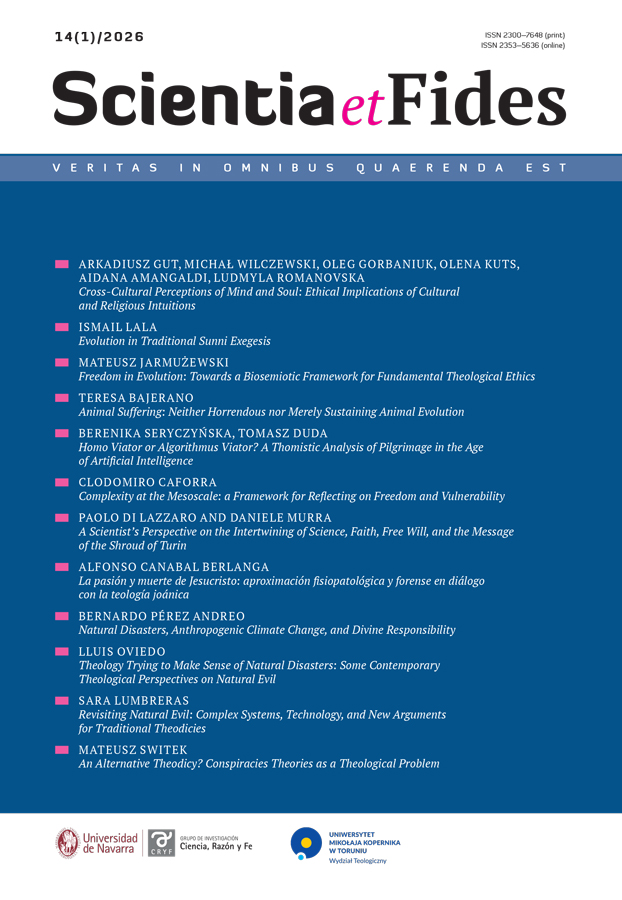
Cross-Cultural Perceptions of Mind and Soul
Ethical Implications of Cultural and Religious Intuitions
DOI:
https://doi.org/10.12775/SetF.2026.001Parole chiave
Dualism, soul, mind, religion, ethical reasoning, cultureAbstract
Research across cognitive science, psychology of religion, linguistics, philosophy, and anthropology emphasizes the intertwined concepts mind and soul in shaping individuals’ perceptions. Both mind and soul significantly impact human intuitions, incorporating psychological, cognitive, religious, moral, and emotional dimensions. Correcting traditional dualistic perspectives on the mind-body relationship, recent studies advocate for a tripartite model (body, mind, and soul) to offer a holistic and nuanced comprehension of human cognition. Our investigation, spanning Catholic Poland (n = 225), Orthodox Ukraine (n = 272), and Islamic Kazakhstan (n = 198), validates the intuitive association of the soul beyond the mind. The results suggest that the soul operates independently of the mind, reflecting deep cultural and religious integration into human cognition. The ethical implications of distinguishing the soul from the mind are evident in participants’ moral dilemma judgments. This research advances cross-cultural comprehension of cultural influences on mental concept development in social contexts.
Riferimenti bibliografici
Anglin, Stephanie M. 2014. “I think, therefore I am? Examining conceptions of the self, soul, and mind.” Consciousness and Cognition: An International Journal 29: 105–16. https://doi.org/10.1016/j.concog.2014.08.014.
Bering, Jesse M. 2006. “The folk psychology of souls.” The Behavioral and Brain Sciences 29 (5): 453–62. https://doi.org/10.1017/S0140525X06009101.
Bloom, Pau.l 2004. Descartes’ baby: How the science of child development explains what makes us human. New York City: Basic Books.
Boeri, Marcelo D., Yasuhira Y. Kanayama, and Jorge Mittelmann, eds. 2018. Soul and Mind in Greek Thought. Psychological Issues in Plato and Aristotle (Vol. 20). New York: Springer.
Cohen, Emma, and Justin Barrett. 2008. “When minds migrate: Conceptualizing spirit possession.” Journal of Cognition and Culture 8 (1–2): 23–48. https://doi.org/10.1163/156770908X289198.
Cohen, Emma, Emily Burdett, Nicola Knight, and Justin Barrett. 2011. “Cross-cultural similarities and differences in person-body reasoning: experimental evidence from the United Kingdom and Brazilian Amazon.” Cognitive Science 35 (7): 1282–304. https://doi.org/10.1111/J.1551-6709.2011.01172.X.
Cruz, Francisco, and André Mata. 2026. “Love is in the soul, math is in the brain: Dualist intuitions and belief in psychological science.” Journal of ExperimentalSocial Psychology 122: 104845. https://doi.org/10.1016/j.jesp.2025.104845.
Dulin, John. 2020. “Vulnerable minds, bodily thoughts, and sensory spirits: local theory of mind and spiritual experience in Ghana.” Journal of the Royal Anthropological Institute 26 (S1): 61–76. https://doi.org/10.1111/1467-9655.13241.
Forstmann, Matthias, Pascal Burgmer, and Thomas Mussweiler. 2012. “The mind is willing, but the flesh is weak: the effects of mind-body dualism on health behavior.” Psychological Science 23 (10): 1239–45. https://doi.org/10.1177/0956797612442392.
Fortuna, Paweł, Zbigniew Wróblewski, Arkadiusz Gut, and Anna Dutkowska. 2024. „The relationship between anthropocentric beliefs and the moral status of a chimpanzee, humanoid robot, and cyborg person: the mediating role of the assignment of mind and soul.” Current Psychology 43 (14): 12664–79. https://doi.org/10.1007/s12144-023-05313-6.
Gray, Heather M., Kurt Gray, and Daniel M. Wegner. 2007. “Dimensions of mind perception.” Science 315 (5812): 619. https://doi.org/10.1126/science.1134475.
Gray, Kurt, T. Anne Knickman, and Daniel M. Wegner. 2011. “More dead than dead: Perceptions of persons in the persistent vegetative state.” Cognition 121 (2): 275–80. https://doi.org/10.1016/J.COGNITION.2011.06.014.
Gut, Arkadiusz, Andrew Lambert, Oleg Gorbaniuk, and Robert Mirski. 2021. “Folk beliefs about soul and mind: Cross-cultural comparison of folk intuitions about the ontology of the person.” Journal of Cognition and Culture 21 (3–4): 346–69. https://doi.org/10.1163/15685373-12340116.
Gut, Arkadiusz, Michał Wilczewski, Oleg Gorbaniuk, Olena Kuts, Aidana Amangaldi and Ludmyla Romanovska. 2025. “Cross-cultural perceptions of mind and soul: Ethical implications of divergent intuitions.” [Data set]. https://doi.org/10.18150/JW7WNW.
Harris, Paul L., and Kathleen H. Corriveau. 2021. “Beliefs of children and adults in religious and scientific phenomena.” Current Opinion in Psychology 40: 20–23. https://doi.org/10.1016/j.copsyc.2020.08.003.
Harris, Paul L., Melissa A. Koenig, Kathleen H. Corriveau, and Vikram K. Jaswal. 2018. “Cognitive foundations of learning from testimony.” Annual Review of Psychology 69: 251–73. https://doi.org/10.1146/annurev-psych-122216-011710.
Hodge, Mitch K. 2008. “Descartes’ mistake: How afterlife beliefs challenge the assumption that humans are intuitive Cartesian substance dualists.” Journal of Cognition and Culture 8 (3–4): 387–415. https://doi.org/10.1163/156853708X358236.
Inglehart, Ronald, and Wayne E. Baker. 2000. “Modernization, cultural change, and the persistence of traditional values.” American Sociological Review 65 (1): 19–51. https://doi.org/10.2307/2657288.
Louw, Maria E. 2007. Everyday Islam in post-Soviet Central Asia. London: Routledge.
Luhrmann, Tanya M. 2020. “Mind and Spirit: a comparative theory about representation of mind and the experience of spirit.” Journal of the Royal Anthropological Institute 26 (S1): 9–27. https://doi.org/10.1111/1467-9655.13238.
Marková, Ivana, Eleanor Moodie, Robert M. Farr, Ewa Drozda-Senkowska, Ferenc Erös, Jana Plichtová, ... and Olga Mullerová. 1998. “Social representations of the individual: A post-Communist perspective.” European Journal of Social Psychology 28 (5): 797–829. https://doi.org/10.1002/(SICI)1099-0992(199809/10)28:5<797::AID-EJSP896>3.0.CO;2-6.
Nezhina, Tamara G., and Aigerim R. Ibrayeva. 2013. “Explaining the role of culture and traditions in functioning of civil society organizations in Kazakhstan.” Voluntas 24: 335–58. https://doi.org/10.1007/s11266-011-9256-7.
Novikova, Tetiana 2020. “Definition of the term ‘soul’ in dictionaries of the Ukrainian language. Current issues of social studies and history of medicine.” Joint Ukrainian-Romanian Scientific Journal 1 (25): 69–73. https://doi.org/10.24061/2411-6181.1.2020.163.
Ostanina-Olszewska, Julia, and Kristina S. Despot. 2017. „When ‘soul’ is lost in translation: Metaphorical conceptions of ‘soul’ in Dostoyevsky’s original ‘БратьяКарамазовы’ (‘The Brothers Karamazov’) and its translations into Polish, Croatian and English.” Cognitive Studies | Étudescognitives 17. https://doi.org/10.11649/cs.1319.
Richert, Rebekah A., and Paul L. Harris. 2008. “Dualism revisited: Body vs. Mind vs. soul.” Journal of Cognition and Culture 8 (1–2): 99–115. https://doi.org/10.1163/156770908X289224.
Richert, Rebekah A., and Erin Smith. 2012. “The essence of soul concepts: How soul concepts influence ethical reasoning across religious af filiation.” Religion, Brain & Behavior 2: 161–76. https://doi.org/10.1080/2153599X.2012.683702.
Richert, Rebekah A., Anondah R. Saide, Kirsten A. Lesage, and Nicholas J. Shaman. 2017. “The role of religious context in children’s differentiation between God’s mind and human minds.” The British Journal of Developmental Psychology 35 (1): 37–59. https://doi.org/10.1111/bjdp.12160.
Richert, Rebekah A., and Erin Smith. 2010. “The role of religious concepts in the evolution of human cognition.” In The nature of God: Evolution and religion, edited by U. Frey, 93–110. Baden-Baden: Tectum.
Roazzi, Maira, Melanie Nyhof, and Carl Johnson. 2013. “Mind, soul and spirit: Conceptions of immaterial identity in different cultures.” International Journal for the Psychology of Religion 23 (1): 75–86. https://doi.org/10.1080/10508619.2013.735504.
Skrzypińska, Katarzyna 2022. I Believe, So I Am: Reflections on the psychology of spirituality. Leiden: Brill.
Slingerland, Edward 2019. Mind and body in early China: Beyond orientalism and the myth of holism. Oxford: Oxford University Press. Steinberg, Mark D., and Catherine Wanner. 2008. Religion, morality, and community in post-Soviet societies. Bloomington: Indiana University Press.
Swinburne, Richard. 2013. Mind, brain, and free will. Oxford: Oxford University Press.
Tatarkiewicz, Władysław 1973. “Outline of the history of philosophy in Poland.” The Polish Review XVIII (3): 73–85.
Varnum, Michael, Igor Grossmann, Daniela Katunar, Richard Nisbett, and Shinobu Kitayama. 2008. “Holism in a European cultural context: Differences in cognitive style between Central and East Europeans and Westerners.” Journal of Cognition and Culture 8 (3–4): 321–33. https://doi.org/10.1163/156853708X358209.
Weisman, Kara, Carol S. Dweck, and Ellen M. Markman. 2017. “Rethinking people’s conceptions of mental life.” PNAS Proceedings of the National Academy of Sciences of the United States of America 114 (43): 11374–9. https://doi.org/10.1073/pnas.1704347114.
Wierzbicka, Anna. Semantics, culture, and cognition: Universal human concepts in culture-specific configurations. Oxford: Oxford University Press, 1992. Willard, Aiyana K., and Rita A. McNamara. 2019. “The Minds of God(s) and Humans: Differences in Mind Perception in Fiji and North America.” Cognitive Science 43 (1): e12703. https://doi.org/10.1111/COGS.12703.
Zhabayeva, Saule S. 2022. “The Kazakh concept of soul in Abai Kunanbaev’s Book of Words.” Asiatic: IIUM Journal of English Language and Literature 16 (2): 7–24. https://doi.org/10.31436/asiatic.v16i2.2645.
Downloads
Pubblicato
Come citare
Fascicolo
Sezione
Licenza
Copyright (c) 2026 Arkadiusz Gut, Michał Wilczewski, Oleg Gorbaniuk, Olena Kuts, Aidana Amangaldi , Ludmyla Romanovska

Questo lavoro è fornito con la licenza Creative Commons Attribuzione - Non opere derivate 4.0 Internazionale.
CC BY ND 4.0. The Creator/Contributor is the Licensor, who grants the Licensee a non-exclusive license to use the Work on the fields indicated in the License Agreement.
- The Licensor grants the Licensee a non-exclusive license to use the Work/related rights item specified in § 1 within the following fields: a) recording of Work/related rights item; b) reproduction (multiplication) of Work/related rights item in print and digital technology (e-book, audiobook); c) placing the copies of the multiplied Work/related rights item on the market; d) entering the Work/related rights item to computer memory; e) distribution of the work in electronic version in the open access form on the basis of Creative Commons license (CC BY-ND 3.0) via the digital platform of the Nicolaus Copernicus University Press and file repository of the Nicolaus Copernicus University.
- Usage of the recorded Work by the Licensee within the above fields is not restricted by time, numbers or territory.
- The Licensor grants the license for the Work/related rights item to the Licensee free of charge and for an unspecified period of time.
FULL TEXT License Agreement
Stats
Number of views and downloads: 417
Number of citations: 0


