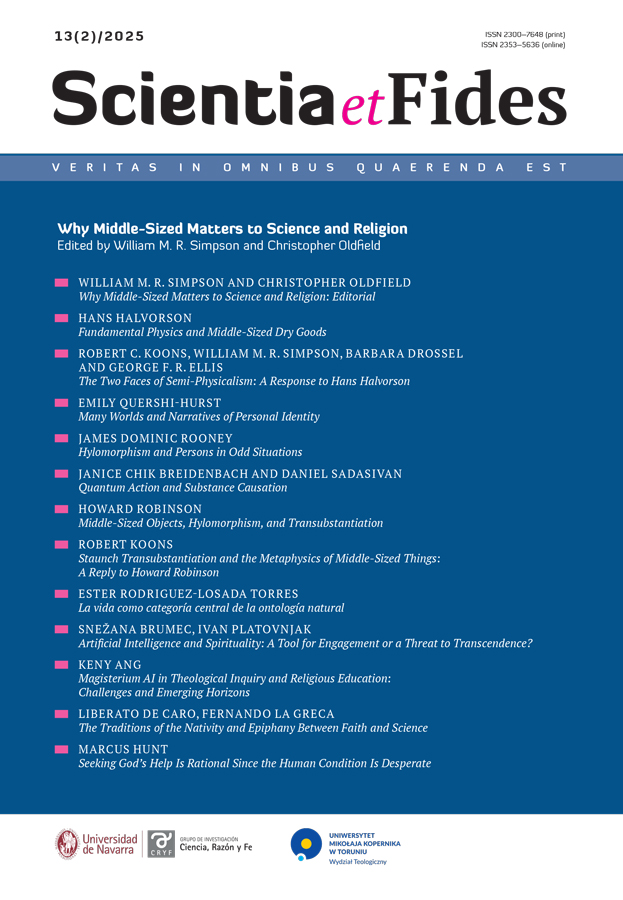
The Two Faces of Semi-Physicalism
A Response to Hans Halvorson
DOI:
https://doi.org/10.12775/SetF.2025.016Słowa kluczowe
quantum, emergence, physicalism, wave function, thermodynamics, hylomorphism, measurement problemAbstrakt
This paper responds to Halvorson’s reflections on hylomorphism by addressing its quantum application (Koons and Simpson) and contextually emergent physics (Ellis and Drossel). It also critiques physicalist interpretations of quantum mechanics and argues for the fundamental nature of thermodynamic phenomena. Koons, Simpson, Ellis and Drossel defend hylomorphism as a framework that challenges dogmatic semi-physicalism. They examine causal pluralism, semantic indeterminacy and the limited validity of quantum mechanics, emphasising the role of micro and macroscopic elements in shaping a consistent worldview.
Bibliografia
Albert, David Z. 2015. After Physics. Cambridge MA: Harvard University Press.
Allori, Valia, Sheldon Goldstein, Roderich Tumulka, & Nino Zanghì. 2008. “On the common structure of Bohmian mechanics and the Ghirardi-Rimini-Weber theory: dedicated to GianCarlo Ghirardi on the occasion of his 70th birthday.” The British Journal for the Philosophy of Science 59(3): 353–389.
Allori, Valia. 2013. “On the metaphysics of quantum mechanics.” In Precis de la Philosophie de la Physique, edited by Soazig Le Bihan, 116–51. Paris: Vuibert.
Bird, Alexander. 2007. Nature’s Metaphysics: Laws and Properties. New York: Oxford University Press.
Cartwright, Nancy. 1983. How the Laws of Physics Lie. Oxford: Oxford University Press.
Cartwright, Nancy. 1994. Nature’s Capacities and Their Measurement. Oxford: Oxford University Press.
Cartwright, Nancy. 2017. “Causal Powers: Why Humeans can’t even be Instrumentalists.” In Causal Powers, edited by Jonathan D. Jacobs, 9–23. Oxford: Oxford University Press.
Demerast, Heather. 2017. “Powerful Properties, Powerless Laws.” In Causal Powers, edited by Jonathan D. Jacobs, 38–56. Oxford: Oxford University Press.
Drossel, Barbara. 2015. “On the relation between the second law of thermodynamics and classical and quantum mechanics.” In Why More Is Different: Philosophical Issues in Condensed Matter Physics and Complex Systems, edited by Brigitte Falkenburg and Margaret Morrison, 41–54. Berlin: Springer.
Drossel, Barbara. 2017. “Ten reasons why a thermalized system cannot be described by a many-particle wave function.” Studies in History and Philosophy of Science Part B: Studies in History and Philosophy of Modern Physics 58: 12–21.
Drossel, Barbara. 2020. “What condensed matter physics and statistical physics teach us about the limits of unitary time evolution.” Quantum Studies: Mathematics and Foundations 7: 217–231
Drossel, Barbara. 2021. “Strong emergence on Condensed Matter Physics.” In Top-Down Causation and Emergence, edited by Jan Voosholz, & Markus Gabriel, 79-99. Cham: Springer Verlag.
Drossel, Barbara, and George Ellis. 2018. “Contextual Wavefunction collapse: an integrated theory of quantum measurement.” New Journal of Physics 20 (11): 113025.
Ellis, George F. R. 2020. “Emergence in solid state physics and biology.” Foundations of Physics 50: 1098–1139
Ellis, George F. R. 2023. “Quantum physics and biology: the local wavefunction approach.” Journal of Physics: Conference Series 2533 012019.
Ellis, George F. R. 2024. “Quantum Physics, Digital Computers, and Life from a Holistic Perspective.” Foundations of Physics 54: 56.
Esfeld, Michael. 2014. “Quantum Humeanism, or: Physicalism without properties.” Philosophical Quarterly 64: 453–70.
Feyerabend, Paul. 1983. “Foreword.” In Chemistry, Quantum Mechanics, and Reductionism: Perspectives in Theoretical Chemistry, edited by Hans Primas, I–XII. Berlin: Springer-Verlag.
Ghirardi, Giancarlo C., Alberto Rimini, & Tullio Weber. 1986. “Unified dynamics for microscopic and macroscopic systems.” Physical Review D 34(2): 470–491.
Hendry, Robin Findlay. 2006. “Is There Downward Causation in Chemistry?” In Philosophy of Chemistry: Synthesis of a New Discipline, edited by Davis Baird, Eric Scerri, and Lee McIntyre, 173–189. Dordrecht: Springer.
Koons, Robert C. 2018. “The Many Worlds Interpretation of QM: A Hylomorphic Critique and Alternative.” In Neo-Aristotelian Perspectives on Contemporary Science, edited by William M. R. Simpson, Robert C. Koons, and Nicholas J. Teh, 61–104. London: Routledge.
Koons, Robert C. 2021a. “Powers ontology and the quantum revolution.” European Journal for Philosophy of Science 11(1):1–28.
Koons, Robert C., and Philip D. Tennis. 2021b. “Thermal Substances: A Neo-Aristotelian Ontology for the Quantum World.” Synthese 198: 2751–2772. doi:10.1007/s11229-019-02318-2.
Koons, Robert C. 2022. Is Thomas Aquinas’s Aristotelian Philosophy of Nature Obsolete? South Bend, IN: St. Augustine Press.
Leggett, Anthony. J. 1992. “On the Nature of Research in Condensed-State Physics.” Foundations of physics 22.2: 221–233.
Lewis, David. 1973. Counterfactuals. Cambridge: Harvard University Press.
Newman, Maxwell H. A. 1928. “Mr. Russell’s ‘Causal Theory of Perception’.” Mind 37:137–148.
Monton, Brad. 2002. “Wave function ontology.” Synthese 130(2): 265–277
Monton, Brad. 2006. “Quantum mechanics and 3N-dimensional space.” Philos. Sci. 73: 778–789.
Monton, Brad 2013. Against 3N-Dimensional Space in The Wave Function: Essays in the Metaphysics of Quantum Mechanics ed Ney A and Albert D. New York: Oxford University Press.
Penrose, Roger. 1996. “On Gravity's role in Quantum State Reduction.” General Relativity and Gravitation 28: 581–600.
Prigogine, Ilya. 1997. The End of Certainty: Time, Chaos, and the New Laws of Nature. New York: Free Press.
Pruss, Alexander R. 2018. “A Traveling Forms Interpretation of Quantum Mechanics.” In Neo-Aristotelian Perspectives on Contemporary Science, edited by William M. R. Simpson, Robert C. Koons, and Nicholas J. Teh, 105-122. London: Routledge.
Putnam, Hilary. 1977. “Realism and Reason.” Proceedings and Addresses of the American Philosophical Association 50: 483-98.
Putnam, Hilary. 1980. “Models and Reality.” Journal of Symbolic Logic 45: 464-82.
Sewell, Geoffrey L. 1986. Quantum Theory of Collective Phenomena. Oxford: Clarendon Press.
Sewell, Geoffrey L. 2002. Quantum Mechanics and its Emergent Macrophysics. Princeton, N. J.: Princeton University Press.
Simpson, William M. R. 2020. What’s the Matter? Toward a neo-Aristotelian Ontology of Nature (Doctoral thesis). Cambridge: Peterhouse.
Simpson, William M. R. 2021a. “Cosmic Hylomorphism: a Powerist Ontology of Quantum Mechanics”, European Journal for the Philosophy of Science 11, 28. DOI: https://doi.org/10.1007/s13194-020-00342-5
Simpson, William M. R. 2021b. “From Quantum Physics to Classical Metaphysics.” In Neo-Aristotelian Metaphysics and the Theology of Nature, edited by William Simpson, Robert Koons, & James Orr, 21–65. New York: Routledge.
Simpson, William M. R. 2021c. “What’s the Matter with Super-Humeanism?” British Journal for the Philosophy of Science 72, 2: 893–911.
Simpson, William M. R. 2023a. Hylomorphism. Cambridge: Cambridge University Press.
Simpson, William M. R. 2023b. “Small Worlds with Cosmic Powers.” Journal of Philosophy 120(8): 401–420.
Simpson, William M. R. 2024. “Cosmopsychism and the Laws of Physics: A Hylomorphic Perspective.” Journal of Consciousness 1, No. 9–10.
Simpson, William M. R., Robert C. Koons, & Nicholas S. Teh. 2017. Neo-Aristotelian Perspectives on Contemporary Science. New York: Routledge.
Simpson, William M. R., & Simon A. Horsley. 2022. “Toppling the Pyramids: Physics without Physical State Monism.” In Powers, Time and Free Will, edited by Anna Marmodoro, Chistropher Austin, Andrea Roselli, 17–50. Cham: Springer.
Simpson, William M. R., & Robert C. Koons. 2025. “The Entanglement Problem for Psychological Hylomorphism.” Res Philosophica 102(1): 41–67.
Simpson, William M. R., & John Pemberton. 2022. “Cosmic Hylomorphism vs Bohmian Dispositionalism: Implications of the ‘No-Successor Problem’.” In Quantum Mechanics and Fundamentality: Naturalizing Quantum Theory between Scientific Realism and Ontological Indeterminacy, edited by Valia Allori, 269–282. Cham: Springer.
Strocchi, Franco. 1985. Elements of Quantum Mechanics of Infinite Systems. World Scientific: Singapore.
van Fraassen, Bas. 1989., Laws and Symmetry. Oxford: Clarendon Press.
Verrill, Robert. 2023. The EPR-Bohm Paradox and Kent’s One-World Solution. [Preprint]
Pobrania
Opublikowane
Jak cytować
Numer
Dział
Licencja
Prawa autorskie (c) 2025 Robert C. Koons, William M R Simpson, George F R Ellis, Barbara Drossel

Utwór dostępny jest na licencji Creative Commons Uznanie autorstwa – Bez utworów zależnych 4.0 Międzynarodowe.
CC BY ND 4.0. Posiadaczem prawa autorskiego (Licencjodawcą) jest Autor, który na mocy umowy licencyjnej udziela nieodpłatnie prawa do eksploatacji dzieła na polach wskazanych w umowie.
- Licencjodawca udziela Licencjobiorcy licencji niewyłącznej na korzystanie z Utworu/przedmiotu prawa pokrewnego w następujących polach eksploatacji: a) utrwalanie Utworu/przedmiotu prawa pokrewnego; b) reprodukowanie (zwielokrotnienie) Utworu/przedmiotu prawa pokrewnego drukiem i techniką cyfrową (e-book, audiobook); c) wprowadzania do obrotu egzemplarzy zwielokrotnionego Utworu/przedmiotu prawa pokrewnego; d) wprowadzenie Utworu/przedmiotu prawa pokrewnego do pamięci komputera; e) rozpowszechnianie utworu w wersji elektronicznej w formule open access na licencji Creative Commons (CC BY-ND 3.0) poprzez platformę cyfrową Wydawnictwa Naukowego UMK oraz repozytorium UMK.
- Korzystanie przez Licencjobiorcę z utrwalonego Utworu ww. polach nie jest ograniczone czasowo ilościowo i terytorialnie.
- Licencjodawca udziela Licencjobiorcy licencji do Utworu/przedmiotu prawa pokrewnego nieodpłatnie na czas nieokreślony
PEŁEN TEKST UMOWY LICENCYJNEJ >>
Statystyki
Liczba wyświetleń i pobrań: 1008
Liczba cytowań: 0


