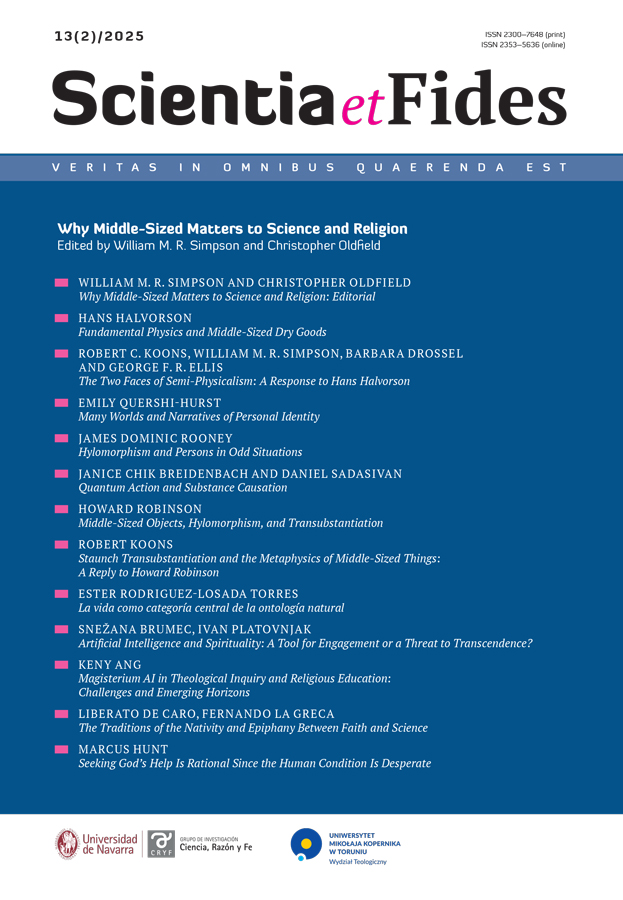
Fundamental Physics and Middle-Sized Dry Goods
DOI:
https://doi.org/10.12775/SetF.2025.015Słowa kluczowe
reductionism, physicalism, emergence, microphysics, quantum mechanicsAbstrakt
I consider the debate between those who believe in microphysical reductionism, and those who believe in the irreducibility of macroscopic objects. I consider, in particular, recent arguments that physics itself refutes the hypothesis of reductionism – from, among others, George Ellis and Barbara Drossel. I raise some questions about the effectiveness of these arguments, and I suggest that this debate is based on an unclear, but emotionally fraught, understanding of what “reduction” means.
Bibliografia
Atherton, Margaret. 2022. “Berkeley and Newton.” In The Oxford Hand-book of Berkeley, edited by Samuel C. Rickless, 237–55. Oxford: Oxford University Press. DOI: https://doi.org/10.1093/oxfordhb/9780190873417.013.16.
Austin, John Langshaw. 1962. Sense and Sensibilia. Oxford: Clarendon Press Oxford.
Bealer, George. 1978. “An inconsistency in functionalism.” Synthese 38 (3): 333–72.
Chalmers, David J., and Kelvin J. McQueen. 2022. “Consciousness and the collapse of the wavefunction.” In Consciousness and Quantum Mechanics, edited by Shan Gao, 11–63. Oxford: Oxford University Press.
Drossel, Barbara, and George Ellis. 2018. “Contextual wavefunction collapse: an integrated theory of quantum measurement.” New Journal of Physics 20 (11): 113025.
Drossel, Barbara. 2017. “Ten reasons why a thermalized system cannot be described by a many-particle wave function.” Studies in History and Philosophy of Modern Physics 58: 12–21.
Fine, Kit. 2005. “Tense and reality.” In Modality and Tense: Philosophical Papers, 261–320. Oxford: Oxford University Press. DOI: https://doi.org/10.1093/0199278709.003.0009.
Garber, Daniel. 1992. Descartes’ Metaphysical Physics. Chicago: University of Chicago Press.
Glick, David. 2021. “QBism and the limits of scientific realism.” European Journal for Philosophy of Science 11 (2): 53. Halvorson, Hans. 2011. “The measure of all things: Quantum mechanics and the soul.” In: The soul hypothesis: Investigations into the existence of the soul, edited by Mark C. Baker, Stewart Goetz, 138–63. New York: Continuum Press.
Hill, Benjamin, Henrik Lagerlund, and Stathis Psillos. 2021. Reconsidering Causal Powers: Historical and Conceptual Perspectives. Oxford: Oxford University Press. Koons, Robert. 2014. “Staunch vs. faint-hearted hylomorphism: Toward an Aristotelian account of composition.” Res Philosophica 91 (2): 151–77.
Koons, Robert. 2024. “Contextual emergence, traveling forms, and cosmic substances: Evaluating the options for quantum hylomorphism.” Unpublished manuscript. McDonough, Jeffrey K. 2009. “Leibniz on natural teleology and the laws of optics.” Philosophy and Phenomenological Research 78 (3): 505–44.
Pruss, Alexander R (2018). “A traveling forms interpretation of quantum mechanics.” In Neo-Aristotelian Perspectives on Contemporary Science edited by William Simpson, Robert Koons, and Nicholas Teh, 105–122. London: Routledge.
Simpson, William M. R. 2021. “Cosmic hylomorphism: A powerist ontology of quantum mechanics.” European Journal for Philosophy of Science 11 (1): 1–25.
Simpson, William M. R. 2022. “From quantum physics to classical metaphysics.” In Neo-Aristotelian Metaphysics and the Theology of Nature, edited by William Simpson, Koons Robert, & James Orr, 21–65. New York: Taylor & Francis.
Simpson, William M. R. 2023. Hylomorphism. Cambridge: Cambridge University Press.
Solomon, Monica. 2022. “Berkeley and Newton.” The Oxford Hand-book of Berkeley, edited by Samuel C. Rickless, 482–502. Oxford: Oxford University Press. DOI: https://doi.org/10.1093/oxfordhb/9780190873417.013.27.
Wallace, David. 2012. The emergent multiverse: Quantum theory according to the Everett interpretation. Oxford: Oxford University Press.
Williams, Neil E. 2019. The Powers Metaphysic. Oxford: Oxford University Press.
Pobrania
Opublikowane
Jak cytować
Numer
Dział
Licencja
Prawa autorskie (c) 2025 Hans Halvorson

Utwór dostępny jest na licencji Creative Commons Uznanie autorstwa – Bez utworów zależnych 4.0 Międzynarodowe.
CC BY ND 4.0. Posiadaczem prawa autorskiego (Licencjodawcą) jest Autor, który na mocy umowy licencyjnej udziela nieodpłatnie prawa do eksploatacji dzieła na polach wskazanych w umowie.
- Licencjodawca udziela Licencjobiorcy licencji niewyłącznej na korzystanie z Utworu/przedmiotu prawa pokrewnego w następujących polach eksploatacji: a) utrwalanie Utworu/przedmiotu prawa pokrewnego; b) reprodukowanie (zwielokrotnienie) Utworu/przedmiotu prawa pokrewnego drukiem i techniką cyfrową (e-book, audiobook); c) wprowadzania do obrotu egzemplarzy zwielokrotnionego Utworu/przedmiotu prawa pokrewnego; d) wprowadzenie Utworu/przedmiotu prawa pokrewnego do pamięci komputera; e) rozpowszechnianie utworu w wersji elektronicznej w formule open access na licencji Creative Commons (CC BY-ND 3.0) poprzez platformę cyfrową Wydawnictwa Naukowego UMK oraz repozytorium UMK.
- Korzystanie przez Licencjobiorcę z utrwalonego Utworu ww. polach nie jest ograniczone czasowo ilościowo i terytorialnie.
- Licencjodawca udziela Licencjobiorcy licencji do Utworu/przedmiotu prawa pokrewnego nieodpłatnie na czas nieokreślony
PEŁEN TEKST UMOWY LICENCYJNEJ >>
Statystyki
Liczba wyświetleń i pobrań: 546
Liczba cytowań: 0


