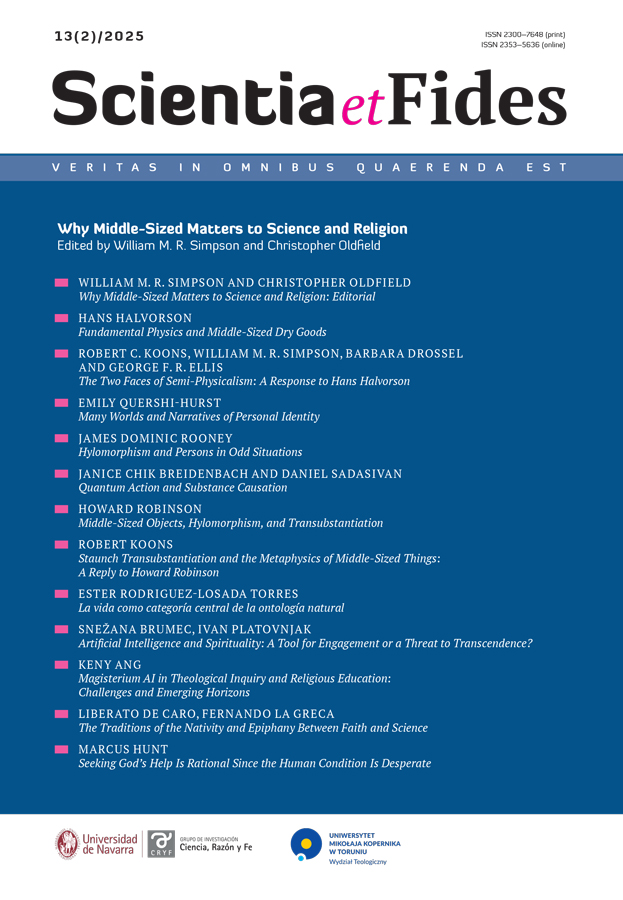
Quantum Action and Substance Causation
DOI:
https://doi.org/10.12775/SetF.2025.019Słowa kluczowe
naturalism, explanation, powers, hylomorphism, Aquinas, Aristotle, wave functionAbstrakt
Aristotelian-Thomistic metaphysics defends a hylomorphic account of substance causation. Recent arguments have developed approaches informed by quantum mechanics (Koons 2021 and 2022, Simpson 2021 and 2023, Pruss 2018). While these arguments have responded to Jaegwon Kim’s critiques concerning overdetermination and causal closure, the ontological status of substantial form, especially as it applies to the category of “thermal substances,” remains an open question. In particular, do the forms of thermal substances (1) qualify as natural kinds, meeting a moderate requirement for naturalistic explanation, and (2) do they actualize the kinds of causal powers needed for substance causation in a way that avoids the event causalist’s critique of explanatory vacuity? This paper defends substance causation on both counts, by relying on a robust reading of Aquinas’s original account of substance causation and its distinction between corporeal and virtual contact. Far from problematizing these recent accounts, a robust Thomistic account in fact vindicates recent contemporary hylomorphic approaches, and even resolves some of the gaps that remain in a sound Aristotelian-Thomistic response to standard critiques concerning substance causation’s naturalistic status and explanatory power.
Bibliografia
Aguilar, Jesús, and Buckareff, Andrei. 2010. “The Causal Theory of Action: Origins and Issues.” In Causing Human Actions: New Perspectives on the Causal Theory of Action, edited by Jesús Aguilar and Andrei Buckareff, 1–26. Cambridge, MA: Massachusetts Institute of Technology Press.
Aquinas, Thomas. 1920. Summa Theologiae. Translated by the Fathers of the English Dominican Province. https://www.newadvent.org/summa/1.htm.
Aquinas, Thomas. 1961. Summa Contra Gentiles. Translated by Laurence Shapcote. https://aquinas.cc/la/en/~SCG2.
Aquinas, Thomas. 1963–1964. De Caelo. Translated by Fabian R. Larcher and Pierre H. Conway. https://isidore.co/aquinas/english/DeCoelo.htm.
Aquinas, Thomas. 1995. De Mixtione Elementorum. Translated by Peter Orlowski, ed. Joseph Kenny. https://isidore.co/aquinas/MixtioElementorum.htm.
Aristotle. 1933. Metaphysics. Translated by Hugh Tredennick. Loeb Classical Library 271. Cambridge, MA: Harvard University Press.
Aristotle. 1931. On the Soul (De Anima). Translated by John A. Smith. Loeb Classical Library 237. Cambridge, MA: Harvard University Press.
Aristotle. 1931. Sense and Sensibilia (De Sensu et Sensibilibus). Translated by William D. Ross. Loeb Classical Library 323. Cambridge, MA: Harvard University Press.
Barzegar, Ali, and Daniele Oriti. 2024. “Epistemic–Pragmatist Interpretations of Quantum Mechanics: A Comparative Assessment.” Foundations of Physics 54 (5): 1–34.
Bishop, John. 2010. “Skepticism About Natural Agency and the Causal Theory of Action.” In Causing Human Actions: New Perspectives on the Causal Theory of Action, edited by Jesús Aguilar, and Andrei Buckareff, 69–83. Cambridge, MA: Massachusetts Institute of Technology Press.
Braine, David. 1992. The Human Person: Animal and Spirit. Notre Dame: University of Notre Dame Press.
Breidenbach, Janice. 2025. “Hylomorphism and Synchronic Dependency.” Res Philosophica 102 (1): 19–39.
Breidenbach, Janice. 2018. “Action, Animacy, and Substance Causation.” In Neo-Aristotelian Perspectives on Contemporary Science, edited by William M. R. Simpson, Robert C. Koons, and Nicholas J. Teh, 235–260. New York: Routledge.
Davidson, Donald. 2001. Essays on Actions and Events. Oxford: Oxford University Press.
De Barros, J. Acacio and Gary Oas. 2017. “Can We Falsify the Consciousness-Causes-Collapse Hypothesis in Quantum Mechanics?” Foundations of Physics 47 (10): 1294–1308. DOI: https://doi.org/10.1007/s10701-017-0110-7.
De Grazia, Margreta. 2010/2015. “Anachronism.” In Cultural Reformations: Medieval and Renaissance in Literary History, edited by Brian Cummings, and James Simpson, 12–32. Oxford: Oxford University Press. DOI: https://doi.org/10.1093/oxfordhb/9780199212484.013.0002.
Drossel, Barbara and George Ellis. 2018. “Contextual Wavefunction Collapse: an integrated theory of quantum measurement.” New Journal of Physics 20. https://iopscience.iop.org/article/10.1088/1367-2630/aaecec
Feynman, Richard. 1963/2011. Six Easy Pieces. New York: Basic Books.
Hornsby, Jennifer. 2011. “Actions in Their Circumstances.” In Essays on Anscombe’s Intention, edited by Anton Ford, Jennifer Hornsby, and Frederick Stoutland, 105–127. Cambridge, MA: Harvard University Press.
Kim, Jaegwon. 1997. “Mechanism, Purpose, and Explanatory Exclusion.” In The Philosophy of Action, edited by Alfred Mele, 77–108. New York: Oxford University Press.
Kim, Jaegwon. 1998. Mind in a Physical World. Cambridge: MIT Press.
Kim, Jaegwon. 1989. “The Myth of Nonreductive Materialism.” In Kim 1993d. First published in Proceedings of the American Philosophical Association 63 (3): 31–47.
Koons, Robert. 2021. “Thermal substances: a Neo-Aristotelian ontology of the quantum world.” Synthese 198 (Suppl 11): 2751–2772.
Koons, Robert. 2022. Is St. Thomas’s Aristotelian Philosophy of Nature Obsolete? South Bend: St. Augustine’s Press.
Koons, Robert. 2014. “Staunch vs. Faint-Hearted Hylomorphism: Toward an Aristotelian Account of Composition.” Res Philosophica 91 (2): 151–177.
Lavin, Douglas. 2012. “Must There Be Basic Action?” Noûs Vol. 00, No. 0: 1–32.
Leggett, Anthony J. 2005. “The Quantum Measurement Problem.” Science 307 (5711): 871–872. DOI: https://doi.org/10.1126/science.1109541.
Ney, Alyssa. 2013. “Introduction.” In The Wave Function: Essays on the Metaphysics of Quantum Mechanics, edited by Alyssa Ney and David Albert, 1–50. New York: Oxford University Press.
Pruss, Alexander. 2018. “A Traveling Forms Interpretation of Quantum Mechanics.” In Neo-Aristotelian Perspectives on Contemporary Science, edited by William M. R. Simpson, Robert C. Koons, and Nicholas J. Teh, 105–122. New York: Routledge.
Sarkar, Sahotra. 1992. “Models of Reduction and Categories of Reductionism.” Synthese 91: 167–194.
Schaffer, Jonathan. 2010. “Monism: The priority of the whole.” Philosophical Review 119 (1): 31–76.
Simpson, William M. R. 2021. “From Quantum Physics to Classical Metaphysics.” In Neo-Aristotelian Metaphysics and the Theology of Nature, edited by William Simpson, Robert Koons, James Orr, 21–65. New York: Routledge.
Simpson, William M. R. 2023. Hylomorphism. Cambridge: Cambridge University Press.
Smart, John. 1963. “Materialism.” Journal of Philosophy 60: 651–662.
Smith, Michael. 1987. “The Humean Theory of Motivation.” Mind 96 (381): 36–61.
Steward, Helen. 2012. A Metaphysics for Freedom. New York: Oxford University Press.
Tahko, Tuomas. 2018. “Disentangling Nature’s Joints.” In Neo-Aristotelian Perspectives on Contemporary Science, edited by William M. R. Simpson, Robert C. Koons, and Nicholas J. Teh, 147–166. New York: Routledge.
Velleman, David. 1992. “What Happens When Someone Acts?” Mind 101 (403): 461–481.
Weinberg, Stephen. 1998. “The Great Reduction: Physics in the Twentieth Century.” In The Oxford History of the Twentieth Century, edited by Michael Howard, and Wm. Roger Louis. 22–34. Oxford: Oxford University Press.
Pobrania
Opublikowane
Jak cytować
Numer
Dział
Licencja
Prawa autorskie (c) 2025 Janice Chik, Daniel Sadasivan

Utwór dostępny jest na licencji Creative Commons Uznanie autorstwa – Bez utworów zależnych 4.0 Międzynarodowe.
CC BY ND 4.0. Posiadaczem prawa autorskiego (Licencjodawcą) jest Autor, który na mocy umowy licencyjnej udziela nieodpłatnie prawa do eksploatacji dzieła na polach wskazanych w umowie.
- Licencjodawca udziela Licencjobiorcy licencji niewyłącznej na korzystanie z Utworu/przedmiotu prawa pokrewnego w następujących polach eksploatacji: a) utrwalanie Utworu/przedmiotu prawa pokrewnego; b) reprodukowanie (zwielokrotnienie) Utworu/przedmiotu prawa pokrewnego drukiem i techniką cyfrową (e-book, audiobook); c) wprowadzania do obrotu egzemplarzy zwielokrotnionego Utworu/przedmiotu prawa pokrewnego; d) wprowadzenie Utworu/przedmiotu prawa pokrewnego do pamięci komputera; e) rozpowszechnianie utworu w wersji elektronicznej w formule open access na licencji Creative Commons (CC BY-ND 3.0) poprzez platformę cyfrową Wydawnictwa Naukowego UMK oraz repozytorium UMK.
- Korzystanie przez Licencjobiorcę z utrwalonego Utworu ww. polach nie jest ograniczone czasowo ilościowo i terytorialnie.
- Licencjodawca udziela Licencjobiorcy licencji do Utworu/przedmiotu prawa pokrewnego nieodpłatnie na czas nieokreślony
PEŁEN TEKST UMOWY LICENCYJNEJ >>
Statystyki
Liczba wyświetleń i pobrań: 569
Liczba cytowań: 0


