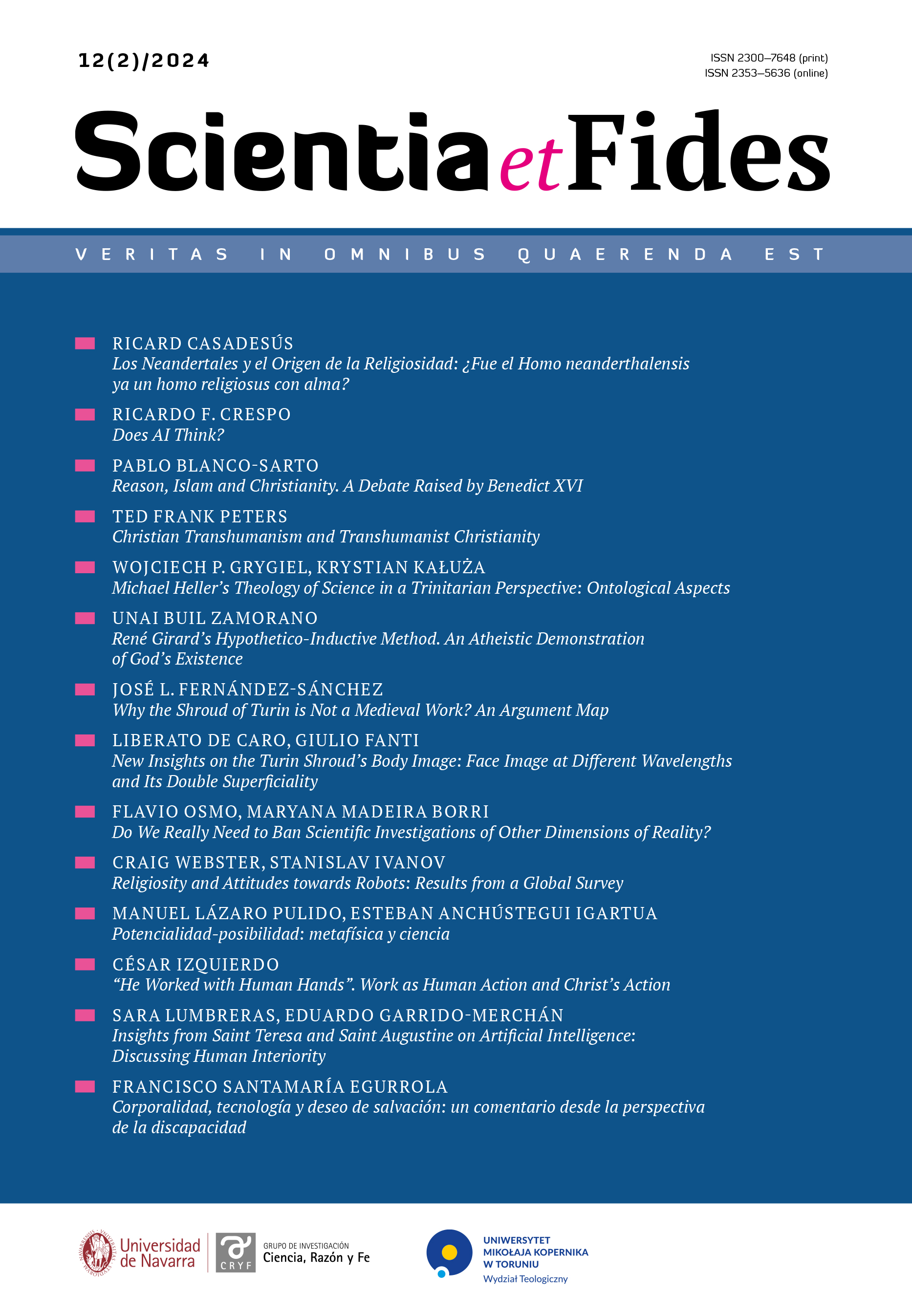
Insights from Saint Teresa and Saint Augustine on Artificial Intelligence: Discussing Human Interiority
DOI:
https://doi.org/10.12775/SetF.2024.025Słowa kluczowe
Artificial Intelligence, Augustine, Saint Teresa, interiorityAbstrakt
This article addresses the issue of attributing phenomenal consciousness to Artificial Intelligence (AI), a mistake that can lead to ethically dangerous consequences and that is becoming widespread due to the advances of Large Language Models such as ChatGPT. We juxtapose advancements in AI with the notion of inner experience as it is present in humans. The study draws from various disciplines, including philosophy of mind, artificial intelligence, and theological texts such as "The Inner Castle" by Saint Theresa of Ávila and "Confessions" by Saint Augustine. Firstly, it reviews the current state of the relationship between phenomenal consciousness and AI, followed by a critique of the idea that advanced language models, like ChatGPT, can achieve an inner experience in the same sense we use the term to describe the human inner experience. A common objection is raised, suggesting that AI can become conscious by increasing its complexity. This is countered by presenting theoretical and empirical evidence on the independence of computational intelligence and phenomenal consciousness. The study concludes that, despite AI's notable cognitive abilities, it lacks the inner experience that characterizes human experience. Then, our second main contribution is an analogy of the dwellings of the Inner Castle to the range of different subjective experiences that are available to human beings, together with actions associated to them, which can be useful to understand where the machine can perform tasks that are similar to the human and where subjective experience is key. We are now in a pivotal moment where it is essential to understand the limitations of AI for deploying it ethically.
Bibliografia
Angel, Hans-Ferdinand., and Rüdiger J. Seitz. 2016. “Process of believing as fundamental brain function: The concept of credition.” SFU Forschungs Bulletin 4(1) September: 1–20.
BBC. 2022. Blake Lemoine: Google fires the engineer who claimed that an artificial intelligence program gained its own consciousness. https://www.bbc.com/mundo/noticias-62280846
Beauregard, Mario, and Denyse O’Leary. 2007. The spiritual brain: A neuroscientist’s case for the existence of the soul. HarperOne/HarperCollins.
Bergson, Henri. 2014. Time and free will: An essay on the immediate data of consciousness. Routledge.
Chalmers, David. 2015. “Panpsychism and panprotopsychism. Consciousness in the physical world: Perspectives on Russellian monism.” 246–76.
Dehaene, Stanislas. 2014. Consciousness and the brain: Deciphering how the brain codes our thoughts. Penguin.
Dennett, Daniel C. 1993. Consciousness explained. penguin uk.
Gamez, David. 2018. Human and machine consciousness. Open Book Publishers.
Garrido Merchán, Eduardo C., and Sara Lumbreras. 2022. “On the independence between phenomenal consciousness and computational intelligence.” arXive-prints, arXiv-2208.
Garrido-Merchán, Eduardo C., and Carlos Blanco. 2022. “Do Artificial Intelligence Systems Understand?” arXiv preprint arXiv:2207.11089.
Garrido-Merchán, Eduardo C., José Luis Arroyo-Barrigüete, and Roberto Gozalo-Brihuela. 2023. Simulating HP. “Lovecraft horror literature with the ChatGPT large language model.” arXiv preprint arXiv:2305.03429.
Gozalo-Brizuela, Roberto, and Eduardo C. Garrido-Merchán. 2023. “A survey of Generative AI Applications.” arXiv preprint arXiv:2306.02781.
Harnad, Stevan. 1990. “The symbol grounding problem.” Physica D: Nonlinear Phenomena 42(1–3): 335–46. DOI: http://dx.doi.org/10.1016/0167-2789(90)90087-6.
Husserl, Edmund. 1989. Ideas pertaining to a pure phenomenology and to a phenomenological philosophy: Second book studies in the phenomenology of constitution (Vol. 3). Springer Science & Business Media.
Jackson, Frank. 1998. “Epiphenomenal qualia.” In Consciousness and emotion in cognitive science, by Frank Jackson, 197–206. Routledge.
Joseph, Rhawn. 2003. NeuroTheology: Brain, science, spirituality, religious experience. California: Univeristy Press California.
Kounios, John, and Mark Beeman. 2009. “The Aha! moment: The cognitive neuroscience of insight.” Current Directions in Psychological Science 18(4): 210–16.
Levine, Joseph. 1983. “Materialism and qualia: The explanatory gap.” Pacific Philosophical Quarterly 64(4): 354–61.
Lin, Tianyang, Yuxin Wang, Xiangyang Liu, and Xipeng Qiu. 2022. A survey of transformers. AIOpen.
Low, Philip, Jaak Panksepp, Diana Reiss, David Edelman, Bruno Van Swinderen, and Christof Koch. 2012. “July. The Cambridge declaration on consciousness.” In Francis crick memorial conference. Cambridge, England (pp. 1–2).
Maslow, Abraham H. 1969. “Various meanings of transcendence.” Journal of Transpersonal Psychology 1(1): 56–66.
McNamara, Patric. 2009. The neuroscience of religious experience. Cambridge: Cambridge University Press.
Mercer, Christa. 2017. “Descartes’ debt to Teresa of Ávila, or why we should work on women in the history of philosophy.” Philosophical Studies 174(10): 2539–55.
Merleau-Ponty, Maurice, Donald Landes (Translator), Taylor Carman (Foreword), and C. Lefort. 2013. Phenomenology of perception. Routledge.
Nagel, Thomas. 1980. “What is it like to be a bat?” In The language and thought series, 159–168. Harvard University Press.
Newen, Albert, Leon De Bruin, and Shaun Gallagher, eds. 2018. The Oxford handbook of 4E cognition. Oxford: Oxford University Press.
Newton, Philip M., and Maira Xiromeriti. 2023. “ChatGPT performance on MCQ exams in higher education. A pragmatic scoping review.” https://osf.io/preprints/edarxiv/sytu3 (Access date: 10.09.2024).
Penrose, Roger, and N. D. Mermin. 1990. The Emperor’s New Mind: Concerning Computers, Minds, and the Laws of Physics. Oxford Paperbacks.
Russo, Maria Teresa. 2018. “The mystical experience from phenomenology: Edith Stein and the Interior Castle of Teresa of Ávila.” Steiniana: Journal of Interdisciplinary Studies 2(1): 60–80.
Searle, John R. 2000. “Consciouness.” Intellectica 31(2): 85–110.
Searle, John. 2009. Chinese room argument. Scholarpedia 4(8): 3100.
Teresa, Santa. 1976. “Castillo interior o Las Moradas.” [1577]. México. Aguilar, Colección Crisol Literario, (38).
Tononi, Giulio, Melanie Boly, Marcello Massimini, and Christof Koch. 2016. „Integrated information theory: from consciousness to its physical substrate.” Nature Reviews Neuroscience 17(7): 450–61.
Varela, Francisco J. 1996. “Neurophenomenology: A methodological remedy for the hard problem.” Journal of consciousness studies 3(4): 330–49.
Villalba, Francisco Dokushô. 1987. What is the Zen?. Madrid: Miraguano Editiones.
Pobrania
Opublikowane
Jak cytować
Numer
Dział
Licencja
Prawa autorskie (c) 2024 Sara Lumbreras, Eduardo Garrido-Merchán

Utwór dostępny jest na licencji Creative Commons Uznanie autorstwa – Bez utworów zależnych 4.0 Międzynarodowe.
CC BY ND 4.0. Posiadaczem prawa autorskiego (Licencjodawcą) jest Autor, który na mocy umowy licencyjnej udziela nieodpłatnie prawa do eksploatacji dzieła na polach wskazanych w umowie.
- Licencjodawca udziela Licencjobiorcy licencji niewyłącznej na korzystanie z Utworu/przedmiotu prawa pokrewnego w następujących polach eksploatacji: a) utrwalanie Utworu/przedmiotu prawa pokrewnego; b) reprodukowanie (zwielokrotnienie) Utworu/przedmiotu prawa pokrewnego drukiem i techniką cyfrową (e-book, audiobook); c) wprowadzania do obrotu egzemplarzy zwielokrotnionego Utworu/przedmiotu prawa pokrewnego; d) wprowadzenie Utworu/przedmiotu prawa pokrewnego do pamięci komputera; e) rozpowszechnianie utworu w wersji elektronicznej w formule open access na licencji Creative Commons (CC BY-ND 3.0) poprzez platformę cyfrową Wydawnictwa Naukowego UMK oraz repozytorium UMK.
- Korzystanie przez Licencjobiorcę z utrwalonego Utworu ww. polach nie jest ograniczone czasowo ilościowo i terytorialnie.
- Licencjodawca udziela Licencjobiorcy licencji do Utworu/przedmiotu prawa pokrewnego nieodpłatnie na czas nieokreślony
PEŁEN TEKST UMOWY LICENCYJNEJ >>
Statystyki
Liczba wyświetleń i pobrań: 1485
Liczba cytowań: 0


