Personal Experience of Suffering
Reflections Inspired by Elements of Karol Wojtyła’s Philosophical Anthropology
DOI:
https://doi.org/10.12775/SetF.2024.001Parole chiave
pain, human experience, fulfilment, personal transcendence, freedomAbstract
Using elements of K. Wojtyła’s philosophical anthropology, I make an attempt to look at the phenomenon of suffering through the experience of the suffering subject, through the uniquely personal experience of ‘I am suffering.’ The personal experience of suffering involves the inclusion of the phenomena of pain and suffering within the domain of self-consciousness, i.e. within the field of experiencing oneself, the sense of one's own identity, including the striving for fulfilment. In this perspective, the experience of suffering has to do with the person-specific openness to transcendence, which makes it possible to show the positive side to the experience of suffering. Both in the field of self-consciousness and in the personal experience of self-determination, the experience of ‘I am suffering’ can serve the person in the realisation of personal truth (about the good), involving and stimulating actions towards fulfilment.
Riferimenti bibliografici
Bain, David, Michael Brady, and Jennifer Corns, eds. 2019. Philosophy of Suffering: Metaphysics, Value, and Normativity. London: Routledge. https://doi.org/10.4324/9781351115469.
Bakan, David. 1968. Disease, pain, and sacrifice: Toward a psychology of suffering. Chicago: University of Chicago Press.
Buttiglione, Rocco. 1997. Karol Wojtyła. The Thought of the Man Who Became Pope John Paul II. Grand Rapids, MI: Eerdmans.
Cassell, Eric. 2004. “The Nature and Psychology of Suffering.” In Handbook of primary care psychology, edited by Leonard J. Haas, 131–43. Oxford: Oxford University Press.
Frankl, Victor E. 1966. “Self-transcendence as a human phenomenon.” Journal of Humanistic Psychology 6: 97–107.
Frankl, Victor E. 1959. Man’s search for meaning: An introduction to logotherapy. Boston: Beacon.
Frankl, Victor E. 2010. Logotherapie und Existenzanalyse. Texte aus sechs Jahrzehnten. Weinheim: Beltz.
Garrison, Andrew. 2001. “Restoring the Human in Humanistic Psychology.” Journal of Humanistic Psychology 41(4): 91–104. https://doi.org/10.1177/0022167801414006.
Gilbert, Paul. 2016. Human Nature and Suffering. London and New York: Routledge. https://doi.org/10.4324/9781315564258.
Hall, M. Elizabeth Lewis, Richard Langer, and Jason Mcmartin. 2010. “The Role of Suffering in Human Flourishing: Contributions from Positive Psychology, Theology, and Philosophy.” Journal of Psychology and Theology 38(2): 111–21. https://doi.org/10.1177/009164711003800204.
Linden, Michael. 2020. “Euthymic suffering and wisdom psychology.” World Psychiatry Feb 19(1): 55–56. https://doi.org/10.1002/wps.20718.
Linley, P. Alex, and Stephen Joseph. 2004. “Positive change following trauma and adversity: A review.” Journal of traumatic stress: official publication of the international society for traumatic stress studies 17.1: 11–21.
Lomranz, Jacob, and David I. Mostofsky. 1997. “The Psychology of Pain and Suffering.” In Handbook of Pain and Aging. The Springer Series in Adult Development and Aging, edited by David I. Mostofsky, and Jacob Lomranz, 3-18. Boston, MA: Springer. https://doi.org/10.1007/978-1-4899-0283-2_1.
Makselon, Józef. 1998. “The psychology of suffering.” Folia Medica Cracoviensia 39(3–4): 59–66.
Peterson, Christopher. 2006. A primer in positive psychology. Oxford: Oxford University Press.
Savage, Deborah. 2013. “The Centrality of Lived Experience in Wojtyła’s account of the Person.” Roczniki Filozoficzne 59/4: 19–51.
Schnitker, Sarah A., Benjamin Houltberg, William Dyrness, and Nanyamka Redmond. 2017. “The virtue of patience, spirituality, and suffering: Integrating lessons from positive psychology, psychology of religion, and Christian theology.” Psychology of Religion and Spirituality 9(3): 264–75. https://doi.org/10.1037/rel0000099.
Smith, Janet E. 2005. “The Human Person as the Subject of Suffering: The Values of Having, Doing, vs. the Values of Being.” Accessed June 27, 2023. https://www.stthom.edu/Public/getFile.asp?File_Content_ID=47.
Spaemann, Robert. 2006. Persons: the difference between “someone” and “something”. Translated by Oliver O'Donovan. New York: Oxford University Press.
Spaemann, Robert. 2007. Das unsterbliche Gerücht: die Frage nach Gott und die Täuschung der Moderne. Stuttgart: Klett-Cotta.
Waterworth, Jayne M. 2004. A Philosophical Analysis of Hope. Basingstoke: Palgrave Macmillan.
Wojtyła, Karol. 1979 (1). “The Transcendence of the Person in Action and Man’s Self-Teleology.” Analecta Husserliana 9: 203–12.
Wojtyła, Karol. 1979 (2). “The Person: Subject and Community.” The Review of Metaphysics 33/2: 273–308.
Wojtyła, Karol. 2020. The Lublin Lectures / Wykłady lubelskie. Translated by Hugh McDonald. Lublin and Roma: Katolicki Uniwersytet Lubelski Jana Pawła II – Società Internazionale Tommaso d’Aquino.
Wojtyła, Karol. 2021. Person and Act and related essays. Translated by Grzegorz Ignatik. Washington: The Catholic University of America Press.
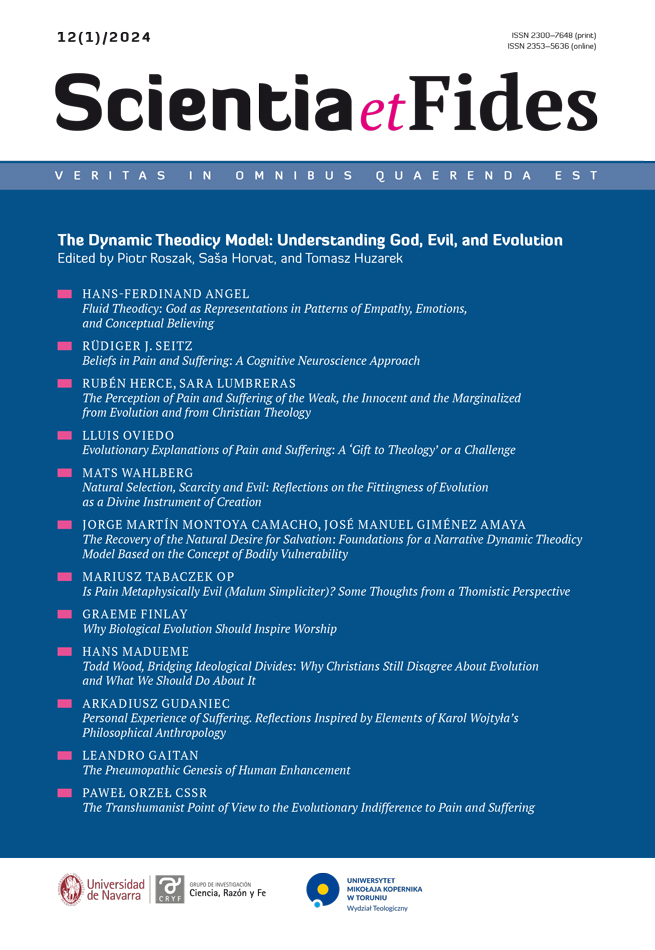
Downloads
Pubblicato
Come citare
Fascicolo
Sezione
Licenza
Copyright (c) 2023 Arkadiusz Gudaniec

Questo lavoro è fornito con la licenza Creative Commons Attribuzione - Non opere derivate 4.0 Internazionale.
CC BY ND 4.0. The Creator/Contributor is the Licensor, who grants the Licensee a non-exclusive license to use the Work on the fields indicated in the License Agreement.
- The Licensor grants the Licensee a non-exclusive license to use the Work/related rights item specified in § 1 within the following fields: a) recording of Work/related rights item; b) reproduction (multiplication) of Work/related rights item in print and digital technology (e-book, audiobook); c) placing the copies of the multiplied Work/related rights item on the market; d) entering the Work/related rights item to computer memory; e) distribution of the work in electronic version in the open access form on the basis of Creative Commons license (CC BY-ND 3.0) via the digital platform of the Nicolaus Copernicus University Press and file repository of the Nicolaus Copernicus University.
- Usage of the recorded Work by the Licensee within the above fields is not restricted by time, numbers or territory.
- The Licensor grants the license for the Work/related rights item to the Licensee free of charge and for an unspecified period of time.
FULL TEXT License Agreement
Stats
Number of views and downloads: 860
Number of citations: 0


