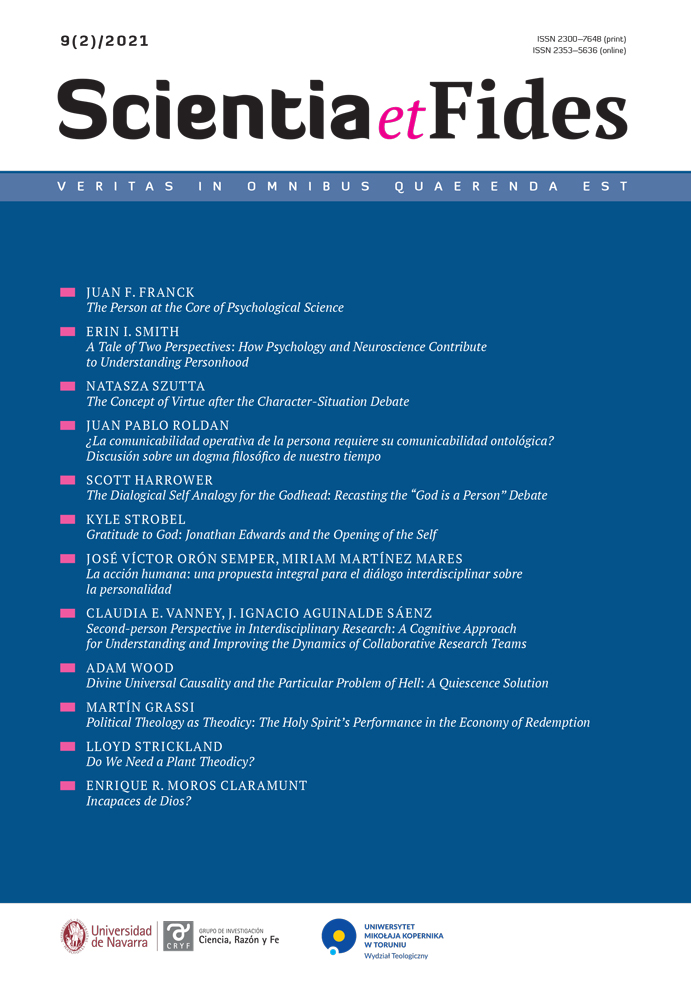
Gratitude to God: Jonathan Edwards and the Opening of the Self
DOI:
https://doi.org/10.12775/SetF.2021.021Słowa kluczowe
Anthropology, Supernatural Virtue, Infused Virtue, Self-RelationAbstrakt
Abstract: The study of gratitude has become an increasingly important topic among psychologists to address the nature of human flourishing. Of more recent interest is how gratitude to God specifically functions within an account of human flourishing, with theologians seeking to provide a distinctively Christian account of the nature of gratitude. This article enters into the ongoing conversation by attending to Jonathan Edwards’s (1703-1758) theological anthropology and development of natural and supernatural gratitude. In particular, Edwards’s anthropology includes within it an account of how the self can, and should, enlarge to receive another in love. This “enlargement” is the creaturely mirror of God’s self-giving and is the supernatural response to the creature who has received God’s grace and been infused with divine love. As a supernatural response based on God’s action in the soul, this account of gratitude differs from its natural counterpart. On Edwards’s account, therefore, there is a need to develop studies that differentiate natural and supernatural gratitude. Furthermore, this article ends with a suggestion for a study that could pick up this task based on recent psychological studies that attend to how gratitude affects self-relation. On Edwards’s account of the enlargement of the self, as well as his notion of supernatural gratitude, there is meaningful research to be done on how these can help assess development in the formation of gratitude and human flourishing.
Bibliografia
Balswick, Jack O., Palema Ebstyne King and Kevin S. Reimer. 2016. The Reciprocating Self: Human Development in Theological Perspective. 2nd Edition. Downers Grove, IL: InterVarsity Press.
Coe. John H., and Todd W. Hall. 2010. Psychological in the Spirit: Contours of a Transformational Psychology. Christian Worldview Integration Series. Downers Grove, IL: InterVarsity Press.
Dunnington, Kent. 2019. Humility, Pride, and Christian Virtue Theory. Oxford Studies in Analytic Theology. Oxford: Oxford University Press.
Eastman, Susan Grove. 2017. Paul and the Person: Reframing Paul’s Anthropology. Grand Rapids, MI: Eerdmans.
Edwards, Jonathan. 1743. Sermon 39. Ps. 147:1 (edited), in Sermons, Series II, 1723-1727 accessed October 7, 2020:
Edwards, Jonathan. 1959. Religious Affections. Edited by John E. Smith. The Works of Jonathan Edwards. Vol. 2. New Haven: Yale University Press.
Edwards, Jonathan. 1989. Ethical Writings. Edited by Paul Ramsey. The Works of Jonathan Edwards. Vol. 8. New Haven: Yale University Press.
Edwards, Jonathan. 1992. Sermons and Discourses, 1720-1723. Edited by Wilson H. Kimnach. The Works of Jonathan Edwards. Vol. 10. New Haven: Yale University Press.
Edwards, Jonathan. 1994. The “Miscellanies”: A-500. Edited by Thomas A. Schafer. The Works of Jonathan Edwards. Vol. 13. New Haven: Yale University Press.
Edwards, Jonathan. 2000. The “Miscellanies”: Entry Nos. 501-832. Edited by Ava Chamberlain. The Works of Jonathan Edwards. Vol. 18. New Haven: Yale University Press.
Edwards, Jonathan. 2001. Sermons and Discourses, 1734-1738. Edited by M. X. Lesser. The Works of Jonathan Edwards. Vol. 19. New Haven: Yale University Press, 2001.
Edwards, Jonathan. 2003. Writings on the Trinity, Grace, and Faith. Edited by Sang Hyun Lee. The Works of Jonathan Edwards. Vol. 21, New Haven: Yale University Press.
Edwards, Jonathan. 2006. Sermons and Discourses, 1743-1758. Edited by Wilson H. Kimnach. The Works of Jonathan Edwards. Vol. 25. New Haven: Yale University Press.
Emmons, Robert A. 2004. “The Psychology of Gratitude: An Introduction.” In The Psychology of Gratitude, edited by Robert A. Emmons and Michael E. McCullough. Oxford: Oxford University Press.
Engberg-Pedersen, Troels. 2008. “Philosophy of the Self in the Apostle Paul.” In Ancient Philosophy of the Self, edited by Pauliina Remes and Juha Sihvola. New York: Springer.
Engberg-Pedersen, Troels. 2010. “From the Self to the Shared.” In Cosmology and Self in the Apostle Paul: The Material Spirit. Oxford: Oxford University Press.
Greggs, Tom. 2017. “In Gratitude for Grace: Praise, Worship and the Sanctified Life,” Scottish Journal of Theology 70:147-48.
Jenson, Matt. 2007. The Gravity of Sin: Augustine, Luther and Barth on 'homo incurvatus in se'. London, T&T Clark.
Kierkegaard, Søren. 1980. The Sickness Unto Death: A Christian Psychological Exposition For Upbuilding and Awakening, edited and translated by Howard V. Hong and Edna H. Hong. Princeton: Princeton University Press.
Leithart, Peter. 2014. Gratitude: An Intellectual History. Waco, TX: Baylor University Press.
Martin, Ryan. 2019. Understanding Affections in the Theology of Jonathan Edwards: “The High Exercises of Divine Love”. London: Bloomsbury.
McFadyen, Alistair I. 1990. The Call to Personhood: A Christian Theory of the Individual in Social Relationships. Cambridge: Cambridge University Press.
Petrocchi, Nichola and Alessandro Couyoumdjian. 2016. “The Impact of Gratitude on Depression and Anxiety: The Mediating Role of Criticizing, Attacking, and Reassuring the Self.” Self and Identity 15:193-194.
Strobel, Kyle C. 2013. Jonathan Edwards’s Theology: A Reinterpretation. T&T Clark.
Strobel, Kyle C. 2017. “Being Seen and Being Known: Jonathan Edwards’s Theological Anthropology.” In The Global Edwards, edited by Rhys Bezzant. Eugene: Wipf & Stock.
Strobel, Kyle C. Forthcoming. “Humanity.” In Jonathan Edwards and Karl Barth: Theologians in Dialogue, edited by Uche Anizor and Kyle Strobel. Bellingham: Lexham Press.
Pobrania
Opublikowane
Jak cytować
Numer
Dział
Licencja
Prawa autorskie (c) 2021 Scientia et Fides

Utwór dostępny jest na licencji Creative Commons Uznanie autorstwa – Bez utworów zależnych 4.0 Międzynarodowe.
CC BY ND 4.0. Posiadaczem prawa autorskiego (Licencjodawcą) jest Autor, który na mocy umowy licencyjnej udziela nieodpłatnie prawa do eksploatacji dzieła na polach wskazanych w umowie.
- Licencjodawca udziela Licencjobiorcy licencji niewyłącznej na korzystanie z Utworu/przedmiotu prawa pokrewnego w następujących polach eksploatacji: a) utrwalanie Utworu/przedmiotu prawa pokrewnego; b) reprodukowanie (zwielokrotnienie) Utworu/przedmiotu prawa pokrewnego drukiem i techniką cyfrową (e-book, audiobook); c) wprowadzania do obrotu egzemplarzy zwielokrotnionego Utworu/przedmiotu prawa pokrewnego; d) wprowadzenie Utworu/przedmiotu prawa pokrewnego do pamięci komputera; e) rozpowszechnianie utworu w wersji elektronicznej w formule open access na licencji Creative Commons (CC BY-ND 3.0) poprzez platformę cyfrową Wydawnictwa Naukowego UMK oraz repozytorium UMK.
- Korzystanie przez Licencjobiorcę z utrwalonego Utworu ww. polach nie jest ograniczone czasowo ilościowo i terytorialnie.
- Licencjodawca udziela Licencjobiorcy licencji do Utworu/przedmiotu prawa pokrewnego nieodpłatnie na czas nieokreślony
PEŁEN TEKST UMOWY LICENCYJNEJ >>
Statystyki
Liczba wyświetleń i pobrań: 1609
Liczba cytowań: 2


