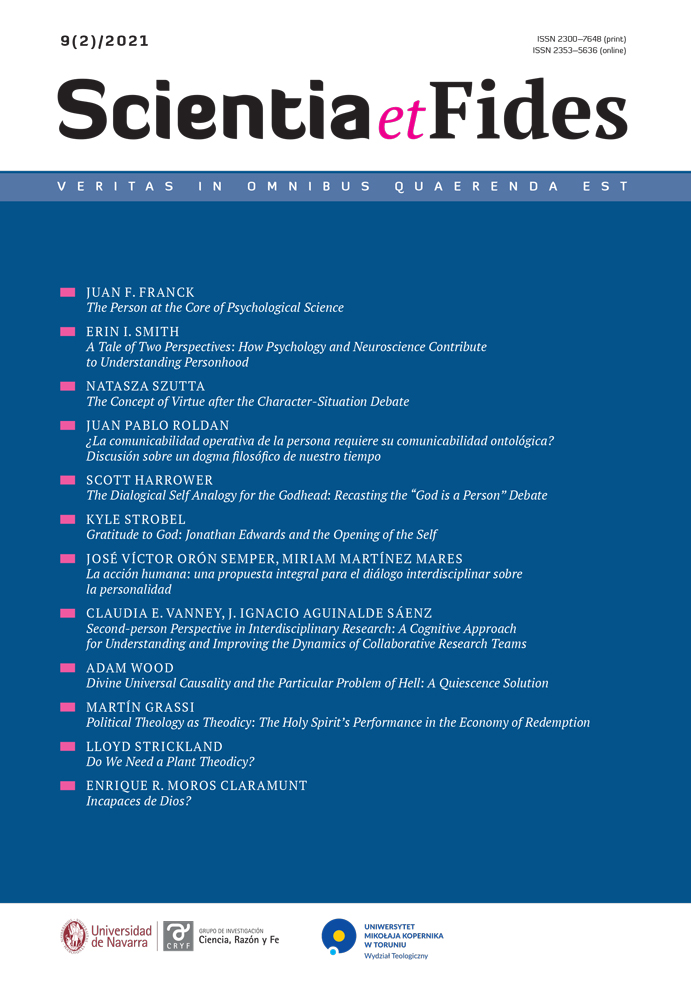
The Person at the Core of Psychological Science
DOI:
https://doi.org/10.12775/SetF.2021.016Słowa kluczowe
psychology, personalism, phenomenology, personalist reduction, humanistic psychology, hermeneuticsAbstrakt
The paper has been written from a philosophical perspective and triggered by the recurrent discussions in psychology about the most suitable methods to study our multifaceted subjectivity. Its main point is that a phenomenological understanding of the human person provides a robust and also flexible philosophical framework for psychology. The first part discusses three classical distinctions –individual/general; explaining/understanding; induction/interpretation– which, in spite of possible deficiencies, are useful to illustrate the specificity of the human sciences relative to the natural sciences. If not understood as an either-or dichotomy these distinctions represent the search of the right balance to reflect the complexity and richness of psychological science. The second part presents the phenomenological notions of ‘vital reduction’ and ‘personalist reduction’, where reductions does not take on an eliminativistic meaning, but of directing the mind’s gaze to attend to what is originally the case. The ‘vital reduction’ reveals a subject of experience at the center of the lifeworld, and the ‘personalist reduction’ sees in rationality –i.e., the power to grasp the meaning of things and to recognize other subjects of experience– a deeper dimension of the subject, who we can thus call a person. Psychology and phenomenology converge in disclosing the person-centeredness of our lifeworld.Bibliografia
Adams, Fred and Aizawa, Ken. 2019. “Embodied cognition and the extended mind”. In The Routledge companion to philosophy of psychology, edited by S. Robins, J. Symons and P. Calvo, 193-213. London and New York: Routledge.
Bechtel, William and Wright, Cory D. 2019. “What is psychological explanation?”. In The Routledge companion to philosophy of psychology, edited by S. Robins, J. Symons and P. Calvo, 113-130. London and New York: Routledge.
Clark, Andy (ed.). 2008. Supersizing the mind. Embodiment, action, and cognitive extension. Oxford: Oxford University Press.
Clark, Andy and Chalmers, David. 1998. “The extended mind”. Analysis 58(1): 7-19.
Danks, David and Eberhardt, Frederick. 2019. “Conceptual problems in statistics, testing and experimentation”. In The Routledge companion to philosophy of psychology, edited by S. Robins, J. Symons and P. Calvo, 214-230. London and New York: Routledge.
Englander, Magnus. 2016. “The phenomenological method in qualitative psychology and psychiatry”. International Journal of Qualitative Studies on Health and Well-being (11): 1, 30682.
Fuchs Thomas. 2020. “Verkörperte Emotionen und ihre Regulation”. In Handbuch Emotionsregulation, edited by S. Barnow. Berlin and Heidelberg: Springer. Doi: 10.1007/978-3-662-60280-5_2.
Gantt, Edwin E. and Williams, Richard N. 2016. “Explanation versus understanding in psychology: A human science approach”. In The qualitative vision for psychology: An invitation to a human science approach, edited by C.T. Fischer, L. Laubscher and R. Brooke, 31-48. Duquesne University Press.
Harré, Rom. 1998. The Singular Self. An Introduction to the Psychology of Personhood. London: Sage.
Healy, Paul. 2012. “Toward an integrative, pluralistic psychology: On the hermeneuticodialogical conditions of the possibility for overcoming fragmentation”. New Ideas in Psychology (30): 271-280.
Husserl, Edmund. 1970. The crisis of European sciences and transcendental phenomenology, translated by David Carr. Northwestern University Press.
Husserl, Edmund. 1989. Ideas pertaining to a pure phenomenology and to a phenomenological philosophy. Second book: Studies in the phenomenology of constitution, translated by R. Rijcewicz and A. Schuwer. Dordrecht/Boston/London: Kluwer.
Hutto, Daniel and Myin, Erik. 2012. Radicalizing enactivism. Basic Minds without Content. Cambridge, MA: MIT Press.
Kendler, Kenneth S. 2005. “Toward a philosophical structure for psychiatry”. American Journal of Psychiatry (162): 433-440. DOI: 10.1176/appi.ajp.162.3.433.
Kirschner, Suzanne R. 2015. “Subjectivity as sociocultural constituted experience”. In The Wiley handbook of theoretical and philosophical psychology, edited by J. Martin, J. Sugarman and K.L. Stanley, 293-307. Oxford: Willy Blackwell.
Krakauer, John W., Ghazanfar, Asif A., Gomez-Marin, Alex, MacIver, Malcolm A. and Poeppel, David. 2017. “Neuroscience Needs Behavior: Correcting a Reductionist Bias”. Neuron 93(3): 480-490. DOI: 10.1016/j.neuron.2016.12.041.
Lamiell, James T. 2003. Beyond individual and group differences: Human individuality, scientific psychology, and William Stern’s critical personalism. London: Sage.
Lehmann-Muriithi, Kolja, de Resende Damas Cardoso, Carolina and Lamiell, James T. 2016. “Understanding Human Being Within the Framework of William Stern’s Critical Personalism: Teleology, Holism, and Valuation”. In Psychology as the science of human being. The Yokohama Manifesto, edited by J. Valsiner et al., 209-223. Springer: Switzerland.
Leocata, Francisco. 2007. Estudios sobre fenomenología de la praxis. Buenos Aires: Proyecto.
Leocata, Francisco. 2010. Filosofía y ciencias humanas. Hacia un nuevo diálogo interdisciplinario. Buenos Aires: Educa.
Lilienfeld, Scott O. 2007. “Cognitive Neuroscience and Depression: Legitimate Versus Illegitimate Reductionism and Five Challenges”. Cognitive Therapy and Research (31): 263-272. DOI: 10.1007/s10608-007-9127-0.
Noë, Alva. 2006. Action in perception. Boston, MA: MIT Press.
Petitot, Jean, Varela, Francisco José, Pachoud, Bernard and Roy, Jean-Michel (eds.). 1999. Naturalizing phenomenology. Issues in contemporary phenomenology and cognitive science. Stanford University Press: Stanford, CA.
Pieper, Josef. 1998. Leisure. The basis of culture. South Bend, IN: St. Augustine’s Press.
Spiegelberg, Herbert. 1972. Phenomenology in psychology and psychiatry: A historical introduction. Evanston, IL: Northwestern University Press.
Stern, William. 2010 [1917]. “Psychology and personalism (trans. J.R. Lamiell)”. New Ideas In Psychology 28: 110–134.
Thompson, Evan. 2007. Mind in life. Cambridge, MA: Belknap Harvard.
Todd, Zazie, Nerlich, Brigitte, McKeown, Suzanne and Clarke, David D. 2004. Mixing methods in psychology: The integration of qualitative and quantitative methods in theory and practice. London, UK: Psychology Press.
Von Wright, Georg Henrik. 1971. Explanation and understanding. Routledge & Kegan Paul: London.
Windelband, Wilhelm. 1894. “Geschichte und Naturwissenschaft”. Translated by Guy Oakes as “History and Natural Science”, History and Theory 1980, 19(2): 169-185.
Zahavi, Dan. 2004. Self and other: exploring subjectivity, empathy and shame. Oxford: OUP.
Pobrania
Opublikowane
Jak cytować
Numer
Dział
Licencja
Prawa autorskie (c) 2021 Scientia et Fides

Utwór dostępny jest na licencji Creative Commons Uznanie autorstwa – Bez utworów zależnych 4.0 Międzynarodowe.
CC BY ND 4.0. Posiadaczem prawa autorskiego (Licencjodawcą) jest Autor, który na mocy umowy licencyjnej udziela nieodpłatnie prawa do eksploatacji dzieła na polach wskazanych w umowie.
- Licencjodawca udziela Licencjobiorcy licencji niewyłącznej na korzystanie z Utworu/przedmiotu prawa pokrewnego w następujących polach eksploatacji: a) utrwalanie Utworu/przedmiotu prawa pokrewnego; b) reprodukowanie (zwielokrotnienie) Utworu/przedmiotu prawa pokrewnego drukiem i techniką cyfrową (e-book, audiobook); c) wprowadzania do obrotu egzemplarzy zwielokrotnionego Utworu/przedmiotu prawa pokrewnego; d) wprowadzenie Utworu/przedmiotu prawa pokrewnego do pamięci komputera; e) rozpowszechnianie utworu w wersji elektronicznej w formule open access na licencji Creative Commons (CC BY-ND 3.0) poprzez platformę cyfrową Wydawnictwa Naukowego UMK oraz repozytorium UMK.
- Korzystanie przez Licencjobiorcę z utrwalonego Utworu ww. polach nie jest ograniczone czasowo ilościowo i terytorialnie.
- Licencjodawca udziela Licencjobiorcy licencji do Utworu/przedmiotu prawa pokrewnego nieodpłatnie na czas nieokreślony
PEŁEN TEKST UMOWY LICENCYJNEJ >>
Statystyki
Liczba wyświetleń i pobrań: 1385
Liczba cytowań: 3


