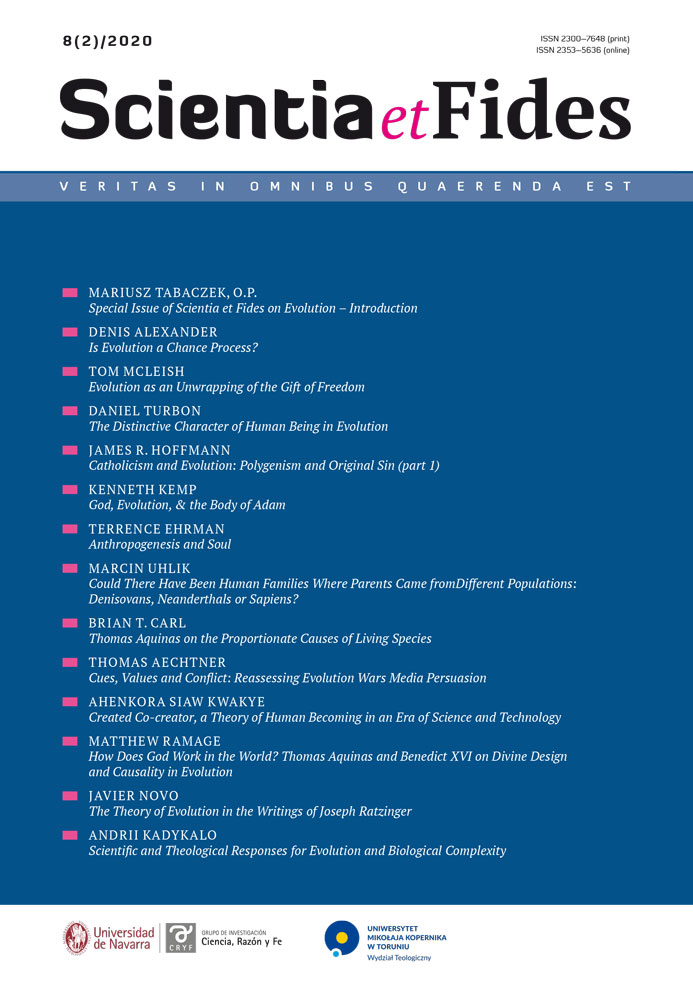
Created Co-creator, a Theory of Human Becoming in an Era of Science and Technology
DOI:
https://doi.org/10.12775/SetF.2020.022Słowa kluczowe
Created Co-creator, Cyborg, Hefner, Evolution, Creation, Religion, ScienceAbstrakt
Scientific discoveries and the emergence of cosmological theories such as the Big Bang Theory and evolution have challenged the Christian doctrine of creation and its reliability on many fronts, because the discoveries appear to contradict the Christian account as to how creation unfolded. Hefner sees the situation as an additional interpretative task to theologians. He, however, posits that scientific discoveries are an opportunity to communicate the Christian message through social and scientific experience to bring meaning to broader society. He expresses the notion that religion will remain relevant only if it measures up to science, because we are in a science and technology era. Hefner, therefore, introduced the concept of created co-creator as a metaphor and analytical tool to explain the meaning and purpose of humans within the biosphere. The concept is characterized by the ability to communicate religion through science and to relate with available models of origin. This work expounds on the concept of created co-creator’s ability to explain human technological trajectory in theology. There is also an effort to establish a relationship between Hefner’s concept and Haraway’s cyborg with an emphasis on the concept’s ability to communicate the Christian doctrine of creation through scientific knowledge and why such an enterprise is useful.
Bibliografia
Ayala, Francisco J. 2008. From Paley to Darwin: Design to Natural Selection. In Back to-Darwin: A Richer Account of Evolution. Edited by John B. Cobb Jr. Grand Rapids, Michigan, Cambridge: William B. Eerdmans, 50–70.
Barbour, Ian. 1966. Issues in Science and Religion. New York: Vantage.
Bentley, Wessel. 2017. “Are we special? A critique of imago Dei.” HTS Teologiese Studies/ Theological Studies 73: 2072–8050.
Bostrom, Nick. 2003. “Human Genetic Enhancements: A Transhumanist Perspective.” The Journal of Value Inquiry 37: 493–506.
Bostrom, Nick. 2005. “Review of Contemporary Philosophy.” Transhumanist Values 4: 87–101.
Burhoe, Ralph W. 1981. Toward a Scientific Theology: Essays on the Relation of Science to Religion. Belfast: Christian Journals Limited.
Coomaraswamy, Ananda K. 1957. “The Dance of Shiva,” In the Dance of Shiva: Fourteen Indian Essay. New York: The Noonday Press.
Csikszentmihalyi, Mihaly. 2000. “The Mythic Potential of Evolution.” Zygon: Journal of Religion and Science, 35: 25–38.
Ecklund, Elaine Howard. 2019. Science vs. Religion; What Scientists Really Think. USA: Oxford University Press Inc.
Ellul, Jacques. 1964, 1954. The Technological Society. Translated by John Wilkinson. New York: Vintage Books.
Faith and Order Paper 119. 2018. World Council of Churches, Geneva, accessed January 20. http://www.oikoumene.org/en/what-we-do/faith-and-order.
Fisher, Helen E. 2011. “Serial monogamy and clandestine adultery: evolution and consequences of the dual human reproductive strategy,” In Applied Evolutionary Psychology. Edited by S. Craig Roberts. Oxford: Oxford University Press, 93–112.
Gleiser, Marcelo. 2005. The Dancing Universe: From Creation Myths to the Big Bang. Dartmouth: College Press.
Haraway, Donna. 2000. A Cyborg Manifesto: Science, Technology and Socialist-Feminism in the Late Twentieth Century. In The Cybercultures Reader. Edited by David Bell and Barbara M. Kennedy. London, New York: Routledge.
Hefner, Philip. 1993. The Human Factor: Evolution, Culture and Religion. Minneapolis: Fortress Press.
Hefner, Philip. 2006. Spiritual Transformation and Healing: Anthropological, Theological, Neuroscientific, and Clinical Perspectives. Edited by Joan Koss-Chioino and Philip Hefner. Oxford, UK: Altamira Press.
Hefner, Philip. 2004. “The Created Co-Creator Meets Cyborg,” accessed February 6, 2020, http://www.metanexus.net/essay/created-co-creator-meets-cyborg.
Hefner, Philip. 1984. “The Doctrine of Creation.” In Christian Dogmatics; The Creation. Edited by Carl E. Braaten and Robert W. Jenson. Philadelphia: Fortress Press.
Kull, Anne. 2000. “A Theology of Technonature Based on Donna Haraway and Paul Tillich.” PhD diss., University of Chicago.
Kull, Anne. 2016. “Cyborg and Religious? Technonature and Technoculture.” Scientia et Fides 4: 295–311.
Lenski Richard E. 2012. “Evolution in Action A 50,000-Generation Salute to Charles Darwin.” In Microbes and Evolution: The World That Darwin Never Saw. Edited by Maloy, S. R., & Kolter, R. Washington, DC: ASM Press.
Lipowicz, Markus. 2009. “Overcoming Transhumanism: Education or Enhancement towards the Overhuman?” Journal of Philosophy of Education 53: 200–214.
Tielhard, Pierre de Chardin. 1959. The Phenomenon of Man. Translated by Bernard Wall. France: William Collins.
Tielhard, Pierre de Chardin. 1968. The Future of Man. Translated by Norman Denny. New York: Harper & Row.
Torrance, Thomas F. 1969. Theological Science. London: Oxford University Press.
Wellum, Stephen J. 2009. “The Urgent Need for a Theological Anthropology Today.” The Southern Baptist Journal of Theology 13: 2–3.
Westhelle, Vítor. 2004. “The Poet, The Practitioner, and the beholder: Remarks on Philip Hefner’s Created Co-Creator.” Zygon 39: 747–754.
Yecla, Gem. 2019. “Co-Creation Spirituality Participating in God’s Ongoing Work of Crea-tion through Spiritual Direction and the Spiritual Exercises.” The Way 58: 7–18.
Pobrania
Opublikowane
Jak cytować
Numer
Dział
Licencja
Prawa autorskie (c) 2020 Scientia et Fides

Utwór dostępny jest na licencji Creative Commons Uznanie autorstwa – Bez utworów zależnych 4.0 Międzynarodowe.
CC BY ND 4.0. Posiadaczem prawa autorskiego (Licencjodawcą) jest Autor, który na mocy umowy licencyjnej udziela nieodpłatnie prawa do eksploatacji dzieła na polach wskazanych w umowie.
- Licencjodawca udziela Licencjobiorcy licencji niewyłącznej na korzystanie z Utworu/przedmiotu prawa pokrewnego w następujących polach eksploatacji: a) utrwalanie Utworu/przedmiotu prawa pokrewnego; b) reprodukowanie (zwielokrotnienie) Utworu/przedmiotu prawa pokrewnego drukiem i techniką cyfrową (e-book, audiobook); c) wprowadzania do obrotu egzemplarzy zwielokrotnionego Utworu/przedmiotu prawa pokrewnego; d) wprowadzenie Utworu/przedmiotu prawa pokrewnego do pamięci komputera; e) rozpowszechnianie utworu w wersji elektronicznej w formule open access na licencji Creative Commons (CC BY-ND 3.0) poprzez platformę cyfrową Wydawnictwa Naukowego UMK oraz repozytorium UMK.
- Korzystanie przez Licencjobiorcę z utrwalonego Utworu ww. polach nie jest ograniczone czasowo ilościowo i terytorialnie.
- Licencjodawca udziela Licencjobiorcy licencji do Utworu/przedmiotu prawa pokrewnego nieodpłatnie na czas nieokreślony
PEŁEN TEKST UMOWY LICENCYJNEJ >>
Statystyki
Liczba wyświetleń i pobrań: 2369
Liczba cytowań: 1


