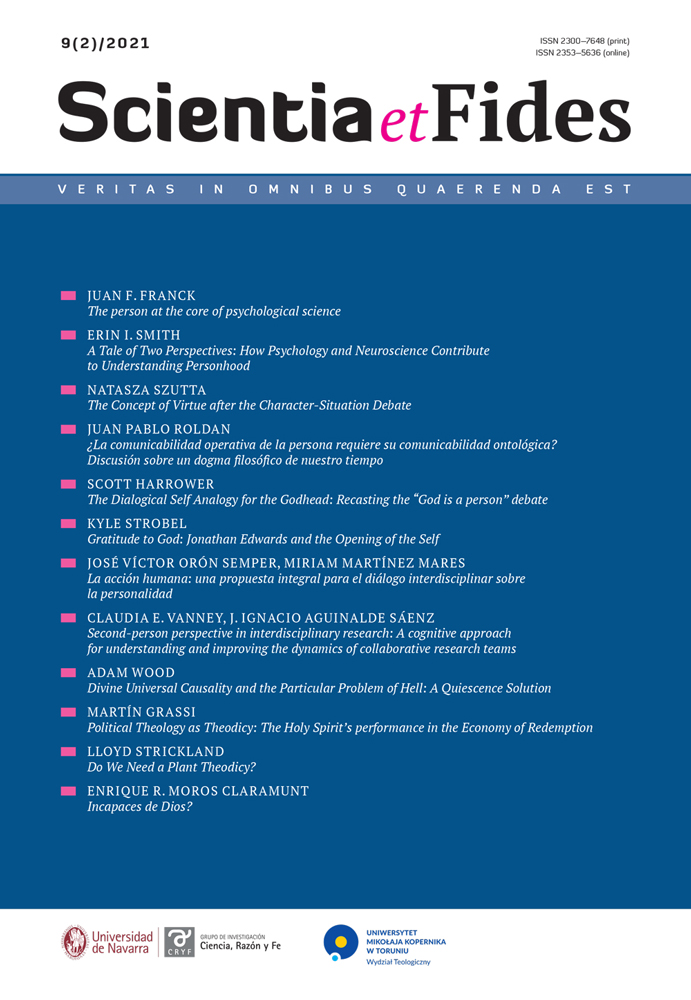
Divine Universal Causality and the Particular Problem of Hell: A Quiescence Solution
DOI:
https://doi.org/10.12775/SetF.2021.024Parole chiave
Theodicy, Predestination, ReprobationAbstract
I call the Particular Problem of Hell (PPH) the problem of explaining why God allows a certain set of created persons to populate hell, as opposed to allowing some other set of created persons to do so. This paper proposes a solution to PPH on behalf of proponents of Divine Universal Causality (DUC) — the view, roughly, that God causes everything distinct from himself to exist at any time it exists. Despite initial appearances, I argue, proponents of DUC can adopt a version of the popular approach to the Problem of Hell sometimes called the Choice Model. My proposal is based upon Eleonore Stump's Thomistically-inspired notion that our wills can enter a state of "quiescence" with respect to a given option. While proponents of DUC will, I argue, most likely find Stump's own quiescence-based solution to PPH unacceptable, there is a way of modifying her approach that renders it compatible with God's causing everything distinct from himself, including the free choices of his creatures.
Riferimenti bibliografici
Adams, Robert Merrihew. 1977. "Middle Knowledge and the Problem of Evil." American Philosophical Quarterly 14.2: 109–117.
Augustine. 1991. Confessions. Translated by Henry Chadwick. Oxford: Oxford University Press.
Augustine. 1999. De dono perseverantiae. Translated by Roland Teske in Answers to the Pelagians IV, edited by John Rotelle. Hyde Park, NY: New City Press.
Flint, Thomas P. 1998. Divine Providence: The Molinist Account. Ithaca, NY: Cornell University Press.
Grant, W. Matthews. 2019. Free Will and God's Universal Causality: The Dual Sources Account. London: Bloomsbury.
Koons, Robert. 2002. "Dual Agency: A Thomistic Account of Providence and Human Freedom." Philosophia Christi 4.2: 397–410.
Kvanvig, Jonathan L. 2011. Destiny and Deliberation: Essays in Philosophical Theology. Oxford: Oxford University Press.
McCann, Hugh. 1995. "Divine Sovereignty and Freedom of the Will." Faith and Philosophy 12.4: 582–98.
Pini, Giorgio. 2013. "What Lucifer Wanted: Anselm, Aquinas and Scotus on the Object of the First Evil Choice." Oxford Studies in Medieval Philosophy 1: 61–82.
Plantinga, Alvin. 1974. The Nature of Necessity. Oxford: Oxford University Press.
Rogers, Katherin. 2008. Anselm on Freedom. Oxford: Oxford University Press.
Stump, Eleonore. 1985. "The Problem of Evil." Faith and Philosophy 2.4: 392–423.
Stump, Eleonore. 1986. "Dante's Hell, Aquinas's Moral Theory and the Love of God." Canadian Journal of Philosophy 16.2: 181–98.
Stump, Eleonore. 1988. "Sanctification, Hardening of Heart and Frankfurt's Concept of Free Will." The Journal of Philosophy. 85.8: 395–420.
Stump, Eleonore. 2001. "Augustine on Free Will." In The Cambridge Companion to Augustine, edited by Stump and Norman Kretzmann, 124–47. Cambridge: Cambridge University Press.
Stump, Eleonore. 2003. Aquinas. London: Routledge.
Downloads
Pubblicato
Come citare
Fascicolo
Sezione
Licenza
Copyright (c) 2021 Scientia et Fides

Questo lavoro è fornito con la licenza Creative Commons Attribuzione - Non opere derivate 4.0 Internazionale.
CC BY ND 4.0. The Creator/Contributor is the Licensor, who grants the Licensee a non-exclusive license to use the Work on the fields indicated in the License Agreement.
- The Licensor grants the Licensee a non-exclusive license to use the Work/related rights item specified in § 1 within the following fields: a) recording of Work/related rights item; b) reproduction (multiplication) of Work/related rights item in print and digital technology (e-book, audiobook); c) placing the copies of the multiplied Work/related rights item on the market; d) entering the Work/related rights item to computer memory; e) distribution of the work in electronic version in the open access form on the basis of Creative Commons license (CC BY-ND 3.0) via the digital platform of the Nicolaus Copernicus University Press and file repository of the Nicolaus Copernicus University.
- Usage of the recorded Work by the Licensee within the above fields is not restricted by time, numbers or territory.
- The Licensor grants the license for the Work/related rights item to the Licensee free of charge and for an unspecified period of time.
FULL TEXT License Agreement
Stats
Number of views and downloads: 1143
Number of citations: 0


