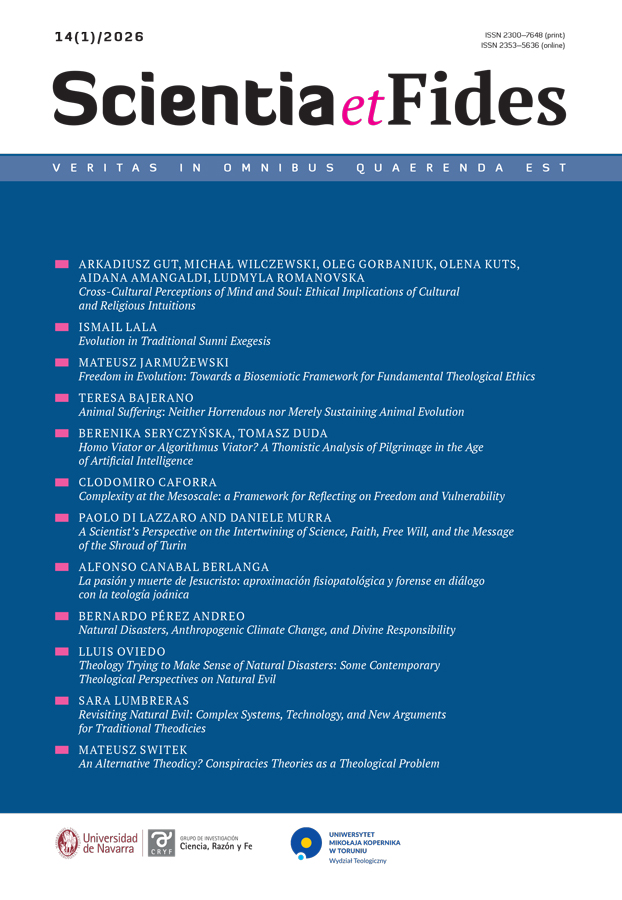
Freedom in Evolution
Towards a Biosemiotic Framework for Fundamental Theological Ethics
DOI:
https://doi.org/10.12775/SetF.2026.003Palabras clave
free will, biosemiotics, moral agency, natural autonomy, theological ethics, theological method, Neo-Darwinism, non-classical biology, science and theologyResumen
The article explores and critically reexamines the popular notion that biological evolution leaves little room for metaphysical freedom and free will. It guides the reader through a selection of emerging paradigms in evolutionary and theoretical biology, including the theories of autocatalysis, autopoiesis, epigenetics, and systems ecology, moving towards biosemiotics as its main focus. Special attention is given to the role of the chance-necessity interplay, the (physical) laws of nature, and the alleged directionality of evolution, as well as to the role and the scope of natural selection. The goal is to show how non-classical biology – and especially the emerging field of biosemiotics – can contribute to a better understanding of freedom as enhanced by, harnessed by, or even intrinsic to biological evolution. In doing so, the article also highlights the insights biosemiotics offers for broader engagement between theological methodology and the natural sciences (and vice versa). First, the classical Neo-Darwinian account of chance and necessity is contrasted with alternative approaches. The article then briefly presents key features of the Extended Evolutionary Synthesis (EES) and the organismal approach in biology, focusing on the concept of biological autonomy. Finally, it argues for the novelty of the biosemiotic paradigm in accommodating the notions of freedom, agency, and choice, and in methodologically engaging other disciplines, including theology. The conclusion points to possible implications for fundamental theological ethics and anthropology, as well as directions for future research in the field of science and theology.
Citas
Aquinas, Thomas. 2006 [1920]. Summa Theologiae. Translated by the Fathers of the English Dominican Province. 2nd rev. ed. Edited by K. Knight. Accessed October 30, 2013. http://www.newadvent.org/summa/.
Baravalle, Lorenzo, and Davide Vecchi. 2016. “Beyond Blindness: On the Role of Organism and Environment in Trial Generation.” Studies in History and Philosophy of Biological and Biomedical Sciences 60 (2016): 25–34. https://doi.org/10.1016/j.shpsc.2016.09.005.
Barbieri, Marcello. 2003. The Organic Code: An Introduction to Semantic Biology. Cambridge: Cambridge University Press.
Barbieri, Marcello. 2011. “Origin and Evolution of the Brain.” Biosemiotics 4, no. 3: 369–98.
Bauman, Zygmunt. 2007. Consuming Life. Cambridge: Polity Press.
Clayton, Philip. 2008. Adventures in the Spirit: God, World, Divine Action. Minneapolis, MN: Fortress Press.
Delio, Ilia. 2013. The Unbearable Wholeness of Being: God, Evolution, and the Power of Love. Maryknoll, NY: Orbis Books.
Doyle, Bob. n.d. The History of the Free Will Problem. Accessed April 9, 2014. http://www.informationphilosopher.com/freedom/history/.
Dyson, Freeman. 1999. The Sun, the Genome, and the Internet: Tools of Scientific Revolutions. Oxford: Oxford University Press.
Eccles, John C., and Karl Popper. 1984. The Self and Its Brain: An Argument for Interaction. London: Routledge.
Emmeche, Claus, Donald Favareau, and Kalevi Kull. 2019. “Jesper Hoffmeyer 1942–2019.” Biosemiotics 12: 365–72. https://doi.org/10.1007/s12304-019-09368-6.
Gilbert, Scott F., Thomas C. G. Bosch, and Cassandra G. Ledón-Rettig. 2015. “Eco-Evo-Devo: Developmental Symbiosis and Developmental Plasticity as Evolutionary Agents.” Nature Reviews Genetics 16, no. 10: 611–22. https://doi.org/10.1038/nrg3982.
Hájíček, Pavel. 2009. “Free Will as Relative Freedom with Conscious Component.” Consciousness and Cognition 18, no. 1: 103–9.
Heidegger, Martin. 1996 [1927]. Being and Time. Trans. Joan Stambaugh. Albany: State University of New York Press.
Heisenberg, Martin. 2009. “Is Free Will an Illusion?” Nature 459: 164–5. https://doi.org/10.1038/459164a.
Hendlin, Yogi H. 2025, October 24. “Fractal Ecologies and Ecodelics.” Colloquium presentation, Exeter Psychedelic Studies, Exeter, UK. https://www.youtube.com/watch?v=Tx9oIIqjMFU.
Hoffmeyer, Jesper. 1996. Signs of Meaning in the Universe. Bloomington: Indiana University Press.
Hoffmeyer, Jesper. 2008. “Semiotic Scaffolding in Living Systems.” In Introduction to Biosemiotics: The New Biological Synthesis, edited by Marcello Barbieri, 149–66. Springer. https://doi.org/10.1007/1-4020-4814-9.
Hoffmeyer, Jesper. 2015. “Introduction: Semiotic Scaffolding.” Biosemiotics 8: 154–5.
Hofmann, Tobias, and Cyrille Michon. 2017. “Aquinas on Free Will and Intellectual Determinism.” Philosophers’ Imprint 17, no. 10: 1–3.
Hulswit, Menno, and Vinicius Romanini. 2014. “Semeiotic Causation and the Breath of Life.” In Peirce and Biosemiotics: A Guess at the Riddle of Life, edited by Vinicius Romanini and Eliseo Fernández, 95–126. Berlin: Springer.
Jarmużewski, Mateusz. 2021. Neurobiology and the Free Will: Implications for Catholic Theological Ethics. PhD diss., KU Leuven.
Jarmużewski, Mateusz. 2022. “Natural Sciences and/in Moral Theology: The Case of Free Will.” Studia Nauk Teologicznych PAN 17: 89–107. https://doi.org/10.31743/snt.13799.
Kant, Immanuel. 1987 [1790]. Critique of Judgment. Indianapolis: Hackett Publishing.
Kauffman, Stuart A., and Philip Clayton. 2006. “On Emergence, Agency, and Organization.” Biology and Philosophy 21, no. 4: 501–21. https://doi.org/10.1007/s10539-005-9003-9.
Keller, Catherine. 2003. Face of the Deep: A Theology of Becoming. London: Routledge.
Kłoś, Adam. 2014. “Od neuronu do kultury – biosemiotyczna historia powstania i ewolucji mózgu według Marcello Barbieriego.” Zagadnienia Filozoficzne w Nauce LVI: 93–129.
Kull, Kalevi, Frederik Stjernfelt, and Claus Emmeche. 2002. “A Brief Biosemiotic Glossary.” In Reading Hoffmeyer, Rethinking Biology. Vol. 3 of Tartu Semiotics Library, 25–30. Tartu: Tartu University Press.
Kull, Kalevi. 2015. “Evolution, Choice, and Scaffolding: Semiosis Is Changing Its Own Building.” Biosemiotics 8: 223–34. https://doi.org/10.1007/s12304-015-9243-2.
Kull, Kalevi. 2023. “Further Considerations on Semiosis in Evolution: Arbitrarity plus Semiotic Fitting, and/or Mutability plus Natural Selection,” Sing System Studies 51: 179–84.
Libet, Benjamin. 1985. “Unconscious Cerebral Initiative and the Role of Conscious Will in Voluntary Action.” Behavioral and Brain Sciences 8, no. 4: 529–66. https://doi.org/10.1017/S0140525X00044903.
Moreno, Álvaro, and Matteo Mossio. 2015. Biological Autonomy: History, Philosophy and Theory of the Life Sciences. Dordrecht: Springer.
Moser, Keith. 2025. “Launching a Transdisciplinary Call for Semioethical Virtue Ethics in the Anthropocene/Capitalocene.” Biosemiotics 18: 381–6. https://doi.org/10.1007/s12304-025-09608-y.
Müller, Gerd B. 2007. “Evo–Devo: Extending the Evolutionary Synthesis.” Nature Reviews Genetics 8, no. 12: 943–9. https://doi.org/10.1038/nrg2219.
Peirce, Charles Sanders. 1998. Chance, Love, and Logic: Philosophical Essays, edited by Morris R. Cohen. Lincoln–London: University of Nebraska Press.
Peirce, Charles Sanders. Collected Papers of Charles Sanders Peirce. Vol. 5. Edited by Charles Hartshorne and Paul Weiss (vols. 1–6) and Arthur W. Burks (vols. 7–8). Cambridge, MA: Harvard University Press.
Petrilli, Susan, and Augusto Ponzio. 2024. “Biosemiotics, Global Semiotics and Semioethics.” Biosemiotics 17: 741–67. https://doi.org/10.1007/s12304-024-09590-x.
Pigliucci, Massimo, Courtney J. Murren, and Carl D. Schlichting. 2006. “Phenotypic Plasticity and Evolution by Genetic Assimilation.” Journal of Experimental Biology 209, no. 12: 2362–7. https://doi.org/10.1242/jeb.02070.
Pope Benedict XVI. 29 June 2009. Caritas in Veritate. Accessed October 9, 2025. https://www.vatican.va/content/benedict-xvi/en/encyclicals/documents/hf_ben-xvi_enc_20090629_caritas-in-veritate.html.
Pope Francis. 24 May 2015. Laudato Si’. Accessed October 9, 2025. https://www.vatican.va/content/francesco/en/encyclicals/documents/papa-francesco_20150524_enciclica-laudato-si.html#_ftn10.
Pope John Paul II. 22 October 1996. “Message to the Pontifical Academy of Sciences: On Evolution.” Accessed October 9, 2025. https://humanorigins.si.edu/sites/default/files/MESSAGE%20TO%20THE%20PONTIFICAL%20ACADEMY%20OF%20SCIENCES%20(Pope%20John%20Paul%20II).pdf.
Pope John Paul II. 26 April 1985. “Address of Pope John Paul II to the Participants of the International Scientific Symposium ‘Christian Faith and Theory of Evolution,’ April 26, 1985.” Accessed October 9, 2025. https://www.vatican.va/content/john-paul-ii/de/speeches/1985/april/documents/hf_jpii_spe_19850426_studiosi-evoluzione.html.
Rosen, Robert. 1991. Life Itself: A Comprehensive Inquiry into the Nature, Origin, and Fabrication of Life. New York: Columbia University Press.
Rosslenbroich, Bernd. 2014. On the Origin of Autonomy: A New Look at the Major Transitions in Evolution. Cham: Springer.
Sharov, Alexei A. 2021. “Towards a Biosemiotic Theory of Evolution.” Biosemiotics 14, no. 1: 101–5. https://doi.org/10.1007/s12304-021-09414-2.
Soon, Chun Siong, Marcel Brass, Hans-Jochen Heinze, and John-Dylan Haynes. 2008. “Unconscious Determinants of Free Decisions in the Human Brain.” Nature Neuroscience 11, no. 5: 543–5. https://doi.org/10.1038/nn.2112.
Timpe, Kevin. 2013. Free Will: Sourcehood and Its Alternatives. London: Bloomsbury.
Tønnessen, Morten, Alexei A. Sharov, and Timo Maran. 2019. “Jesper Hoffmeyer’s Biosemiotic Legacy.” Biosemiotics 12: 357–63. https://doi.org/10.1007/s12304-019-09369-5.
Ulanowicz, Robert. 2010. “God and the World of Signs: Semiotics and the Emergence of Life.” Zygon 45, no. 2: 397–408. https://doi.org/10.1111/j.1467-9744.2010.01072.x.
Ulanowicz, Robert. 2013. “A World of Contingencies.” Zygon 48, no. 1: 77–92.
Varela, Francisco J. 1979. Principles of Biological Autonomy. New York: North-Holland.
Varela, Francisco J. 1997. “Patterns of Life: Intertwining Identity and Cognition.” Brain and Cognition 34, no. 1: 72–87. https://doi.org/10.1006/brcg.1997.0907.
Varela, Francisco J., Humberto R. Maturana, and R. Uribe. 1974. “Autopoiesis: The Organization of Living Systems, Its Characterization and a Model.” Biosystems 5, no. 4: 187–96. https://doi.org/10.1016/0303-2647(74)90031-8.
Waller, Bruce N. 1998. The Natural Selection of Autonomy. Albany: State University of New York Press.
Waller, Bruce N. 2003. “Empirical Free Will and the Ethics of Moral Responsibility.” The Journal of Value Inquiry 37, no. 4: 533–42.
Wojtyła, Karol. 1969. Osoba i czyn. Kraków: Polskie Towarzystwo Teologiczne.
Descargas
Publicado
Cómo citar
Número
Sección
Licencia
Derechos de autor 2026 Mateusz Jarmuzewski

Esta obra está bajo una licencia internacional Creative Commons Atribución-SinDerivadas 4.0.
CC BY ND 4.0. The Creator/Contributor is the Licensor, who grants the Licensee a non-exclusive license to use the Work on the fields indicated in the License Agreement.
- The Licensor grants the Licensee a non-exclusive license to use the Work/related rights item specified in § 1 within the following fields: a) recording of Work/related rights item; b) reproduction (multiplication) of Work/related rights item in print and digital technology (e-book, audiobook); c) placing the copies of the multiplied Work/related rights item on the market; d) entering the Work/related rights item to computer memory; e) distribution of the work in electronic version in the open access form on the basis of Creative Commons license (CC BY-ND 3.0) via the digital platform of the Nicolaus Copernicus University Press and file repository of the Nicolaus Copernicus University.
- Usage of the recorded Work by the Licensee within the above fields is not restricted by time, numbers or territory.
- The Licensor grants the license for the Work/related rights item to the Licensee free of charge and for an unspecified period of time.
FULL TEXT License Agreement
Stats
Number of views and downloads: 220
Number of citations: 0


