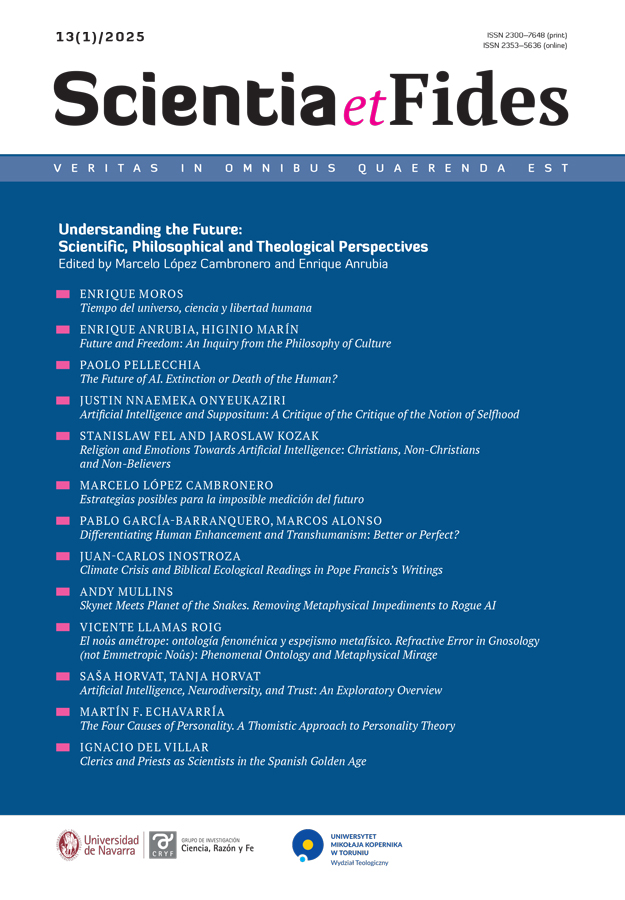
Future and Freedom: An Inquiry from Philosophy of Culture
DOI:
https://doi.org/10.12775/SetF.2025.002Palabras clave
future, freedom, contemporary culture, presenceResumen
This paper inquiries the relationship between Freedom and Future. Initially, it examines the notion of the future as conceived within the Classical worldview, particularly through the idea of destiny, and differentiates it from the modern notion of the future. The contemporary linear conception of the future is predicated on two essential components of freedom: novelty and possibility -an idea originally introduced by Christianity. However, Modernity and Postmodernity have radicalized these concepts, resulting in a sharp dichotomy between the future and the past. The final section proposes a synthetic approach to reconciling the concepts of future and freedom.
Citas
John P., Alsobrook II and David L. Pauls. 2000. “Genetics and Violence.” Child and Adolescent Psychiatric Clinics of North America 9(4): 765–776.
Alvira, Rafael. 1992. “Origen y Negatividad.” Thémata. Revista de Filosofía 10: 403–413.
Aristotle. 1989. Política. Madrid: Centro de Estudios Constitucionales.
Bauman, Zygmunt. 2005. Liquid Life. Cambridge: Polity.
Beauvoir, Simone. 1949. Le Deuxième Sexe. París: Gallimard.
Cambronero, Marcelo and Merino, Feliciana. 2018. Mayo del 68. Cuéntame cómo te ha ido. Madrid: Encuentro.
Choza, Jacinto et Choza, Pilar. 1995. Ulises. Un arquetipo de la existencia humana. Barcelona: Ariel.
Geertz, Clifford. 1973. The Interpretation of Cultures. Basic Books: New York.
Jaeger, Werner. 1962. Paideia. Los ideales de la cultura griega. México DF: FCE.
Kirk, Geoffrey et Raven, John at al. 1957. The Presocratic Philosophers. Cambridge: Cambridge University Press.
Lipovestky, Gilles. 1987. L’Empire de l’éphémère: la mode et son destin dans les so-ciétés modernes. Paris: Gallimard.
Lyotard, Jean-François. 1979. La condition postmoderne: rapport sur le savoir. Paris: Minuit.
Martínez-Lucena, Jorge. 2023. “The Issue of Social Control in Late Modernity: Alienation and Narrativity”. Scientia et Fides 11(1): 137–154. DOI: https://doi.org/10.12775/SetF.2023.007.
Marín, Higinio. 2007. La invención de lo humano. La génesis sociohistórica del individuo. Encuentro: Madrid.
Pico della Mirandola, Giovanni. 2004: Discurso sobre la dignidad del hombre. Trans. of Adolfo Ruiz Díaz. México: UNAM.
Taylor, Charles. 1991. The Malaise of Modernity. Toronto: House of Anansi Press
Vico, Giambatista. 1995. Ciencia Nueva. Barcelona: Tecnos.
Zweig, Stefan. 2012. El mundo de ayer. Memorias de un Europeo. Barcelona: Acantilado.
Descargas
Publicado
Cómo citar
Número
Sección
Licencia
Derechos de autor 2025 Enrique Anrubia

Esta obra está bajo una licencia internacional Creative Commons Atribución-SinDerivadas 4.0.
CC BY ND 4.0. The Creator/Contributor is the Licensor, who grants the Licensee a non-exclusive license to use the Work on the fields indicated in the License Agreement.
- The Licensor grants the Licensee a non-exclusive license to use the Work/related rights item specified in § 1 within the following fields: a) recording of Work/related rights item; b) reproduction (multiplication) of Work/related rights item in print and digital technology (e-book, audiobook); c) placing the copies of the multiplied Work/related rights item on the market; d) entering the Work/related rights item to computer memory; e) distribution of the work in electronic version in the open access form on the basis of Creative Commons license (CC BY-ND 3.0) via the digital platform of the Nicolaus Copernicus University Press and file repository of the Nicolaus Copernicus University.
- Usage of the recorded Work by the Licensee within the above fields is not restricted by time, numbers or territory.
- The Licensor grants the license for the Work/related rights item to the Licensee free of charge and for an unspecified period of time.
FULL TEXT License Agreement
Stats
Number of views and downloads: 955
Number of citations: 0


