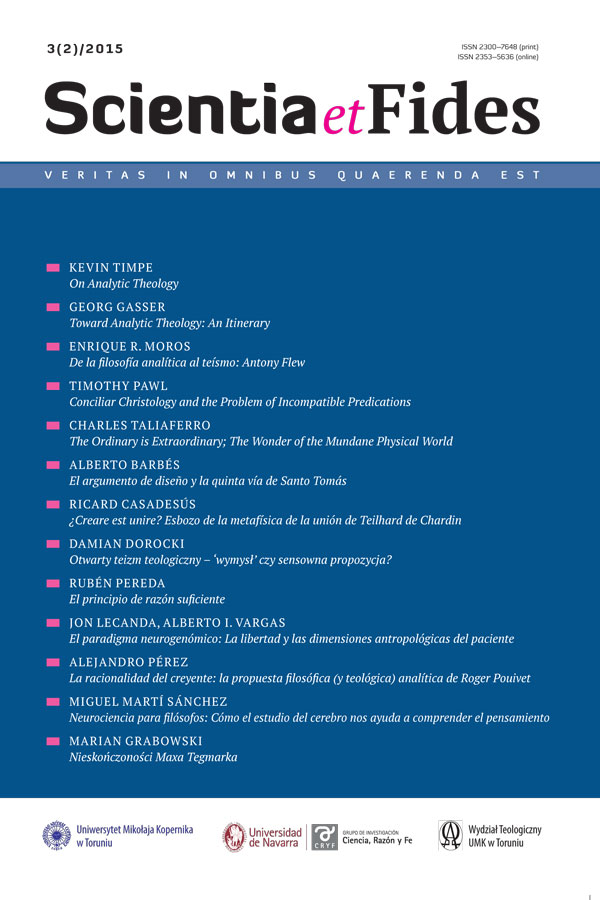
El argumento de diseño y la quinta vía de Santo Tomás
Schlagworte
fifth way, argument from design, finality, natural order, science, Intelligent DesignAbstract
The argument from design and Aquinas’ fifth way
In scientific literature it is common to make equivalence between the so-called argument from design and the fifth way of Thomas Aquinas. It is commonly assumed that both demonstrations for the existence of God are based on the concept of finality to proof the need for an intelligent being capable of causing order in nature. However, we think that the differences between the two arguments have great significance: each of them have as starting point a different type of order, are based on a different kind of finality, and the way in which they use the principle of causality is also different. We believe that such differences permit us to say that the two arguments are not at all comparable and may even be seen as opposite arguments.
Literaturhinweise
Aquino, Santo Tomás. Summa Theologiae.
Artigas, M. 1985. “Ciencia, finalidad y existencia de Dios.” Scripta Theologica 17: 151-189.
Artigas, M. 1992. La inteligibilidad de la naturaleza. EUNSA.
Artigas, M. 1999. La Mente del Universo. EUNSA.
Ayala, F.J. 2004. “Design without Designer. Darwin’s Greatest Discovery.” In Debating Design. From Darwin to DNA, edited by W.A. Dembski and M. Ruse, 55-80. Cambridge University Press: Cambridge.
Ayala, F.J. 2007. Darwin's gift to science and religion, Joseph Henry Press.
Behe, M.J. 2006. Darwin's black box: the biochemical challenge to evolution Free Press.
Behe, M.J. 2007a. The edge of evolution: the search for the limits of Darwinism. Free Press.
Behe, M.J. 2007b. “Darwin's Breakdown: Irreducible Complexity and Design at the Foundation of Life.” In Signs of intelligence: understanding intelligent design, edited by W.A. Dembski and J.M. Kushiner, 90-101. Brazos Press.
Carroll, W. E. 2003. La creación y las ciencias naturales: actualidad de Santo Tomás de Aquino. Universidad Católica de Chile.
Collado, S. 2007. “Análisis del Diseño Inteligente.” Scripta Theologica 39: 573-605.
Darwin, C. 1910. El origen de las especies por medio de la selección natural. F. Sempere y Compañía.
Dawkins, R. 2006. The God delusion. Houghton Mifflin.
Dembski, W. A. 2002. No free lunch: why specified complexity cannot be purchased without intelligence. Rowman and Littlefield.
Dembski, W. A. 2004. The design revolution: answering the toughest questions about intelligent design. InterVarsity Press.
García López, J. 1995. El conocimiento filosófico de Dios. EUNSA.
Haught, J. 2010. “Science, God and cosmic purpose.” In The Cambridge Companion to Science and Religion, edited by P. Harrison, 260-277. Cambridge University Press.
Hume, D. 1964. “Dialogues concerning natural religion.” In The philosophical works, vol. II, edited by T. Green and T. Grose. Scientia Verlag.
Martin, C. 1997. Thomas Aquinas: God and explanations. Edinburgh University Press.
Paley, W. 2008. Natural Theology, or, Evidences of the existence and attributes of the deity, collected from the appearences of nature. Oxford University Press.
Ratzsch, D. 2003. “Perceiving design.” In God and Design, edited by N. A. Manson, 124-144. Routledge.
Ratzsch, D., and J. Koperski. 2015. “Teleological Arguments for God’s Existence.” In The Stanford Encyclopedia of Philosophy, edited by E.N. Zalta. Spring 2015 Edition.
Rhonheimer, M. 2008. “Teoria dell'evoluzione neodarwinista, Intelligent Design e creazione. In dialogo con il Cardinal Christoph Schönborn.” Acta Philosophica 17: 87-132.
Ruse, M. 2006. Darwinism and Its discontens. Cambridge University Press.
Swinburne, R. 2004. The existence of God. Clarendon Press.
Downloads
Veröffentlicht
Zitationsvorschlag
Ausgabe
Rubrik
Lizenz
CC BY ND 4.0. The Creator/Contributor is the Licensor, who grants the Licensee a non-exclusive license to use the Work on the fields indicated in the License Agreement.
- The Licensor grants the Licensee a non-exclusive license to use the Work/related rights item specified in § 1 within the following fields: a) recording of Work/related rights item; b) reproduction (multiplication) of Work/related rights item in print and digital technology (e-book, audiobook); c) placing the copies of the multiplied Work/related rights item on the market; d) entering the Work/related rights item to computer memory; e) distribution of the work in electronic version in the open access form on the basis of Creative Commons license (CC BY-ND 3.0) via the digital platform of the Nicolaus Copernicus University Press and file repository of the Nicolaus Copernicus University.
- Usage of the recorded Work by the Licensee within the above fields is not restricted by time, numbers or territory.
- The Licensor grants the license for the Work/related rights item to the Licensee free of charge and for an unspecified period of time.
FULL TEXT License Agreement
Stats
Number of views and downloads: 1312
Number of citations: 0


