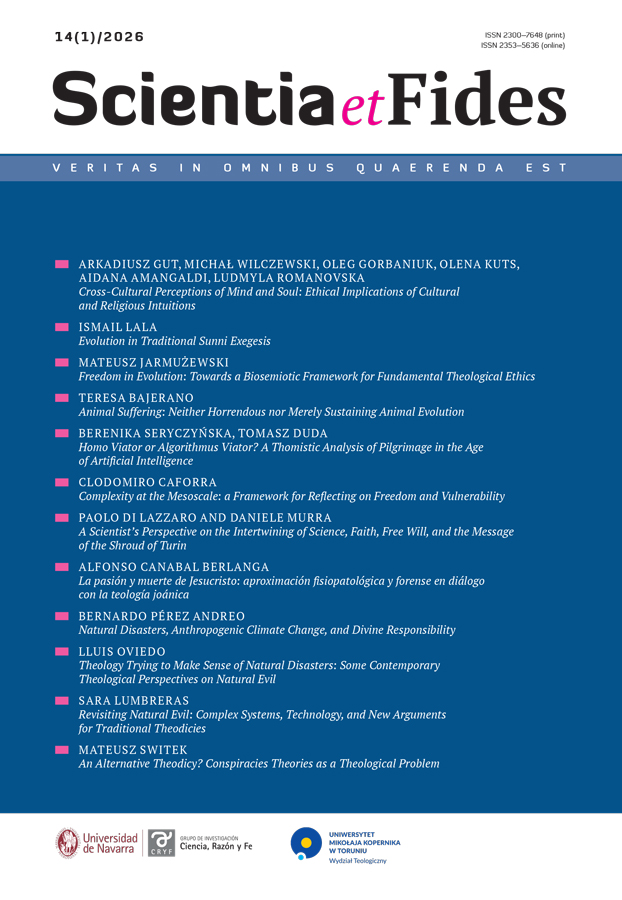
Complexity at the Mesoscale: a Framework for Reflecting on Freedom and Vulnerability
DOI:
https://doi.org/10.12775/SetF.2026.006Schlagworte
nanoscience, nanoscale physics, nanotechnology, mesoscale, human freedom and God’s action, determinism, quantum theory, chaos, randomness, complexityAbstract
Condensed matter nanoscience and nanotechnology have profoundly–transformed modern life, from advanced computing to biomedical applications.–In condensed matter, the mesoscale, here understood as the regime spanning–approximately nanometre to micrometre dimensions, marks a domain of structural–complexity, in which surface effects, collective phenomena, thermal fluctuations, and–nonlinear couplings often operate at comparable energy scales. In such a regime, no–single interaction term typically dominates the effective physical description, and–simplified asymptotic reductions give way to multiscale and numerically intensive–modelling approaches. Observable behaviour may therefore not be exhausted by–closed-form reduction without implying any suspension of underlying physical law.–Despite its scientific importance, the mesoscale has received comparatively little–philosophical attention. Philosophical and theological reflection has traditionally–concentrated on the cosmic scale, where gravitational order suggests intelligibility,–or on the quantum scale, where formal indeterminacy has prompted discussions–of contingency and divine action. By contrast, the mesoscale has received–comparatively less attention, even though biological organisation and embodied–human existence crucially depend upon processes operating within the mesoscale–regime.–This paper proposes that mesoscale complexity offers a fruitful context for revisiting–questions of freedom, suffering, and the privation of good. Rather than opposing 14(1)/2026–scientific explanation and metaphysical meaning, the mesoscale is presented not as–a distinct ontological realm, but as a structurally intermediate regime in which stable–laws and dynamical openness coexist, thereby inviting renewed dialogue between–philosophy of science, natural philosophy, and theology.
Literaturhinweise
Abbagnano, Nicola and Fornero Giovanni. 2001. Storia della filosofia. Turin: UTET.
Adams, Marilyn McCord. 1999. Horrendous evils and the goodness of God. Ithaca: Cornell University Press.
Allison, Lizabeth A. 2021. Fundamental molecular biology. Hoboken: John Wiley & Sons.
Aquinas, Thomas. 2025. Summa contra gentiles. San Antonio: Henderson Publishing. (Original work published ca. 1260).
Aquinas, Thomas. 1947. Summa Theologiae. Translated by the Fathers of the English Dominican Province. New York: Benziger Bros. (Original work published ca. 1270).
Augustine. 1961. The enchiridion on faith, hope and love. Washington: Regnery Publishing. (Original work published ca. 420).
Augustine. 2015. Confessions. Irvine: Xist Publishing. (Original work published ca. 400).
Banasik, Jacquelyn L. 2021. Pathophysiology. St. Louis: Elsevier.
Barth, Karl. 2004. Church Dogmatics. London–New York: T&T Clark. (Original work published 1936–1969).
Batterman, Robert W. 2001. The devil in the details: asymptotic reasoning in explanation, reduction, and emergence. Oxford: Oxford University Press.
Bhaskar, Roy. 2008. A realist theory of science. Abingdon: Routledge. (Original work published 1975).
Blundell, Steven J., and Katherine M. Blundell. 2010. Concepts in thermal physics. Oxford: Oxford University Press.
Boucher, Jamie G. 2025. Evil, ontology, and scripture: a diachronic analysis of Augustine of Hippo’s privatio boni concept. Doctoral dissertation. Berrien Springs: Andrews University.
Breakspear, Michael. 2017. “Dynamic models of large-scale brain activity.” Nature Neuroscience 20 (3): 340–52. https://doi.org/10.1038/nn.4497.
Carroll, Bradley W., and Dale A. Ostlie. 2017. An introduction to modern astrophysics. Cambridge: Cambridge University Press.
Carroll, Sean M. 2019. Spacetime and geometry. Cambridge: Cambridge University Press.
Cartwright, Nancy. 1999. The dappled world: a study of the boundaries of science. Cambridge: Cambridge University Press.
Chaisson, Eric J. 2001. Cosmic evolution: the rise of complexity in nature. Cambridge: Harvard University Press.
Craig, William Lane. 2008. Reasonable faith: Christian truth and apologetics. Wheaton: Crossway.
Cullity, Bernard Dennis, and Chad D. Graham. 2011. Introduction to magnetic materials. Hoboken: John Wiley & Sons.
Davies, Paul. 2007. The Goldilocks enigma: why is the universe just right for life? Boston: Houghton Mifflin.
Dehaene, Stanislas, and Jean-Pierre Changeux. 2011. “Experimental and theoretical approaches to conscious processing.” Neuron 70 (2): 200–27. https://doi.org/10.1016/j.neuron.2011.03.018.
Dobson Christopher M. 2003. Protein folding and misfolding. Nature 426 (6968): 884–90. https://doi.org/10.1038/nature02261.
Einstein, Albert. 1905. “On a heuristic point of view concerning the production and transformation of light.” Annalen der Physik 17: 132–48.
Ellis, George F. R. 2012. “Top-down causation and emergence: some comments on mechanisms.” Interface Focus 2 (1): 126–40. https://doi.org/10.1098/rsfs.2011.0062.
Esposito, Massimiliano, Katja Lindenberg, and Christian Van den Broeck. 2010. “Entropy production as correlation between system and reservoir.” New Journal of Physics 12 (1): 013013. https://doi.org/10.1088/1367-2630/12/1/013013.
Friston, Karl. 2010. “The free-energy principle: a unified brain theory?” Nature Reviews Neuroscience 11 (2): 127–38. https://doi.org/10.1038/nrn2787.
George, Soney C. and Tawiah Benjamin. 2024. Nanotechnology in societal development. Berlin: Springer Nature.
Giddings, Steven B. 2025. “Quantum gravity observables: observation, algebras, and mathematical structure.” Journal of Physics A: Mathematical and Theoretical 58 (4): 415401. https://doi.org/10.1088/1751-8121/ae0b12.
Giustino, Feliciano. 2014. Materials modelling using density functional theory. Oxford: Oxford University Press.
Goold, John, Marcus Huber, Arnau Riera, Lídia del Rio, and Paul Skrzypczyk. 2016. “The role of quantum information in thermodynamics- a topical review.” Journal of Physics A: Mathematical and Theoretical 49 (14): 143001. https://doi.org/10.1088/1751-8113/49/14/143001.
Green, Natalie A., Mariana Rodrigues, Stephanie Espinoza Perez, Annette Milu, Gabrielle Martin, Janice Jachero Caldas, Sabrina Loureiro, and Stephanie H. Cook. 2025. “Exploring intersectionality in psychoneuroendocrinology research: a systematic review.” Psychoneuroendocrinology 180: 107536. https://doi.org/10.1016/j.psyneuen.2025.107536.
Griffiths, David. 2020. Introduction to elementary particles. Hoboken: John Wiley & Sons.
Hanahan, Douglas and Weinberg, Robert A. 2011. “Hallmarks of cancer: the next generation.” Cell 144 (5): 646–74. https://doi.org/10.1016/j.cell.2011.02.013.
Hanc, Józef, Slavomir Tuleja, and Martina Hancova. 2004. “Symmetries and conservation laws: consequences of Noether’s theorem.” American Journal of Physics 72 (4): 428–35. https://doi.org/10.1119/1.1591764.
Heisenberg, Werner. 1958. Physics and philosophy: the revolution in modern science. New York: Harper & Row.
Heller, Michal P., Jacopo Papalini, and Tim Schuhmann. 2025. “Krylov spread complexity as holographic complexity beyond Jackiw-Teitelboim gravity.” Physical Review Letters 135 (15): 151602. https://doi.org/10.1103/spcr-jgm6.
Herce, Rubén, and Sara Lumbreras. 2024. “The perception of pain and suffering of the weak, the innocent and the marginalized from evolution and from Christian theology.” Scientia et Fides 12 (1): 73–88. https://doi.org/10.12775/SetF.2024.004.
Herculano-Houzel, Suzana. 2009. “The human brain in numbers: a linearly scaled-up primate brain.” Frontiers in Human Neuroscience 3: 857. https://doi.org/10.3389/neuro.09.031.2009.
Hick, John. 1966. Evil and the God of love. London: Palgrave Macmillan (rev. ed. 2010).
Hoefer, Carl. 2003. Causal determinism. Stanford: Stanford Encyclopedia of Philosophy.
Jones, Richard A. L. 2002. Soft condensed matter. Oxford: Oxford University Press.
Kandel, Eric R., Schwartz, James H., Jessell, Thomas M., Siegelbaum, Steven, and Hudspeth, A.J. 2012. Principles of neural science. New York: McGraw-Hill.
Kant, Immanuel. 1998. Critique of pure reason. Cambridge: Cambridge University Press. (Original work published 1781).
Longo, Dan L., Anthony S. Fauci, Dennis L. Kasper, Stephen L. Hauser, J. Larry Jameson, Joseph Loscalzo, Steven M. Holland, and Carol A. Langford. 2022. Harrison’s principles of internal medicine. New York: McGraw-Hill.
Koeppen, Bruce M., and Bruce A. Stanton. 2023. Berne and Levy physiology. Philadelphia: Elsevier.
Koestler, Arthur. 1959. The sleepwalkers: a history of man’s changing vision of the universe. London: Hutchinson & Co.
Langacker, Paul. 2017. The standard model and beyond. Milton Park: Taylor & Francis.
Layzer, David. 1990. Cosmogenesis: the growth of order in the Universe. Oxford: Oxford University Press.
Leibniz, Gottfried Wilhelm. 1985. Theodicy: essays on the goodness of God, the freedom of man and the origin of evil. Chicago: Open Court. (Original work published 1710).
Lewis, William D., Seth Lilly, and Kristin L. Jones. 2020. “Lymphoma: diagnosis and treatment.” American Family Physician 101(1): 34–41.
Ligler, Frances S., and Henry S. White. 2013. “Nanomaterials in analytical chemistry.” Analytical Chemistry 85 (23): 11161–11162. https://doi.org/10.1021/ac403331m.
Lineweaver, Charles H., Paul C. W. Davies, and Michael Ruse. 2013. Complexity and the arrow of time. Cambridge: Cambridge University Press.
López Cambronero, Marcelo. 2023. “Metaverse, religions and metahumans: a window to a hypercontrolled post-pandemic world.” Scientia et Fides 11 (1): 121–35. https://doi.org/10.12775/SetF.2023.010.
Lorenz, Edward N. 1963. “Deterministic nonperiodic flow.” Journal of the Atmospheric Sciences 20: 130–41. https://doi.org/10.1175/1520-0469(1963)020%3C0130:DNF%3E2.0.CO;2.
Martínez-Lucena, Jorge. 2023. “The issue of social control in late modernity: alienation and narrativity.” Scientia et Fides 11 (1): 137–154. https://doi.org/10.12775/SetF.2023.007.
Mate, C. Mathew, and Robert W. Carpick. 2019. Tribology on the small scale: a modern textbook on friction, lubrication, and wear. Oxford: Oxford University Press.
McCabe, Gordon. 2017. Cosmology and entropy: in search of further clarity. Pittsburgh: PhilSci Archive.
McLeish, Tom. 2016. Faith and wisdom in science. Oxford: Oxford University Press.
Messori, Vittorio. 1979. Ipotesi su Gesù. Turin: SEI.
Moltmann, Jürgen. 1972. “The ‘crucified God’ a trinitarian theology of the cross.” Interpretation 26 (3): 278–99. https://doi.org/10.1177/002096437202600302.
Moltmann, Jürgen. 1996. The coming of God: Christian eschatology. Minneapolis: Fortress Press.
Müller, Thomas, and Tomasz Placek. 2018. “Defining determinism.” The British Journal for the Philosophy of Science 69 (1): 215–52. https://doi.org/10.1093/bjps/axv049.
Mullins, Andy. 2025. “Skynet meets planet of the snakes. Removing metaphysical impediments to rogue AI.” Scientia et Fides 13 (2): 161–82. https://doi.org/10.12775/SetF.2025.009.
Newton, Isaac. 1999. The principia: mathematical principles of natural philosophy. Berkeley: University of California Press. (Original work published 1687).
Nielsen, Michael A., and Isaac L. Chuang. 2010. Quantum computation and quantum information. Cambridge: Cambridge University Press.
Ormerod, Neil. 2022. “Providence, apocalypse and the pandemic.” The Australian & New Zealand Theological Review 54: 2.
Oviedo, Lluis. 2024. “Evolutionary explanations of pain and suffering: a ‘gift to theology’ or a challenge?” Scientia et Fides 12 (1): 89–105. https://doi.org/10.12775/SetF.2024.005.
Patel, Vihan M., and Charles H. Lineweaver. 2017. “Solutions to the cosmic initial entropy problem without equilibrium initial conditions.” Entropy 19 (8): 411. https://doi.org/10.3390/e19080411.
Peters, Ted Frank. 2024. “Christian transhumanism and transhumanist Christianity.” Scientia et Fides 12 (2): 65–82. https://doi.org/10.12775/SetF.2024.016.
Planelles, Susana, Dominik R. Schleicher, and Andrei Mikhailovich Bykov. 2015.
“Large-scale structure formation: from the first non-linear objects to massive galaxy clusters.” Space Science Reviews 188 (1): 93–139. https://doi.org/10.1007/s11214-014-0045-7.
Plato. 2000. Timaeus (D. J. Zeyl, Trans.). Indianapolis: Hackett Publishing. (Original work published ~360 BC).
Pollard, William Grosvenor. 1958. Chance and providence: God’s action in a world governed by scientific law. New York City: Scribner.
Polkinghorne, John. 1998a. Belief in God in an age of science. London: Yale University Press.
Polkinghorne, John. 1998b. Science and providence: God’s interaction with the world. Philadelphia: Templeton Foundation Press.
Polkinghorne, John. 2000. Faith, science and understanding. London: Yale University Press.
Pope, Francis. 2015. Laudato Si’. Milan: San Paolo Edizioni.
Psillos, Stathis. 2005. Scientific realism: how science tracks truth. London: Routledge.
Roszak, Piotr, and Saśa Horvat. 2024. “Pain, life, and theodicy: exploring uncharted territory.” In Overcoming reductionism and crafting a new synthesis: theodicy confronting pain and suffering. Berlin: Springer Nature. https://doi.org/10.1007/978-3-031-62498-8_3.
Qin, Chenxi, Hao Yang, Yaqiong Lu, Bin Li, Shuanhong Ma, Yanfei Ma, and Feng Zhou. 2025. “Tribology in nature: inspirations for advanced lubrication materials.” Advanced Materials (51) 2420626. https://doi.org/10.1002/adma.202420626.
Schofield, Rebecca, Leon Menezes, and Stephen Richard Underwood. 2021. “Nuclear cardiology: state of the art.” Heart 107 (12): 954–61. https://doi.org/10.1136/heartjnl-2019-315628.
Seitz, Rüdiger J. 2024. “Beliefs in pain and suffering: a cognitive neuroscience approach.” Scientia et Fides 12 (1): 51–71. https://doi.org/10.12775/SetF.2024.003.
Simpson, William and Oldfield Christopher. 2025. “Why middle-sized matters to science and religion.” Scientia et Fides 13 (2): 7–21. https://doi.org/10.12775/SetF.2025.014.
Šmejkal, Libor, Jairo Sinova, and Tomas Jungwirth. 2022. “Beyond conventional ferromagnetism and antiferromagnetism: a phase with nonrelativistic spin and crystal rotation symmetry.” Physical Review X 12 (3): 031042. https://doi.org/10.1103/PhysRevX.12.031042.
Stewart, Ian, and Martin Golubitsky. 2010. Fearful symmetry: is God a geometer? New York: Dover Publications.
Teilhard, de Chardin Pierre. 1955. The phenomenon of man (B. Wall, Trans.). New York: Harper & Brothers.
Tokura, Yoshinori, and Naoya Kanazawa. 2020. “Magnetic skyrmion materials.” Chemical Review 121 (5): 2857–97. https://doi.org/10.1021/acs.chemrev. 0c00297.
Tononi, Giulio, Melanie Boly, Marcello Massimini, and Christof Koch. 2016. “Integrated information theory: from consciousness to its physical substrate.” Nature Reviews Neuroscience 17 (7): 450–61. https://www.nature.com/articles/nrn.2016.44.pdf.
Torrance, Thomas F. 1981. Divine and contingent order. Oxford: Oxford University Press.
Tsuboyama, Kotaro, Justas Dauparas, Jonathan Chen, Elodie Laine, Yasser Mohseni Behbahani, Jonathan J. Weinstein, Niall M.Mangan, Sergey Ovchinnikov and Gabriel J Rocklin. 2023. “Mega-scale experimental analysis of protein folding stability in biology and design.” Nature 620 (7973): 434–44. https://doi.org/10.1038/s41586-023-06328-6.
Vallis, Geoffrey K. 2017. Atmospheric and oceanic fluid dynamics. Cambridge: Cambridge University Press.
Van Fraassen, Bas C. 1980. The scientific image. Oxford: Oxford University Press.
Vatican Council II. 1965. Gaudium et Spes. Vatican City: Libreria Editrice Vaticana.
Vilenkin, Alexander, and E. Paul S. Shellard. 1994. Cosmic strings and other topological defects. Cambridge: Cambridge University Press.
Voltaire. 2020. Candide. London: Macmillan Collector’s Library (Original work published 1759).
Wahlberg, Mats. 2024. “Natural selection, scarcity and evil: reflections on the fittingness of evolution as a divine instrument of Creation.” Scientia et Fides 12 (1): 107–18. https://doi.org/10.12775/SetF.2024.006.
Wald, Robert M. 2001. “The thermodynamics of black holes.” Living Reviews in Relativity 4 (1): 6. https://doi.org/10.12942/lrr-2001-6.
Wallace, David. 2012. The emergent multiverse: quantum theory according to the Everett interpretation. Oxford: Oxford University Press.
Was, Gary S. 2007. Fundamentals of radiation materials science: metals and alloys. New York: Springer.
Webster, Craig, and Stanislav Ivanov. 2024. “Religiosity and attitudes towards robots: results from a global survey.” Scientia et Fides 12 (2): 197–215. https://doi.org/10.12775/SetF.2024.022.
Weyl, Hermann. 1952. Symmetry. Princeton: Princeton University Press.
Wilkinson, David. 2025. How does God act in the world? Eugene: Cascade Books.
Wilming, Henrik, Michael J. Kastoryano, Albert H. Werner and Jens Eisert. 2017. “Emergence of spontaneous symmetry breaking in dissipative lattice systems.” Journal of Mathematical Physics 58 (3): 033302. https://doi.org/10.1063/1.4978328.
Wilson, Kenneth G. 1979. “Problems in physics with many scales of length.” Scientific American 241 (2): 158–79. https://www.jstor.org/stable/24965270.
Worrall, John. 1989. “Structural realism: the best of both worlds?” Dialectica 43 (1–2): 99–124. https://doi.org/10.1111/j.1746-8361.1989.tb00933.x.
Young, Hugh D., and Roger A. Freedman. 2016. University Physics with Modern Physics. Boston: Addison-Wesley.
Zee, Anthony. 2016. Group theory in a nutshell for physicists. Princeton: Princeton University Press.
Zubko, Pavlo, Stefano Gariglio, Marc Gabay, Philippe Ghosez, and Jean-Marc Triscone. 2011. “Interface physics in complex oxide heterostructures.” Annual Review of Condensed Matter Physics 2 (1): 141–65. https://doi.org/10.1146/annurev-conmatphys-062910-140445.
Downloads
Veröffentlicht
Zitationsvorschlag
Ausgabe
Rubrik
Lizenz
Copyright (c) 2026 Miro

Dieses Werk steht unter der Lizenz Creative Commons Namensnennung - Keine Bearbeitungen 4.0 International.
CC BY ND 4.0. The Creator/Contributor is the Licensor, who grants the Licensee a non-exclusive license to use the Work on the fields indicated in the License Agreement.
- The Licensor grants the Licensee a non-exclusive license to use the Work/related rights item specified in § 1 within the following fields: a) recording of Work/related rights item; b) reproduction (multiplication) of Work/related rights item in print and digital technology (e-book, audiobook); c) placing the copies of the multiplied Work/related rights item on the market; d) entering the Work/related rights item to computer memory; e) distribution of the work in electronic version in the open access form on the basis of Creative Commons license (CC BY-ND 3.0) via the digital platform of the Nicolaus Copernicus University Press and file repository of the Nicolaus Copernicus University.
- Usage of the recorded Work by the Licensee within the above fields is not restricted by time, numbers or territory.
- The Licensor grants the license for the Work/related rights item to the Licensee free of charge and for an unspecified period of time.
FULL TEXT License Agreement
Stats
Number of views and downloads: 374
Number of citations: 0


