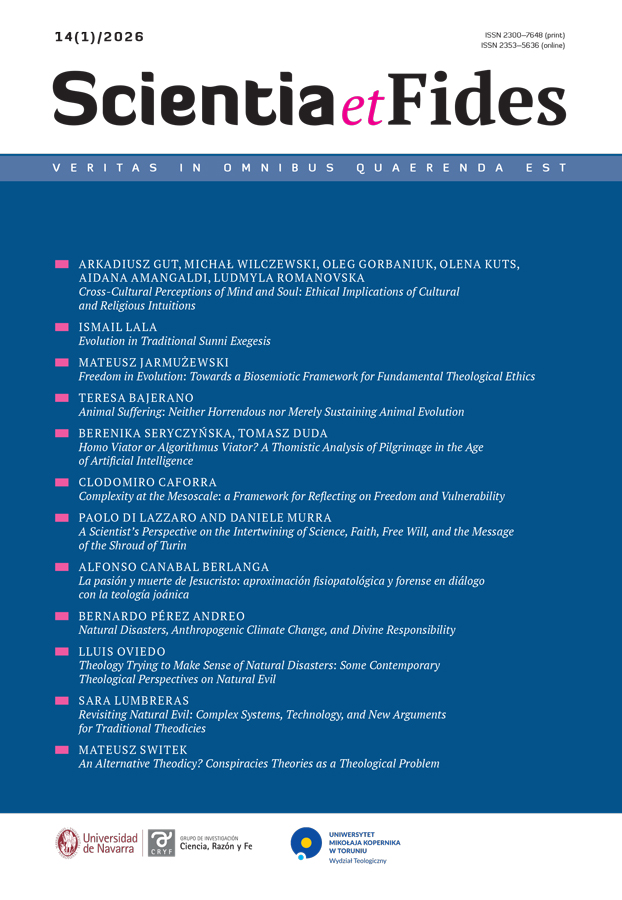
Revisiting Natural Evil
Complex Systems, Technology, and New Arguments for Traditional Theodicies
DOI:
https://doi.org/10.12775/SetF.2026.011Słowa kluczowe
Theodicy, Complex Systems, Technology, Natural evilAbstrakt
This paper revisits our understanding of natural evil and its related defences in the light of relatively new evidence in Complex Systems Science and Science and Technology Studies.
Complex Systems Science shows unpredictability is a necessary feature of a universe open to innovation and the emergence of life and consciousness. This casts the Free Process, Natural Order, and Process Defences in a fresh light: God created a truly free cosmos, governed by dependable laws that, however, foster novelty and growth, and natural evil is a necessary by‑product of a living, adaptive creation.
In addition, overcoming natural evil has been the key force in developing Science and Technology. Understanding this strengthens the Better Goods and Soul-making Defences by showing that hardship fuels our drive for insight and creating supportive communities.
These insights present evil not as a punishment or an anomaly but as an intrinsic component of a dynamic creation that invites both divine freedom and human responsibility.
Bibliografia
Araujo, Ana Cristina. 2006. “European Public Opinion and the Lisbon Earthquake.” European Review 14 (3): 313–19. https://doi.org/10.1017/S1062798706000317.
Clarke, Ben J., Friederike E. L. Otto, and Richard G. Jones. 2021. “Inventories of Extreme Weather Events and Impacts: Implications for Loss and Damage from and Adaptation to Climate Extremes.” Climate Risk Management 31:100285. https://doi.org/10.1016/j.crm.2021.100285.
Diamandis, Peter H., and Steven Kotler. 2012. Abundance: The Future Is Better than You Think. New York: Simon & Schuster.
Drake, Brendan L. 2012. “The Influence of Climatic Change on the Late Bronze Age Collapse and the Greek Dark Ages.” Journal of Archaeological Science 39 (6): 1862–70. https://doi.org/10.1016/j.jas.2012.01.029.
Ebi, Kristie L., and Jordana K. Schmier. 2005. “A Stitch in Time: Improving Public Health Early Warning Systems for Extreme Weather Events.” Epidemiologic Reviews 27 (1): 115–21. https://doi.org/10.1093/epirev/mxi006.
Giannoulis, Konstantinos, and Vaitsa Giannouli. 2021. “Religiosity and Spirituality in the Era of the COVID-19 Pandemic: An Overview of Exploring Emotional Parameters.” Encephalos 58: 24–28.
Giannouli, Vaitsa, and Konstantinos Giannoulis. 2020. “Gazing at Medusa: Alzheimer’s Dementia through the Lenses of Spirituality and Religion.” Health Psychology Research 8 (1):8833. https://doi.org/10.4081/hpr.2020.8833.
Gendron, Bernard. 1977. Technology and the Human Condition. New York: St. Martin’s Press.
Griffin, David Ray. 1976. God, Power, and Evil: A Process Theodicy. Philadelphia: Westminster Press.
Hartshorne, Charles. 1984. Omnipotence and Other Theological Mistakes. Albany: State University of New York Press.
Haught, John F. 2000. God after Darwin: A Theology of Evolution. Boulder: Westview Press.
Hick, John. 1977. Evil and the God of Love. 2nd ed. New York: Harper & Row.
Hutchinson, Robert. 2014. The Spanish Armada. New York: Macmillan.
Irenaeus. 1885. Against Heresies. In Ante-Nicene Fathers, vol. 1, The Apostolic Fathers, Justin Martyr, Irenaeus, edited by Alexander Roberts and James Donaldson. Buffalo: Christian Literature Publishing Co. Originally written ca. 180.
Keim, Mark E. 2020. “The Epidemiology of Extreme Weather Event Disasters (1969–2018).” Prehospital and Disaster Medicine 35 (3): 267–71. https://doi.org/10.1017/S1049023X20000461.
Leibniz, Gottfried Wilhelm. 1985. Teodicea: Ensayo sobre la bondad de Dios, la libertad del hombre y el origen del mal. Spanish ed. Mexico City: Fondo de Cultura Económica. Originally published 1791.
Lorenz, Edward N. 1963. “Deterministic Nonperiodic Flow.” Journal of the Atmospheric Sciences 20 (2): 130–41. https://doi.org/10.1175/1520-0469(1963)020<0130:DNF>2.0.CO;2.
Lumbreras, Sara. 2023. “Una perspectiva del mal en la ciencia y en la tecnología.” Cauriensia. Revista Anual de Ciencias Eclesiásticas 18: 677–92. https://doi.org/10.17398/2340-4256.18.677.
Mantini, Alessio. 2024. “A Franciscan Theological and Metaphysical Perspective about the Structure of the Cosmos.” In A Franciscan Theological-Metaphysical Foundation of Emergence: Theology and Science in an Enriching Dialogue, 179–264. Cham: Springer Nature Switzerland.
Mitchell, Melanie. 2009. Complexity: A Guided Tour. Oxford: Oxford University Press.
Murray, Michael J. 2008. Nature Red in Tooth and Claw: Theism and the Problem of Animal Suffering. Oxford: Oxford University Press.
Nixon, Ian G. 1985. “The Volcanic Eruption of Thera and Its Effect on the Mycenaean and Minoan Civilizations.” Journal of Archaeological Science 12 (1): 9–24. https://doi.org/10.1016/0305-4403(85)90012-3.
Oviedo, Lluis, Berenika Seryczyńska, Magdalena Jelińska, Piotr Roszak, Josefa Torralba, and Alfonso M. A. Bruno. 2025. “Is the Rosary Still Relevant? Exploring Its Impact on Mental Health and Well-Being: A Multinational Study.” Journal of Religion and Health 64 (2): 1173–94. https://doi.org/10.1007/s10943-025-02265-y.
Oviedo, Lluis O. 2024. “Evolutionary Explanations of Pain and Suffering: A ‘Gift to Theology’ or a Challenge.” Scientia et Fides 12 (1): 89–105. https://doi.org/10.12775/SetF.2024.005.
Peacocke, Arthur. 2004. Christianity and Science. Minneapolis: Fortress Press.
Peacocke, Arthur. 2006. All Things New: Explorations in Universal Christology. Maryknoll: Orbis Books.
Plantinga, Alvin. 1974. God, Freedom, and Evil. Grand Rapids: Eerdmans.
Polkinghorne, John. 1989. Science and Providence: God’s Interaction with the World. Boston: Shambhala.
Quinn, Philip L. 1993. “God, Moral Perfection, and Suffering.” In Reason and the Heart: A Prolegomenon to a Critique of Passional Reason, edited by Eleonore Stump, 121–45. Ithaca: Cornell University Press.
Roland, Alex. 2016. War and Technology: A Very Short Introduction. Oxford: Oxford University Press.
Sánchez Meca, Diego. 2013. Historia de la filosofía antigua y medieval. Madrid: Dykinson.
Southgate, Christopher. 2008. The Groaning of Creation: God, Evolution, and the Problem of Evil. Louisville: Westminster John Knox Press.
Stein, Ruediger. 1991. Accumulation of Organic Carbon in Marine Sediments: Results from the Deep Sea Drilling Project/Ocean Drilling Program (DSDP/ODP). Berlin: Springer-Verlag.
Swinburne, Richard. 1998. Providence and the Problem of Evil. Oxford: Clarendon Press.
Swinburne, Richard. 2004. The Existence of God. 2nd ed. Oxford: Clarendon Press.
van Inwagen, Peter. 2006. The Problem of Evil. Oxford: Clarendon Press.
Van Creveld, Martin. 2010. Technology and War: From 2000 BC to the Present. New York: Simon & Schuster.
Wahlberg, Mats. 2024. “Natural Selection, Scarcity and Evil: Reflections on the Fittingness of Evolution as a Divine Instrument of Creation.” Scientia et Fides 12 (1): 107–18. https://doi.org/10.12775/SetF.2024.006.
Zachos, James, Mark Pagani, Lisa Sloan, Ellen Thomas, and Katharina Billups. 2001. “Trends, Rhythms, and Aberrations in Global Climate 65 Ma to Present.” Science 292 (5517): 686–93. https://doi.org/10.1126/science.1059412.
Pobrania
Opublikowane
Jak cytować
Numer
Dział
Licencja
Prawa autorskie (c) 2026 Sara Lumbreras

Utwór dostępny jest na licencji Creative Commons Uznanie autorstwa – Bez utworów zależnych 4.0 Międzynarodowe.
CC BY ND 4.0. Posiadaczem prawa autorskiego (Licencjodawcą) jest Autor, który na mocy umowy licencyjnej udziela nieodpłatnie prawa do eksploatacji dzieła na polach wskazanych w umowie.
- Licencjodawca udziela Licencjobiorcy licencji niewyłącznej na korzystanie z Utworu/przedmiotu prawa pokrewnego w następujących polach eksploatacji: a) utrwalanie Utworu/przedmiotu prawa pokrewnego; b) reprodukowanie (zwielokrotnienie) Utworu/przedmiotu prawa pokrewnego drukiem i techniką cyfrową (e-book, audiobook); c) wprowadzania do obrotu egzemplarzy zwielokrotnionego Utworu/przedmiotu prawa pokrewnego; d) wprowadzenie Utworu/przedmiotu prawa pokrewnego do pamięci komputera; e) rozpowszechnianie utworu w wersji elektronicznej w formule open access na licencji Creative Commons (CC BY-ND 3.0) poprzez platformę cyfrową Wydawnictwa Naukowego UMK oraz repozytorium UMK.
- Korzystanie przez Licencjobiorcę z utrwalonego Utworu ww. polach nie jest ograniczone czasowo ilościowo i terytorialnie.
- Licencjodawca udziela Licencjobiorcy licencji do Utworu/przedmiotu prawa pokrewnego nieodpłatnie na czas nieokreślony
PEŁEN TEKST UMOWY LICENCYJNEJ >>
Statystyki
Liczba wyświetleń i pobrań: 314
Liczba cytowań: 0


