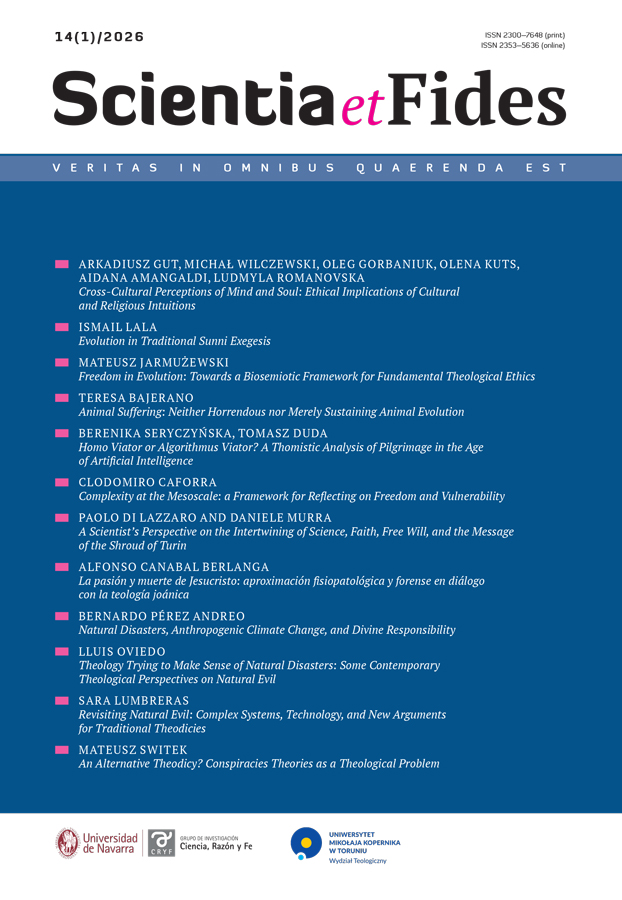
Evolution in Traditional Sunni Exegesis
DOI:
https://doi.org/10.12775/SetF.2026.002Schlagworte
Evolution, Sunni, Qur'an, Exegesis, Adam, ConsensusAbstract
Traditional Sunni commentaries of verses 33:72, 6:38, 24:41, and 2:30 of the Qur’an make it clear that Sunni exegetes endorsed the belief that creatures, imbued with consciousness, who were subject to moral law, and similar to humans, existed long before the creation of Adam. This would seem to allow creationism, human exceptionalism, and Adamic exceptionalism. However, traditional Sunni scholars dissociate the existence of creatures before and with Adam from he and his early progeny interbreeding with them. The qualifier of ‘single’ in Q4:1 is taken by Sunni exegetes as textual proof of exclusive descent from Adam, which would preclude Adamic exceptionalism. Yet the acceptance of human-jinn unions by some scholars in the Islamic tradition casts doubt on whether all exegetes would have denounced Adamic exceptionalism if that option were available. On the other hand, the fact that most Sunni exegetes accept Eve was created from Adam’s rib in order to affirm exclusive descent from Adam intimates that this would be their preference. The exceptionally high bar of universal scholarly agreement required for a consensus on the issue of exclusive descent cannot be claimed. Whether the more realistic bar of majority consensus is attained on this issue continues to be a vexed question. Further, it is difficult to argue that this majority consensus, even if it were attained, would be doctrinally binding since it only represents an exegetical consensus that is inherently of low evidentiary value. Therefore, all we can legitimately claim is most traditional Sunni exegetes’ views would only be consistent with creationism or human exceptionalism.
Literaturhinweise
Adang, Camilla. 2000. “Islam as the Inborn Religion of Mankind: The Concept of Fiṭra in the Works of Ibn Ḥazm.” Al-Qanṭara 21: 391–410.
Ali, Mansur. 2023. “The Human Being as the Mystery of Kun Fa Kān: An Engagement with Shoaib Ahmed Malik’s Islam and Evolution: Al-Ghazālī and the Modern Evolutionary Paradigm.” Theology and Science 21 (4): 732–44.
‘Alī al-Qārī, Mullā. 2002. Mirqāt al-mafātīḥ sharḥ mishkāt al-maṣābīḥ. Dār al-Fikr.
Ālūsī, Abu’l-Thanā, al- .1994. Al-Rūh al-ma‘ānī fī tafsīr al-Qur’ān al-aẓīm wa sab‘ al-mathānī. Beirut: Dār al-Kutub al-‘Ilmiyya.
Andani, Khalil. 2022. “Evolving Creation: An Ismaili Muslim Interpretation of Evolution.” Zygon: Journal of Religion and Science 57 (2): 443–66. https://doi.org/10.1111/zygo.12774.
Anwar, Khoirul, Abu Hapsin, Nazar Nurdin, Ubbadul Adzkiya, Iman Fadhilah, and Tedi Kholiludin. 2020. “Ka‘b Al-Ahbar: Founder of the Transformation Jewish Tradition to Islam.” ICON-ISHIC. https://doi.org/10.4108/eai.14-10-2020.2303851.
Aṣfahānī, Al-Rāghib, al-. 1999. Tafsīr Al-Rāghib Al-Aṣfahānī. Tanta: Tanta University Press.
Ashqar, Umar Sulaiman. 2005. The World of the Jinn and Devils, translated by Jamaal al-Din M. Zarabozo. Riyadh: International Islamic Publishing House.
‘Asqalānī, Ibn Ḥajar. 1959. Fatḥ al-bārī sharḥ ṣaḥīḥ al-Bukhārī. Dār al-Ma‘rifa.
Baghawī, Abū Muḥammad, al- .1997. Tafsīr al-Baghawī. Riyad: Dār Ṭayyiba.
Baqlī, Rūzbahān, al-. 2008. ‘Arā’is al-bayān fī ḥaqā’iq al-qur’ān. Beirut: Dār al-Kutub al-‘Ilmiyya.
Bauer, Karen. 2015. Gender Hierarchy in the Qur’ān: Medieval Interpretations, Modern Responses. Cambridge: Cambridge University Press.
Berg, Herbert. 2000. The Development of Exegesis in Early Islam. Surrey: Curzon Press.
Boyarin, Daniel. 2019. Judaism: The Genealogy of a Modern Notion. New Bruswick: Rutgers University Press.
Brown, Jonathan. 2007. The Canonization of al-Bukhārī and Muslim: The Formation and Function of the Sunnī Ḥadīth Canon. Leiden: Brill.
Brown, Jonathan. A. C. 2017. Hadith: Muhammad’s Legacy in the Medieval and Modern World (The Foundations of Islam). London: Oneworld.
Dajani, Rana. 2012. “Evolution and Islam’s Quantum Question.” Zygon: Journal of Religion and Science 47 (2): 343–53.
Calder, Norman. 1993. “Tafsīr from Ṭabarī to Ibn Kathīr: Problems in the Description of the Genre, Illustrated with Reference to the Story of Abraham.” In Approaches to the Qurʾan, edited by G. R. Hawting and A. A. Shareef, 101–40. London: Routledge.
Craig, William L. 2021. In Quest of the Historical Adam: A Biblical and Scientific Exploration. Michigan: Eerdmans.
Dhahabī, Muḥammad Ḥusayn, al-. N.d. Al-Tafsīr waʾl-mufassirūn. 3 vols. Cairo: Maktabat al-Wahbiyya.
Dogan, Recep. 2014. Usul al Tafsir: The Sciences and Methodology of the Qur’an. New Jersey: Tughra Books.
Doko, Enis. 2021. “Islam and Evolution: A Defense.” Kader 19 (2): 929–43.
Elias, Jamal J. 1998. “Sufism.” Iranian Studies 31 (3–4): 595–613.
El-Tobgui, Carl S. 2020. Ibn Taymiyya on Reason and Revelation: A Study of Dar’ al-ta‘ārud al-‘aql wa-l-naql. Leiden: Brill.
El-Zein, Amira. 2009. Islam, Arabs, and Intelligent World of the Jinn. New York: Syracuse University Press.
Guessoum, Nidhal. 2011. Islam’s Quantum Question: Reconciling Muslim Tradition and Modern Science. London: I.B. Tauris.
Hallaq, Wael. 2005. Islamic Legal Theories: An Introduction to Sunnī Uṣūl al-Fiqh. Cambridge: Cambridge University Press.
Ibn ‘Ajība, Abu’l-‘Abbās. 1998. Al-Baḥr al-madīd fī tafsīr al-qur’ān al-majīd. Ḥasan ‘Abbās Zakī.
Ibn Kathīr, ‘Imād al-Dīn. 1999. Tafsīr al-Qur’an al-‘aẓīm. Beirut: Dār al-Kutub al-‘Ilmiyya.
Ibn Manẓūr, Abu’l-Faḍl. 2000. Lisān al-‘arab. Beirut: Dār Ṣādar.
Inloes, Amina. 2023. “Other “Adams”: Twelver Shiʿism and Human Evolution.” Theology and Science 21 (4): 708–31.
‘Irāqī, Zayn al-Dīn, and Ibn al-‘Irāqī. N.d. Ṭarḥ al-tathrīb fī sharḥ al-taqrīb. Beirut: Dār Iḥyā al-Turāth al-‘Arabī.
Jalajel, David S. 2018. Tawaqquf and Acceptance of Human Evolution. Irving: Yaqeen Institute.
Jalajel, David S. 2022. “Presumptions about God’s Wisdom in Muslim Arguments for and against Evolution.” Zygon 57 (2): 467–89. https://doi.org/10.1111/zygo.12772.
Kamali, Mohammad H. 2013. Principles of Islamic Jurisprudence. Cambridge: Islamic Texts Society.
Khan, Nazir, and Yasir Qadhi. 2019. Human Origins: Theological Conclusions and Empirical Limitations. Irving: Yaqeen Institute, 2019.
Keller, Nuh Ha Mim. 2011. Sea without Shore: A Manual of the Sufi Path. Cornwall: Sunna Books.
Kocsenda, Karim. 2022. “Shi‘ī Readings of Human Evolution: Ṭabāṭabā’ī to Ḥaydarī.” Zygon 57 (2): 418–42.
Lane, Edward. 2003. An Arabic-English Lexicon, 8 vols. New Delhi/ Chennai: Asian Educational Services.
Lāshīn, Mūsā Shāhīn. 2002. Fatḥ al-mun‘im sharḥ ṣaḥīḥ Muslim. Cairo–Beirut: Dār al-Shurūq.
Losos, Jonathan. 2014. “What is Evolution?” In The Princeton Guide to Evolution, edited by Jonathan Losos, 3–9. Princeton: Princeton University Press.
Malik, Shoaib A.; Kulieva, Elvira.; and Ayub, Ayub. 2021. “Accepting Evolution Entails Kufr?: A Critical Appraisal of Nuh Ha Mim Keller’s Fatwa.” Zygon: Journal of Religion and Science 55(3): 638–62. https://doi.org/10.1111/zygo.12620.
Malik, Shoaib A. 2021. Islam and Evolution: Al-Ghazālī and the Modern Evolutionary Paradigm. London: Routledge.
Malik, Shoaib A. 2023. “Defending Islam and Evolution: Al-Ghazālī and the Modern Evolutionary Paradigm: Abrahamic Dialogues and Interdisciplinary Insights.” Theology and Science 21 (4): 745–80. https://doi.org/10.1080/14746700.2023.2255955.
Māwardī, Abu’l-Ḥasan, al-. N.d. Al-Nukat wa’l-‘uyūn. Beirut: Dār al-Kutub al-‘Ilmiyya.
Maẓharī, Muḥammad Thanā’ Allāh, al-. 1992. Tafsīr al-Maẓharī. Pakistan: Maktabat al-Rushdiyya.
Nafi, Basheer M. 2002. “Abu al-Thana’ al-Alusi: An Alim, Ottoman Mufti, and Exegete of the Qur’an.” International Journal of Middle East Studies 34 (3): 465–94.
Nasafī, Abū Ḥafs, al-. 1998. Tafsīr al-Nasafī. Beirut: Dār al-Kalim al-Ṭayyib.
Nasir, Jamal J. 2009. The Islamic Law of Personal Status. Leiden: Brill.
Nawawī, Yaḥyā ibn Sharaf. 1972. Al-Minhāj sharḥ ṣaḥīḥ Muslim ibn al-Hajjāj. Beirut: Dār Iḥyā’ al-Turāth al-‘Arabī.
Nasr, Seyyed Hossein. 2006. “On the Question of Biological Origins.” Islam and Science 4 (2): 181–97.
Pānīpatī, Muḥammad Thanā’ Allāh, 1991. Tafsīr al-Maẓharī. Pakistan: Maktabat al-Rushdiyya.
Qurṭubī, Abū ‘Abd Allāh, al-. 1964. Tafsīr al-Qurṭubī. Cairo: Dār al-Kutub al-Miṣriyya.
Rashid, Rafāqat. 2024. Exploring Tawaqquf in Islamic Theology: Navigating Belief Obligations, Adamic Exceptionalism, and Application Challenges. Bradford: Al Balāgh Academy Publication Papers.
Rāzī, Fakhr al-Dīn, al-. 1999. Mafātīḥ al-ghayb. Beirut: Dār Iḥyā’ al-Turāth al-‘Arabī.
Sā‘ātī, Aḥmad ibn ‘Abd al-Raḥmān. N.d. Al-Fatḥ al-rabbānī li-tartīb musnad al-imām Aḥmad al-shaybānī wa ma‘ah bulūgh al-amānī min asrār al-fatḥ al-rabbānī. Beirut: Dār Iḥyā’ al-Turāth al-‘Arabī.
Riḍā, Muḥammad Rashīd. 1990. Tafsīr al-manār. Cairo: Al-Hay’a al-Miṣriyya al-‘Āmma li’l-Kitāb.
Saeed, Abdullah. 2006. Interpreting the Qur’an: Towards a Contemporary Approach. London & New York: Routledge.
Saeed, Sohaib. 2018. The Great Exegesis (Al-Tafsīr al-Kabīr): Volume 1, The Fātiḥa. Cambridge: Islamic Texts Society.
Saleh, Walid. 2004. The Formation of the Classical Tafsīr Tradition. Leiden–Boston: Brill.
Saleh, Walid. 2016. “Rereading al-Ṭabarī through al-Māturīdī: New Light on the Third Century Hijrī.” Journal of Qur’anic Studies 18 (2): 180–209.
Schaffner, Stephen. 2021. “What Genetics Says About Adam and Eve.” Biologos. Accessed online 20 April 2022. https://biologos.org/articles/what-genetics-say-about-adam-and-eve.
Scott, Eugenie C. 1997. “Antievolution and Creationism in the United States.” Annual Review of Anthropology 26: 263–89.
Stoltzfus, Arlin. 2021. Mutation, Randomness, and Evolution. Oxford: Oxford University Press.
Suyūṭī, Jalāl al-Dīn, al-. N.d. Al-Durr al-manthūr fī tafsīr bi’l-ma’thūr. Beirut: Dār al-Fikr.
Swamidass, S. Joshua. 2019. The Genealogical Adam and Eve: The Surprising Science of Universal Ancestry. London: IVP Academic.
Ṭabarī, Ibn Jarīr, al-. 2000. Jāmi‘ al-bayān fī ta’wīl āy al-Qur’ān. Beirut: Mu’assasat al-Risāla.
Taslaman, Caner. 2020. Can a Muslim Be an Evolutionist? Istanbul: Istanbul Yayınevi.
Tha‘ālibī, ‘Abd al-Raḥmān, al-. 1998. Al-Jawāhir al-ḥisān fī tafsīr al-Qur’ān. Beirut: Dār Iḥyā al-Turāth al-‘Arabī.
Tha‘labī, Abū Isḥāq, al-. 2015. Al-Kashf wa’l-bayān ‘an tafsīr al-qur’ān. Jeddah: Dār al-Tafsīr.
Ṭībī, Al-Ḥusayn ibn ‘Abd Allāh. 1997. Shar Al-Ṭībī ‘alā mishkāt al-maṣābīḥ. Riyadh: Maktaba Nazzār Muṣṭafā al-Bāz.
Tottoli, Roberto. 1999. “Origin and Use of the Term Isrāʾīliyyāt in Muslim Literature.” Arabica 46 (2): 193–210.
Van Ess, Josef. 2006. The Flowering of Muslim Theology, translated by Jane Marie Todd. Cambridge–London: Harvard University Press.
Wansbrough, John. 1988. Quranic Studies: Sources and Methods of Scriptural Interpretation. Oxford: Oxford University Press.
Wood, Bernard. 2019. Human Evolution: A Very Short Introduction. Oxford: Oxford University Press.
Yusuf, Hamza. 2009. The Creed of Imam al-Tahawi. Louisville: Fons Vitae.
Downloads
Veröffentlicht
Zitationsvorschlag
Ausgabe
Rubrik
Lizenz
Copyright (c) 2026 Ismail Lala

Dieses Werk steht unter der Lizenz Creative Commons Namensnennung - Keine Bearbeitungen 4.0 International.
CC BY ND 4.0. The Creator/Contributor is the Licensor, who grants the Licensee a non-exclusive license to use the Work on the fields indicated in the License Agreement.
- The Licensor grants the Licensee a non-exclusive license to use the Work/related rights item specified in § 1 within the following fields: a) recording of Work/related rights item; b) reproduction (multiplication) of Work/related rights item in print and digital technology (e-book, audiobook); c) placing the copies of the multiplied Work/related rights item on the market; d) entering the Work/related rights item to computer memory; e) distribution of the work in electronic version in the open access form on the basis of Creative Commons license (CC BY-ND 3.0) via the digital platform of the Nicolaus Copernicus University Press and file repository of the Nicolaus Copernicus University.
- Usage of the recorded Work by the Licensee within the above fields is not restricted by time, numbers or territory.
- The Licensor grants the license for the Work/related rights item to the Licensee free of charge and for an unspecified period of time.
FULL TEXT License Agreement
Stats
Number of views and downloads: 1489
Number of citations: 0


