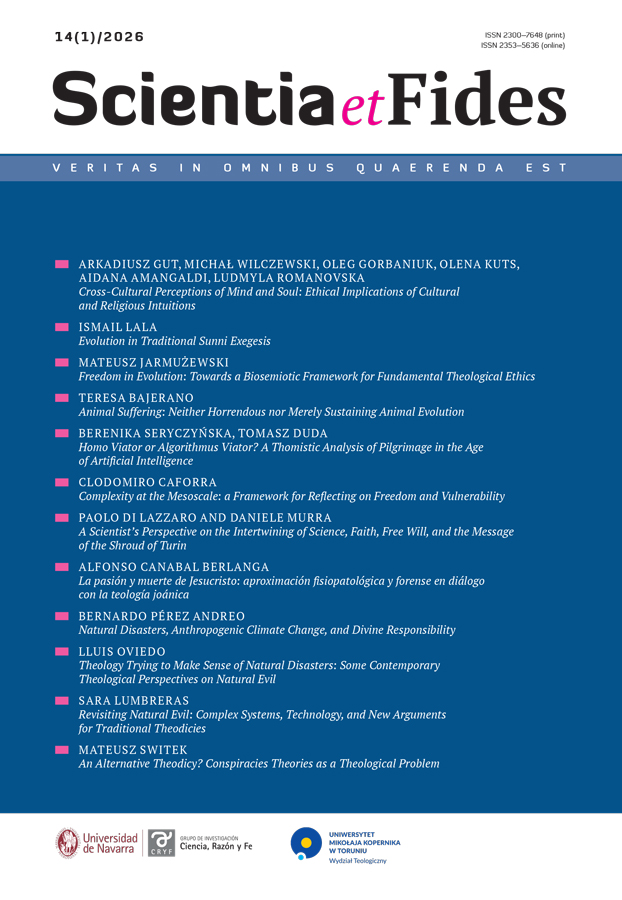
Animal Suffering
Neither Horrendous nor Merely Sustaining Animal Evolution
DOI:
https://doi.org/10.12775/SetF.2026.013Keywords
holiness, pelican heaven, the other’s mental content, self-control, spontaneous altruismAbstract
Regarding animal suffering —a theological problem that relatively recent developments intensify—, I propose two points. (1) For human holiness to be able to emerge, we humans must possess a double inheritance. On the one hand, in our immediate evolutionary past we acquired two immensely adaptive capacities –firstly, the ability to grasp others’ mental contents, and, later, the self-directed speech, which enhances the self-control that had previously emerged at protecting and improving one’s own reputation, i.e., one’s own social interests. On the other hand, we inherit from an enormously long evolutionary process the pleasure–pain pair. This pair, which serves as a guide for behavior, is essential for both animals and humans; yet at times it obscures the knowledge that we, unlike non-human animals, possess of another person’s mental contents. Thus, a conflict arises between pursuing my physical and social interests, prompted by my pleasure/pain, or, by contrast, recognizing that the needs of another person are also important. Consequently, since this conflict makes human holiness possible, we can say that the progressive evolution of animal suffering was one of the causes that made human holiness possible. (2) The horrendous nature of human suffering need not be attributed to the suffering of animals. In moments of pain or danger, animals focus solely on the immediate future as framed by their goal of escaping. This is the only adaptive animal behavior in such situations. By contrast, humans additionally deploy their capacity to evoke past experiences, non-immediate futures, or even states they have already realized are impossible to attain, all of which can at times be useful in the attempt to creatively find a way to escape, but, when they are not, greatly amplify pain.
References
Amici, Federica et al. 2025. “Experience with animals, religion, and social integration predict anthropomorphism.” iScience. https://doi.org/10.1016/j.isci.2025.112693.
Andrews, Kristin & Susana Monsó. 2025. “Does comparative cognition have a WEIRD problem?” Journal of Comparative Psychology. https://doi.org/10.1037/com0000423.
Bai, Dawei, Alon Hafri, Véronique Izard, Chaz Firestone, and Brent Strickland. 2025. “Core Perception: Re-imagining Precocious Reasoning as Sophisticated Perceiving.” Behavioral and brain sciences. https://doi.org/10.1017/S0140525X25102756.
Baron, Mark, Minert, Anne & Devor, Marshall. 2025. “Pain and the evolutionary origins of subjective experience.” Behavioral and Brain Sciences. https://doi.org/10.1017/S0140525X25100708.
Baumard, Nicolas, Jean-Baptiste André, and Dan Sperber. 2013. A Mutualistic Approach to Morality. Behavioral and Brain Sciences 36: 59–122. https://doi.org/10.1017/S0140525X11002202.
Bejarano, Teresa. 1997. La explicación de la conciencia ¿Qué se puede hacer hoy? Revista de Filosofía, vol. X, nº17: 83–104. URI: https://hdl.handle.net/11441/106627.
Bejarano, Teresa. 2011. Becoming human. Benjamins.
Bejarano, Teresa. 2014. “From Holophrase to Syntax: Intonation and the Victory of Voice over Gesture.” HUMANA.MENTE 7 (27): 21–37. https://www.humanamente.eu/index.php/HM/article/view/95.
Bejarano, Teresa. 2022. “The Most Demanding Moral Capacity: Could Evolution Provide Any Base?” Isidorianum 31 (2): 91–126. https://doi.org/10.46543/ISID.2231.1056.
Bejarano, Teresa. 2025. “The Origin of Human Theory-of-Mind.” Humans, 5, 5. https://doi.org/10.3390/humans5010005.
Conradie, Ernst. 2017. “Do Only Humans Sin? In Conversation with Frans de Waal.” In Issues in Science and Theology: Are We Special?, 117–33. https://doi.org/10.1007/978-3-319-62124-1_9.
Conradie, Ernst 2018. “The Christian faith and evolution.” Verbum et Ecclesia 39 (1): 2–14. https://doi.org/10.4102/ve.v39i1.1843.
De Waal, Frans 2010. The Age of Empathy. New York City: Three Rivers Press.
Deane-Drummond, Celia 2018. “Perceiving natural evil through the lens of Divine glory?” Zygon 53: 792–807. https://doi.org/10.1111/zygo.12432.
Edwards, Denis. 1999. The God of Evolution: A Trinitarian Theology. Paulist Press.
Fleming, Stephen and Matthias Michel. 2025. “Sensory Horizons and the Functions of Conscious Vision.” Behavioral & Brain Sciences. https://doi.org/10.1017/S0140525X25000068.
Gainotti, Guido. 2026. “Emotions Amygdala and the Right Hemisphere.” https://doi.org/10.2139/ssrn.6145189.
Griffiths, Paul. 2018. Decreation: The Last Things of All Creatures. Waco: Baylor University Press.
Hartshorne, Charles. 1984. “Indeterministic freedom as universal principle.” Journal of Social Philosophy 15: 5–11. https://doi.org/10.1111/j.1467-.
Herce, Rubén, and Sara Lumbreras. 2024. “The Perception of Pain and Suffering of the Weak, the Innocent and the Marginalized from Evolution and from Christian Theology.” Scientia et Fides 12 (1): 73–8. https://doi.org/10.12775/SetF.2024.004.
Hoggard Creegan, Nicola. 2018. “Theodicy: A response to Christopher Southgate.” Zygon 53: 808–20. https://doi.org/10.1111/zygo.12456.
Horvat, Sasa 2023. “Pain, Life, and God: Theodicy Informed by Biology and Evolutionary Medicine.” Religions 14: 319. https://doi.org/10.3390/rel14030319.
Hrdy, Sarah. 2009. Mothers & others. Cambridge, MA: Harvard University Press.
Humphrey, Nicholas. 2025. “Phenomenal consciousness: its scope and limits.” Philosophical Transactions of the Royal Society B: Biological Sciences. https://doi.org/10.1098/rstb.2024.0306.
Joyce, Richard. 2007. The Evolution of Morality. Cambridge, MA: MIT Press.
Kasser, Sven, Kevin Lala, Laura Fortunato, and Marcus Feldman. 2025. “Not by Selection Alone: Expanding the Scope of Gene-Culture Coevolution.” Evolutionary Anthropology. https://doi.org/10.1002/evan.70007.
King, Stephanie and Vincent Janik. 2013. “Bottlenose dolphins can use learned vocal labels to address each other.” Proc Natl Acad Sci USA. https://doi.org/10.1073/pnas.1304459110.
Kliesch, Christian. 2025. “Postnatal dependency as the foundation of social learning in humans.” Proceedings of the Royal Society B 292. https://doi.org/10.1098/rspb.2024.2818.
Koszkało, Martyna & Koszkało, Robert. 2021. What the Fall of Angels Tells Us about the Essence of Morality. Religions. 12. https://doi.org/10.3390/rel12110920.
LeDoux, Joseph. 2025. “What the functions of consciousness are depends on what one thinks consciousness is.” Philosophical Transactions of the Royal Society B: Biological Sciences. https://doi.org/10.1098/rstb.2024.0311.
Lee, Yoonsang and Randall Engle. 2026. “Beyond Working Memory Capacity: Attention Control as the Underlying Mechanism of Cognitive Abilities.” Journal of Intelligence. https://doi.org/10.3390/jintelligence14020022.
Lewis, Clive. 2001 (first edition 1940). The problem of Pain. New York City: Harper.
Lloyd, Michael. 1998. “The Humanity of Fallenness.” In Grace and Truth in the Secular Age, edited by Timothy Bradshaw, 66–82. Grand Rapids, MI: Eerdmans.
Madueme, Hans. 2021. “The theological problem with evolution.” Zygon 56: 481–99. https://doi.org/10.1111/zygo.12690.
Marler, Peter. 1991. “The instinct to learn.” In The Epigenesis of Mind, edited by Susan Carey and Rochel Gelman, 37–66. New Jersey: Erlbaum.
McDaniel, Jay. 1989. Of God and pelicans. Louisville: John Knox Press.
Moritz, Joshua. 2014. “Animal suffering, evolution, and the origins of evil: Toward a ‘free creatures’ defense.” Zygon 49 (2): 348–80. https://doi.org/10.1111/zygo.12085.
Osvath, Mathias, and Mikael Johansson. 2024. “A short natural history of mental time travels.” Philosophical Transactions of the Royal Society B. https://doi.org/10.1098/rstb.2023.0402.
Oviedo, Lluis. 2024. “Evolutionary Explanations of Pain and Suffering: A ‘Gift to Theology’ or a Challenge.” Scientia et Fides 12 (1): 89–105. https://doi.org/10.12775/SetF.2024.005.
Peters, Ted. 2018. “Extinction, natural evil, and the cosmic cross.” Zygon 53 (3): 691–710. https://doi.org/10.1111/zygo.12454.
Phaniraj, Nikhil, Rahel, Brügger, Paola Cerrito, and Judith Burkart. 2026. “Opportunities and mechanisms for learning through social interactions: lessons from marmosets.” Philosophical Transactions B. 381. https://doi.org/10.1098/rstb.2024.0367.
Ramage, Matthew. 2021. “Ratzinger on Evolution and Evil.” Religions 12 (8): 583. https://doi.org/10.3390/rel12080583.
Ratzinger, Joseph. 1986. In the Beginning. Grand Rapids, MI: Eerdmans.
Rolston, Holmes. 2018. “Redeeming a cruciform nature.” Zygon 53 (3): 739–51. https://doi.org/10.1111/zygo.12428.
Russell, Robert. 2018. “Southgate’s compound theodicy.” Zygon 53 (3): 711–26. https://doi.org/10.1111/zygo.12438.
Sehner, Sandro & Judith Burkart. 2023. “Cumulative culture is the result of our double legacy.” Entwicklungspsychologie und Pädagogische Psychologie. https://doi.org/10.1026/0049-8637/a000268.
Sollereder, Bethany 2018. “Exploring old and new paths in theodicy.” Zygon 53 (3), 727–38. https://doi.org/10.1111/zygo.12425.
Southgate, Christopher. 2008. The Groaning of Creation. Louisville, KY. John Knox P. Southgate, Christopher. 2014. “Divine Glory in a Darwinian World.” Zygon 49: 784–807. https://doi.org/10.1111/zygo.12126.
Sznycer, Daniel, Asmir Gračanin, and Debra Lieberman. 2025. “Emotional tears: What they are and how they work.” Evolution and Human Behavior 46. https://doi.org/10.1016/j.evolhumbehav.2025.106652.
Veit, Walter, Heather Browning, Elias Garcia-Pelegrin, James Davies, Jamie DuBois, and Nicola Clayton. 2025. “Dimensions of corvid consciousness.” Animal Cognition 28. https://doi.org/10.1007/s10071-025-01949-y.
Wahlberg, Mats. 2024. “Natural Selection, Scarcity and Evil.” Scientia et Fides 12 (1): 107–18. https://doi.org/10.12775/SetF.2024.006.
Downloads
Published
How to Cite
Issue
Section
License
Copyright (c) 2026 Teresa Bejarano

This work is licensed under a Creative Commons Attribution-NoDerivatives 4.0 International License.
CC BY ND 4.0. The Creator/Contributor is the Licensor, who grants the Licensee a non-exclusive license to use the Work on the fields indicated in the License Agreement.
- The Licensor grants the Licensee a non-exclusive license to use the Work/related rights item specified in § 1 within the following fields: a) recording of Work/related rights item; b) reproduction (multiplication) of Work/related rights item in print and digital technology (e-book, audiobook); c) placing the copies of the multiplied Work/related rights item on the market; d) entering the Work/related rights item to computer memory; e) distribution of the work in electronic version in the open access form on the basis of Creative Commons license (CC BY-ND 3.0) via the digital platform of the Nicolaus Copernicus University Press and file repository of the Nicolaus Copernicus University.
- Usage of the recorded Work by the Licensee within the above fields is not restricted by time, numbers or territory.
- The Licensor grants the license for the Work/related rights item to the Licensee free of charge and for an unspecified period of time.
FULL TEXT License Agreement
Stats
Number of views and downloads: 403
Number of citations: 0


