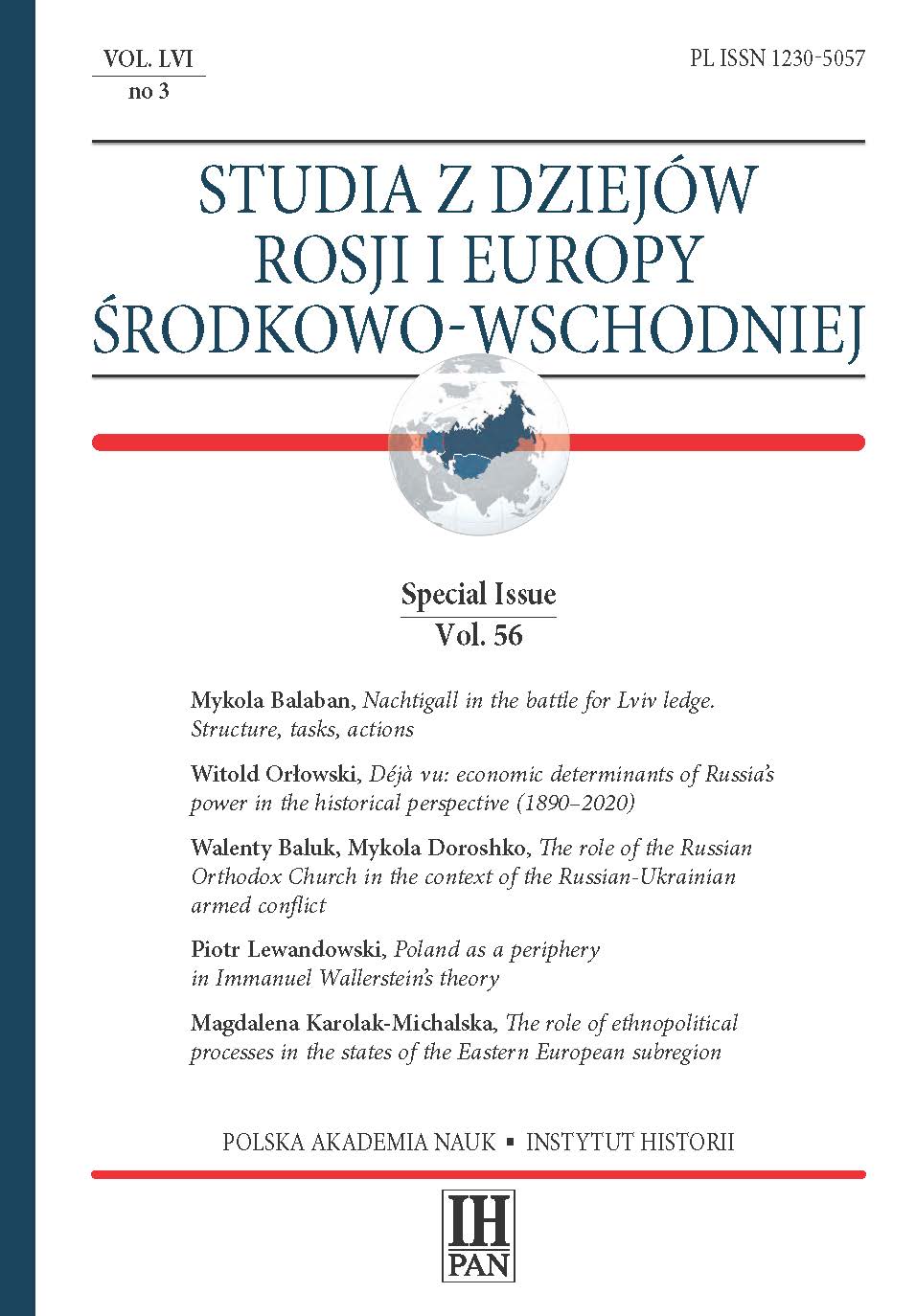
Déjà vu: economic determinants of Russia’s power in the historical perspective (1890–2020)
DOI:
https://doi.org/10.12775/SDR.2021.EN6.07Schlagworte
national power, economic growth, political economy, development policy, superpower status, economic crisisAbstract
What reasons stood behind the instability of the power position of Russia over the last 130 years? This analysis, covering three periods of time: 1890–1913, 1980–1991, and 2000–2020, reveals astonishing similarities of structural economic problems that led to severe economic and socio-political crises. Despite different causes, each time the crisis was triggered by insufficient savings compared to needs resulting from a program of economic modernisation and imperial policy, low competitiveness of industry, and dependence on export of raw materials. These vulnerabilities of Russia became especially apparent under extraordinary circumstances (wars, economic blockades, sanctions).
Literaturhinweise
Acemoglu D., Johnson S., “Unbundling Institutions,” Journal of Political Economy, 113 (5) (2005), pp. 949–995.
Algieri B., “The Dutch Disease: Evidences from Russia,” Economic Change and Restructuring, 44 (3) (2011), pp. 243–277.
Allen R.C., “The Rise and Decline of the Soviet Economy,” The Canadian Journal of Economics / Revue canadienne d’économique, 34 (4) (November 2001), pp. 859–881.
Chaplyuk V., Andryushchenko G., Sorokina L., Kukharenko O., Petrovskaya M., “Problems of the Russian Economy,” Mediterranean Journal of Social Sciences, 7 (3) (2016), pp. 206–211.
Cheremukhin A., Golosov M., Guriev S., Tsyvinski A., “Was Stalin Necessary for Russia’s Economic Development?,” NBER Working Paper No. 19425, 2013.
Collins J.M., Severns E.A., “US/Soviet Military Balance. Statistical Trends 1970–1980,” Congressional Research Service, Washington, 1981.
CIA, The World Factbook (2020), https://www.cia.gov/library/publications/the-world-factbook (accessed: 22 January 2021).
Cornish N., Karachtchouk A., The Russian Army 1914–1918, Oxford, 2001.
Davies R.W., The Industrialisation of Soviet Russia, vol. 1: Socialist Offensive, London, 1980.
Easterly W., Fischer S., “The Soviet Economic Decline,” The World Bank Economic Review, 9 (3) (September 1995), pp. 341–371.
Filatochev I., Bradshaw R., “The Soviet Hyperinflation: Its Origins and Impact throughout the Former Republics,” Soviet Studies, 44 (5) (1992), pp. 739–759.
Fischer S., “Russia and the Soviet Union Then and Now,” in: The Transition in Eastern Europe, vol. 1, ed. Blanchard O., Froot K., Sachs J., Chicago, 1994, pp. 221–257.
Gajdar J., Anomalie wzrostu gospodarczego, Warszawa, 1999.
Goldman M., Petrostate: Putin, Power, and the New Russia, Oxford, 2008.
Gregory P., Russian National Income 1885–1913, Cambridge (MA), 1982.
Gregory P., Экономический рост Российской империи (конец XIX – начало XX в.). Новые подсчеты и оценки, Moscow, 2003.
Gregory P., Lazarev V., “Structural Change in Russian Transition,” Yale University Economic Growth Center Discussion Paper no. 896, 2004.
Gregory P., Stuart R., Soviet Economic Structure and Performance, New York, 1986.
Heller M., Historia imperium rosyjskiego, Warszawa, 2000.
Jappelli, T., Pagano, M., “Saving, Growth and Liquidity Constraints,” The Quarterly Journal of Economics, 109 (1) (February 1994), pp. 83–109.
Kennedy P., The Rise and Fall of the Great Powers, New York, 1989.
Kuźniar R., Pozimnowojenne dwudziestolecie 1989-2919. Stosunki międzynarodowe na przełomie XX i XXI wieku, Warszawa, 2011.
Ledyaeva S., Karhunen P., Kosonen R., Whalley J., “Foreign Investment from Offshore Jurisdictions into Russia: An Analytical Overview,” Russian Analytical Digest (November 2013), no. 140.
Loayza N., Schmidt-Hebbel K., Servén L., “Saving in Developing Countries: An Overview,” The World Bank Economic Review, 14 (3) (2000), pp. 393–414.
Maddison A., The World Economy: A Millennial Perspective, Paris, 2001.
Markevich A., Harrison M., “Great War, Civil War, and Recovery: Russia’s National Income, 1913 to 1928,” The Journal of Economic History, 71 (3) (September 2011), pp. 672–703.
Mironov B. N., “The Development of Literacy in Russia and the USSR from the Tenth to the Twentieth Centuries,” History of Education Quarterly, 31 (2) (1991), pp. 229–252.
Norquist W., “How the United States Won the Cold War,” Journal of US Intelligence Studies, Winter/Spring 2003.
Orłowski W.M., W pogoni za straconym czasem. Wzrost gospodarczy w Europie Środkowo-Wschodniej 1950–2030, Warszawa, 2010.
Orłowski W.M., “Trajectories of the economic transition in Central and Eastern Europe,” in: Social and Economic Development in Central and Eastern Europe, ed. G. Gorzelak, London/ New York, 2020.
Pipes R., Rewolucja rosyjska, Warszawa, 2006.
Plaggenborg S., “Tax Policy and the Question of Peasant Poverty in Tsarist Russia, 1881–1905,” Cahiers du Monde Russe, 36 (1/2) (January–June 1995), pp. 53–69.
Sutela P., The Political Economy of Putin’s Russia, New York, 2012.
Tsygankov A., “Preserving Influence in a Changing World: Russia’s Grand Strategy,” Problems of Post-Communism, 58 (1) (March–April 2011), pp. 28–44.
UNESCO, World Illiteracy at Mid-Century, Paris, 1957.
US Energy Information Administration, Russia, 2020 (accessed: 22 January 2021).
WIIW, Comecon Data 1990, London, 1991.
Wohlforth W.C., “The Perception of Power: Russia in the Pre-1914 Balance,” World Politics, 39 (3) (April 1987), pp. 353–381.
Downloads
Veröffentlicht
Zitationsvorschlag
Ausgabe
Rubrik
Lizenz

Dieses Werk steht unter der Lizenz Creative Commons Namensnennung - Keine Bearbeitungen 4.0 International.
Stats
Number of views and downloads: 774
Number of citations: 0


