Body-fortress and text. Roxane Gay’s somatic practices
DOI:
https://doi.org/10.12775/LSE.2026.65.03Keywords
obesity, body, trauma, rapeAbstract
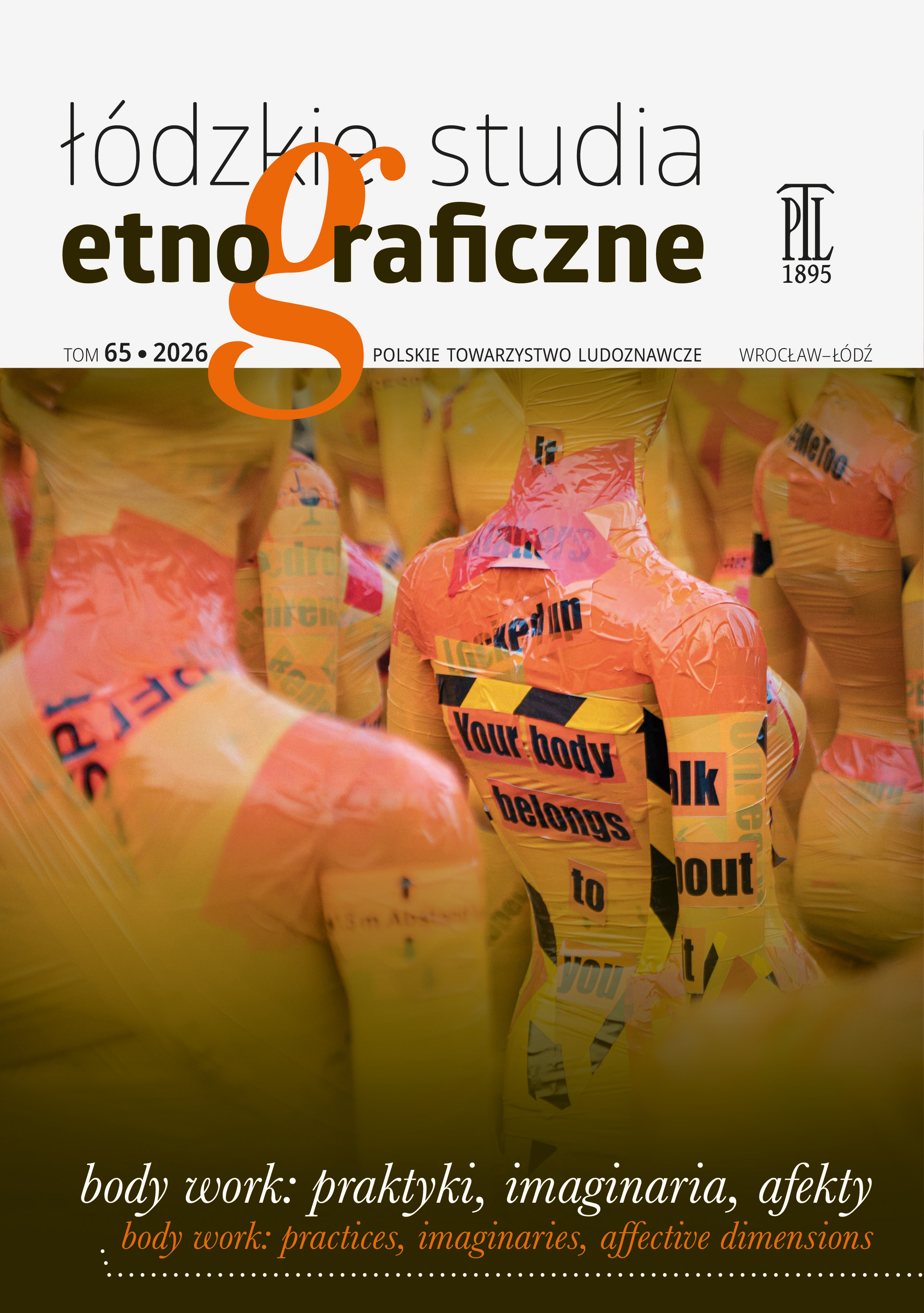
The article concerns the somatic practices of the American writer and feminist Roxane Gay. The main direction of interpretation is determined by trauma embedded in the writer’s obese body, which she calls her ‘work’ or ‘achievement’, and takes on a narrative form in the book of memoirs titled Hunger: A Memoir of (My) Body. The author of the article examines somatic practices in both indicated areas. Firstly, she is interested in the mechanism of compulsive eating, which is Gay’s long-standing reaction to the rape she had experienced at the age of twelve. Secondly, she examines the themes, style and rhetoric of memories. The framework of the reading is determined primarily by the theory of trauma and traumatic visualization presented in the book Empathic Vision. Affect, Trauma and Contemporary Art by Jill Bennett. This theory allows us to perceive Gay’s body as a work of art and understand how the effect of visibility is imposed on traumatic memory. The themes present in Gay’s memoir, in turn, allow us to look at it as a reparative text.
References
Appignanesi, L. (2021). Szalone, złe i smutne. Kobiety i psychiatrzy (przeł. J. Dzierzgowski). Warszawa: Marginesy.
Bennett, J. (2005). Empathic Vision. Affect, Trauma and Contemporary Art. California: Stanford University Press. DOI: https://doi.org/10.1515/9781503625006
Bennett, J. (2014). Wnętrza, zewnętrza: trauma, afekt i sztuka (przeł. A. Kowalcze-Pawlik, T. Bilczewski). W: Z. Budrewicz, R. Sendyka, R. Nycz (red.), Pamięć i afekty (s. 145–179). Warszawa: Instytut Badań Literackich Wydawnictwo. DOI: https://doi.org/10.4000/books.iblpan.5115
Bennett, J. (2020). Widzenie empatyczne. Afekt, trauma i sztuka współczesna (przeł. Ł. Mojsak). Widok. Teorie i Praktyki Kultury Wizualnej, 26. Pozyskano z: https://www.pismowidok.org/pl/archiwum/2020/26-empatyczne-obrazy/widzenie-empatyczne.-afekt-trauma-i-sztuka-wspolczesna. DOI: https://doi.org/10.36854/widok/2020.26.2174
Bordo, S. (2003). Unbearable Weight: Feminism, Western Culture, and the Body. Berkeley–Los Angeles: University of California Press. DOI: https://doi.org/10.2307/jj.8441705
Gay, R. (2021). Głód. Pamiętnik (mojego) ciała (przeł. A. Dzierzgowska). Warszawa: Wydawnictwo Cyranka.
Izydorczyk, B. (2017). Trauma a wzorzec objawów impulsywnych u kobiet chorujących na bulimię psychiczną i kompulsywne objadanie się. Psychologiczne Zeszyty Naukowe, 2, 37–54.
Lisowska, K. (2024). Retoryka przemocy seksualnej w polskiej prozie współczesnej – wstępne rozpoznania (ujęcie feministyczne). Wielogłos, 4, 9–80. DOI: 10.4467/2084395XWI.24.028.20905
Orbach, S. (1998). Fat is a Feminist Issue. London: Arrow Books. DOI: https://doi.org/10.1038/24506
Orbach, S. (2018). Forty years since Fat is A Feminist Issue. Pozyskano z: https://www.theguardian.com/society/2018/jun/24/forty-years-since-fat-is-a-feminist-issue
Szopa, K. (2013). Monstrualne demonstracje. Kulturowa reprezentacja otyłości. W: D. Bastek, M. Fołta (red.), Transgresywne monstrum (s. 51–74). Katowice: Wydawnictwo Uniwersytetu Śląskiego.
Szopa, K. (2014). Fitting bodies: Kulturowa polityka rozmiaru ciała. W: P. Chudzicka-Dudzik, E. Durys (red.), Konteksty feministyczne. Gender w życiu społecznym i kulturze (s. 131–143). Łódź: Wydawnictwo Uniwersytetu Łódzkiego. DOI: http://dx.doi.org/10.18778/7969-034-3.09
Tabaszewska, J. (2010). Trauma jako estetyczne, afektywne doświadczenie. Próba analizy „empatycznej wizji”. Teksty Drugie, 4, 221–234.
Tomalski, R. (2007). Trauma i dysocjacja w zaburzeniach jedzenia. Psychoterapia, 2, 17–27.
Getty Images. 450 Roxane Gay Photos and High-Res Pictures: https://www.gettyimages.com/photos/roxane-gay
Downloads
Published
How to Cite
Issue
Section
License
Copyright (c) 2026 Lodz Ethnographic Studies

This work is licensed under a Creative Commons Attribution-NoDerivatives 4.0 International License.
- The authors give the publisher (Polish Ethnological Society) non-exclusive license to use the work in the following fields:
- recording of a Work / subject of a related copyright;
- reproduction (multiplication) Work / subject of a related copyright in print and digital technique (ebook, audiobook);
- marketing of units of reproduced Work / subject of a related copyright;
- introduction of Work / object of related copyright to computer memory;
- dissemination of the work in an electronic version in the formula of open access under the Creative Commons license (CC BY - ND 4.0).
- The authors give the publisher the license free of charge.
- The use of the work by publisher in the above mentioned aspects is not limited in time, quantitatively nor territorially.
Stats
Number of views and downloads: 16
Number of citations: 0


