Skip to main content Skip to main navigation menu Skip to site footer
  • Register
  • Login
  • Language
    • Deutsch
    • English
    • Español (España)
    • Français (France)
    • Italiano
    • Język Polski
  • Menu
  • Home
  • Current
  • Archives
  • About
    • About the Journal
    • Submissions
    • Editorial Team
    • Privacy Statement
    • Contact
  • Register
  • Login
  • Language:
  • Deutsch
  • English
  • Español (España)
  • Français (France)
  • Italiano
  • Język Polski

Litteraria Copernicana

Asking Piotr Skarga: an attempt to describe the strategy of writer’s approach towards the Protestants
  • Home
  • /
  • Asking Piotr Skarga: an attempt to describe the strategy of writer’s approach towards the Protestants
  1. Home /
  2. Archives /
  3. Vol. 15 No. 1 (2015): Skarga /
  4. Studies

Asking Piotr Skarga: an attempt to describe the strategy of writer’s approach towards the Protestants

Authors

  • Krzysztof Koehler Uniwersytet Kardynała Stefana Wyszyńskiego w Warszawie

DOI:

https://doi.org/10.12775/LC.2015.006

Keywords

Skarga, „heretics”, ecumenism, rhetorics, sermon

Abstract

Asking Piotr Skarga: an attempt to describe the strategy of writer’s approach towards the Protestants is trying to rewrite the proposition of Skarga’s approach towards the Reformation. For King’s preacher reformers are unambiguously: „heretics”. Koehler analyses some basic Skarga’s texts, addressed to different readers, arisen in different historical or social contexts. His aim is to check if Skarga’s attitude towards protestants is permanent or connected with the context. Koehler then reads political treatise Kazania sejmowe, the formative text for Polish clergy Kazania na niedzielę i święta, as well as the sermon addressed to the King and his army given just before their marching off to the war: Wsiadane na wojnę and text Wzywanie do pokuty the audience of which was projected by King’s preacher as a general one.

Previous understanding of Skarga’s approach toward the „heretics” (historical and contemporary one) unequivocally stressed the aggressive and provocative attitude of him towards „heretics”. His contemporaries as well as 19th and 20 th centuries scholars referred Skarga with such terms as: „incendiary” (turbator rei publice). Koehler, using the methodology of close reading and intentional reading tries to verify: if this types of understanding of Skarga’s discourse, which came from outside the texts really coresponds with author’s intentions which are embodied in the texts. So finally Koehler gives a portrait of a person who unequivocally fights against the protestants and their religion (from different reasons: from religious to political one) but at the same time a person who values common good more (bonum commune) than religious differences or religious war.
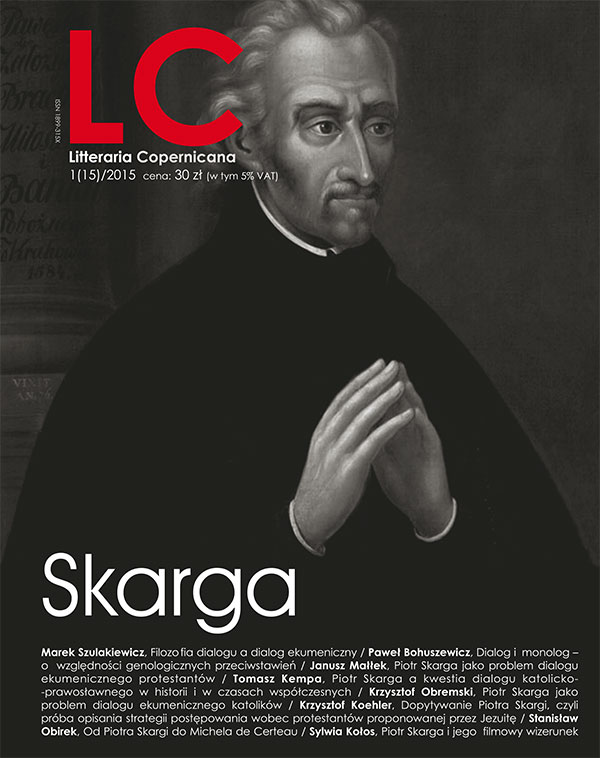
Litteraria Copernicana

Downloads

  • PDF (Język Polski)

Published

2015-05-21

How to Cite

1.
KOEHLER, Krzysztof. Asking Piotr Skarga: an attempt to describe the strategy of writer’s approach towards the Protestants. Litteraria Copernicana. Online. 21 May 2015. Vol. 15, no. 1, pp. 88-107. [Accessed 4 May 2026]. DOI 10.12775/LC.2015.006.
  • ISO 690
  • ACM
  • ACS
  • APA
  • ABNT
  • Chicago
  • Harvard
  • IEEE
  • MLA
  • Turabian
  • Vancouver
Download Citation
  • Endnote/Zotero/Mendeley (RIS)
  • BibTeX

Issue

Vol. 15 No. 1 (2015): Skarga

Section

Studies

Stats

Number of views and downloads: 619
Number of citations: 0

Search

Search

Browse

  • Browse Author Index
  • Issue archive

User

User

Current Issue

  • Atom logo
  • RSS2 logo
  • RSS1 logo

Information

  • For Readers
  • For Authors
  • For Librarians

Newsletter

Subscribe Unsubscribe

Language

  • Deutsch
  • English
  • Español (España)
  • Français (France)
  • Italiano
  • Język Polski

Tags

Search using one of provided tags:

Skarga, „heretics”, ecumenism, rhetorics, sermon
Up

Akademicka Platforma Czasopism

Najlepsze czasopisma naukowe i akademickie w jednym miejscu

apcz.umk.pl

Partners

  • Akademia Ignatianum w Krakowie
  • Akademickie Towarzystwo Andragogiczne
  • Fundacja Copernicus na rzecz Rozwoju Badań Naukowych
  • Instytut Historii im. Tadeusza Manteuffla Polskiej Akademii Nauk
  • Instytut Kultur Śródziemnomorskich i Orientalnych PAN
  • Instytut Tomistyczny
  • Karmelitański Instytut Duchowości w Krakowie
  • Ministerstwo Kultury i Dziedzictwa Narodowego
  • Państwowa Akademia Nauk Stosowanych w Krośnie
  • Państwowa Akademia Nauk Stosowanych we Włocławku
  • Państwowa Wyższa Szkoła Zawodowa im. Stanisława Pigonia w Krośnie
  • Polska Fundacja Przemysłu Kosmicznego
  • Polskie Towarzystwo Ekonomiczne
  • Polskie Towarzystwo Ludoznawcze
  • Towarzystwo Miłośników Torunia
  • Towarzystwo Naukowe w Toruniu
  • Uniwersytet im. Adama Mickiewicza w Poznaniu
  • Uniwersytet Komisji Edukacji Narodowej w Krakowie
  • Uniwersytet Mikołaja Kopernika
  • Uniwersytet w Białymstoku
  • Uniwersytet Warszawski
  • Wojewódzka Biblioteka Publiczna - Książnica Kopernikańska
  • Wyższe Seminarium Duchowne w Pelplinie / Wydawnictwo Diecezjalne „Bernardinum" w Pelplinie

© 2021- Nicolaus Copernicus University Accessibility statement Shop