Skip to main content Skip to main navigation menu Skip to site footer
  • Register
  • Login
  • Language
    • Čeština
    • Deutsch
    • English
    • Français (France)
    • Język Polski
  • Menu
  • Home
  • Current
  • Archives
  • Announcements
  • About
    • About the Journal
    • Submissions
    • Editorial Team
    • Privacy Statement
    • Contact
  • Register
  • Login
  • Language:
  • Čeština
  • Deutsch
  • English
  • Français (France)
  • Język Polski

Klio. CPDPiP

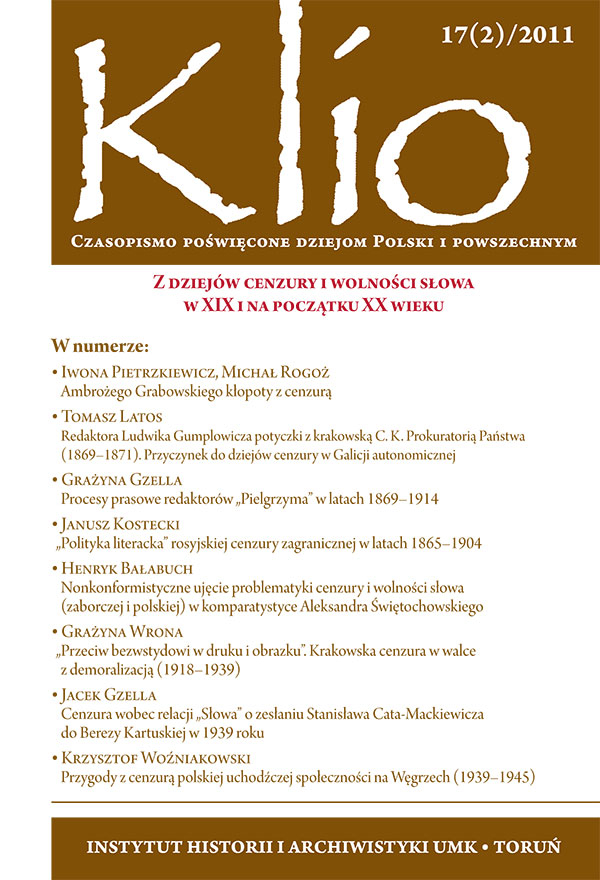
Przygody z cenzurą polskiej uchodźczej społeczności na Węgrzech (1939–1945)
  • Home
  • /
  • Przygody z cenzurą polskiej uchodźczej społeczności na Węgrzech (1939–1945)
  1. Home /
  2. Archives /
  3. Vol. 17 No. 2 (2011) /
  4. Artykuły

Przygody z cenzurą polskiej uchodźczej społeczności na Węgrzech (1939–1945)

Authors

  • Krzysztof Woźniakowski Uniwersytet Pedagogiczny im. Komisji Edukacji Narodowej. Instytut Informacji Naukowej i Bibliotekoznawstwa

DOI:

https://doi.org/10.12775/KLIO.2011.030

Abstract

Censorship games among the Polish émigré community in Hungary in the years 1939–1945

(Summary)

Civilian and military émigrés of the wartime period who had come to Hungarywhen the Polish-Hungarian border had been temporarily open (17–28 Sept. 1939)had a relatively rich artistic and cultural life. Thanks to the Hungarian authorities, the Polish émigrés even formed their own institutions. As a result, some kind ofpress was started and approximately 60 newspapers and magazines were in circulation. What is more, 300 different books and brochures were duplicated in 13 publishing houses. In Budapest, the Polish Institute (Instytut Polski) and Polish Club (Świetlica Polska), among others, organized several dozen public cultural performances. Polish publications and books were controlled by the Press Department ofthe Hungarian Ministry of Foreign Affairs. This censorship function was held by István Mészáros (1891–1964), who later became a famous translator of the Polishliterature. After the Nazis entered Hungary in March 1944 he was substituted by Sándor Vajlok. Mészáros was always pro-Polish: he never questioned or refused any Polish publication, was secretly helping the Polish émigrés. However, he was unable to oppose the intervention of the Embassy of the Third Reich in Budapest which temporarily stopped the publication of the leading émigré periodical „Wieści Polskie” („Polish News”) from the 12 May to the 3 June 1941. The reason of it was a quotation from Churchill’s speech allegedly offensive to the German nation. Among public performances which had serious problems with the official Hungarian authorities, two of them must be mentioned. The first was a guest performanceby an émigré puppet theatre from Ipolyhidvég, presenting Polish Nativity Scene on 23 Feb. 1943 in the Polish Institute: the organizers and performers were denounced to the police authorities because the puppet of Herod resembled Hitler. The second was a performance of the youth group from the Polish secondaryschool in Balatonboglár, planned in Budapest on 16  May 1943, but cancelled at the last minute (as a result of the suggestion put forward by the Hungarian authoritieswho feared to irritate Nazis). Apart from the official Hungarian censorship, there was also an internal censorship of all religious publications held by the Polish Catholic Chaplaincy.
Klio. CPDPiP

Downloads

  • PDF (Język Polski)

Published

2011-06-30

How to Cite

1.
WOŹNIAKOWSKI, Krzysztof. Przygody z cenzurą polskiej uchodźczej społeczności na Węgrzech (1939–1945). Klio. CPDPiP. Online. 30 June 2011. Vol. 17, no. 2, pp. 125-142. [Accessed 24 December 2025]. DOI 10.12775/KLIO.2011.030.
  • ISO 690
  • ACM
  • ACS
  • APA
  • ABNT
  • Chicago
  • Harvard
  • IEEE
  • MLA
  • Turabian
  • Vancouver
Download Citation
  • Endnote/Zotero/Mendeley (RIS)
  • BibTeX

Issue

Vol. 17 No. 2 (2011)

Section

Artykuły

Stats

Number of views and downloads: 618
Number of citations: 0

Search

Search

Browse

  • Browse Author Index
  • Issue archive

User

User

Current Issue

  • Atom logo
  • RSS2 logo
  • RSS1 logo

Information

  • For Readers
  • For Authors
  • For Librarians

Newsletter

Subscribe Unsubscribe

Language

  • Čeština
  • Deutsch
  • English
  • Français (France)
  • Język Polski
Up

Akademicka Platforma Czasopism

Najlepsze czasopisma naukowe i akademickie w jednym miejscu

apcz.umk.pl

Partners

  • Akademia Ignatianum w Krakowie
  • Akademickie Towarzystwo Andragogiczne
  • Fundacja Copernicus na rzecz Rozwoju Badań Naukowych
  • Instytut Historii im. Tadeusza Manteuffla Polskiej Akademii Nauk
  • Instytut Kultur Śródziemnomorskich i Orientalnych PAN
  • Instytut Tomistyczny
  • Karmelitański Instytut Duchowości w Krakowie
  • Ministerstwo Kultury i Dziedzictwa Narodowego
  • Państwowa Akademia Nauk Stosowanych w Krośnie
  • Państwowa Akademia Nauk Stosowanych we Włocławku
  • Państwowa Wyższa Szkoła Zawodowa im. Stanisława Pigonia w Krośnie
  • Polska Fundacja Przemysłu Kosmicznego
  • Polskie Towarzystwo Ekonomiczne
  • Polskie Towarzystwo Ludoznawcze
  • Towarzystwo Miłośników Torunia
  • Towarzystwo Naukowe w Toruniu
  • Uniwersytet im. Adama Mickiewicza w Poznaniu
  • Uniwersytet Komisji Edukacji Narodowej w Krakowie
  • Uniwersytet Mikołaja Kopernika
  • Uniwersytet w Białymstoku
  • Uniwersytet Warszawski
  • Wojewódzka Biblioteka Publiczna - Książnica Kopernikańska
  • Wyższe Seminarium Duchowne w Pelplinie / Wydawnictwo Diecezjalne „Bernardinum" w Pelplinie

© 2021- Nicolaus Copernicus University Accessibility statement Shop