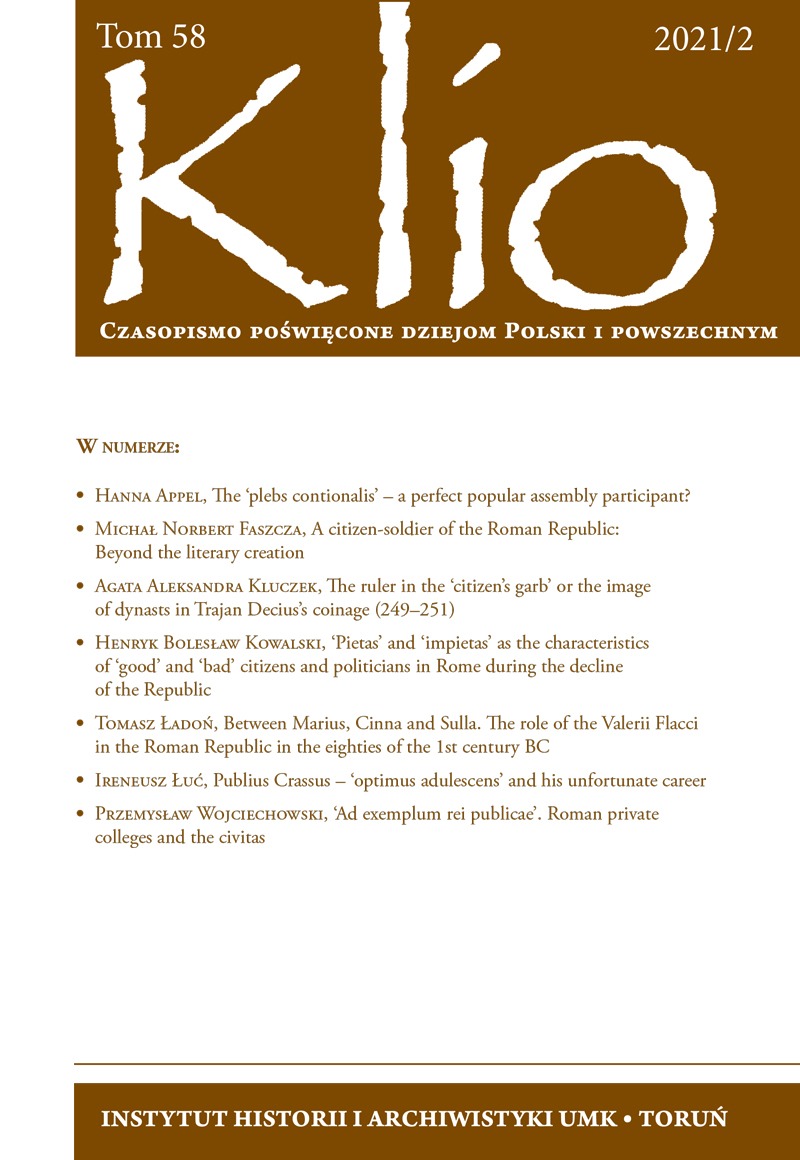
Between Marius, Cinna and Sulla. The role of the Valerii Flacci in the Roman Republic in the eighties of the 1st century BC
The role of the Valerii Flacci in the Roman Republic in the eighties of the 1st century BC
DOI:
https://doi.org/10.12775/KLIO.2021.014Keywords
Valerii Flacci, Sulla, Marians, Cinanns, Sullans, First Civil WarAbstract
Abstract: Valerii Flacci was one of the most influential families in Rome in the first two decades of the 1st century BC. Cicero called them a nobilissima familia, while they themselves were the apple of the Roman aristocracy and were perceived as the best citizens (optimi cives). During the First Civil War, they were initially associated with the Marian camp. L. Valerius Flaccus (consul of 100 BC) acted as princeps senatus since 86 BC, and his cousin, also L. Valerius Flaccus was consul suffectus in 86 BC, after the death of C. Marius. The brother of L. Valerius Flaccus, Caius, consul of 93 BC, during the reign of Cinna in Rome was the governor of Spain for many years, and later of Transalpine Gaul too. It is known that Valerii Flacci wanted to reach a compromise between Sulla and the Marian camp, and when their efforts failed, they opted for Sulla.
Despite the significant role Valerii Flacci played in the Republic, their activities remain overshadowed by other figures of that period. Also, their switch to the Sulla camp in the memory of the ancients was quite poorly recorded, especially when compared with the publicity of the transition of figures such as Metellus Pius, Pompeius or Crassus to Sulla’s side. The author of the presented paper will attempt to coax Valerii Flacci out of the shadows of history, examine the genesis of their defection to the Sulla camp and determine the role they played in this camp in the initial period of Sulla’s dictatorship.
Abstrakt: Valerii Flacci byli jednym z bardziej wpływowych rodów w Rzymie w pierwszych dwóch dekadach I wieku przed Chr. Cicero określał ich mianem nobilissima familia, sami zaś stanowili kwiat arystokracji rzymskiej i postrzegani byli jako najlepsi obywatele (optimi cives). W okresie pierwszej wojny domowej początkowo związani byli z obozem mariańskim. L. Valerius Flaccus (konsul 100 roku przed Chr.) od 86 roku przed Chr. występował jako princeps senatus, zaś jego kuzyn, również L. Valerius Flaccus, po śmierci C. Mariusa zastąpił go na stanowisku konsula (jako consul suffectus w 86 roku przed Chr.). Rodzony brat tego ostatniego, C. Valerius Flaccus, konsul 93 roku przed Chr., w okresie rządów Cynny w Rzymie był wieloletnim namiestnikiem Hiszpanii, a później także Galii Zaalpejskiej. Wiadomo, że Valerii Flacci chcieli doprowadzić do kompromisu między Sullą a obozem mariańskim, a gdy ich starania zakończyły się fiaskiem, opowiedzieli się za Sullą.
Mimo znaczącej roli, jaką Valerii Flacci odgrywali w Republice, ich działalność pozostaje w cieniu innych postaci owego okresu. Także ich akces do obozu sullańskiego w pamięci starożytnych został odnotowany dość słabo, zwłaszcza jeśli zestawi się go z nagłośnieniem przejścia na stronę Sulli takich postaci jak Metellus Pius, Pompeius czy Crassus. Autor prezentowanego artykułu wydobywa Valerii Flacci z cienia historii, bada genezę ich dołączenia do obozu sullańskiego oraz określa ich znaczenie w tym obozie w początkowym okresie dyktatury Sulli.
References
Bibliography
Alexander M.C, Trials in the Late Roman Republic, 149 BC to 50 BC, Toronto – Buffalo – London 1990.
Appel H., Kontrowersje wokół senatus consultum ultimum. Studium z dziejów późnej republiki rzymskiej, Toruń 2013.
Badian E., Caepio and Norbanus: Notes on the Decade 100 – 90 B.C., “Historia”1957, 6, p. 318–346.
Badian E., Waiting for Sulla, JRS 1962, 52, p. 47–61.
Badian E., Studies in Greek and Roman History, Oxford 1964.
Badian E., Three Non-Trials in Cicero. Notes on the Text, Prosopography and Chronology of Divinatio in Caecilium 63, “Klio” 1984, 66, p. 291–309.
Bauman R.A., The Hostis Declaration, “Athenaeum” 1973, 61, p. 270–293.
Bellen H., Sullas Brief an den Interrex L. Valerius Flaccus: Zur Genese der sullanischen Diktatur, “Historia” 1975, 15, p. 555–569.
Bennet H., Cinna and his Times, Menasha 1924.
Broughton T.R.S., The Magistrates of the Roman Republic, vol. 1-2, New York 1951-1952, vol. 3, Atlanta 1986.
Bulst C.M., Cinnanum Tempus: A Reassessment of the Dominatio Cinnae, “Historia” 1964, 13, p. 307–337.
Corey Brennan T., The Praetorship in the Roman Republic, Oxford 2000.
Evans R.J., Gaius Marius. A Political Biography, Pretoria 1994.
Frier B.W., Sulla’s Propaganda: The Collapse of the Cinnan Republic, “American Journal of Philology” 1971, 92, p. 585–604.
Gruen E.S., Political Prosecutions in 90’s B.C., “Historia” 1966, 15, p. 32–64.
Hayne L., The Valerii Flacci – A Family in Decline, “Ancient Society” 1978, 9, p. 223–233.
Katz B.R., The First Fruits of Sulla March, “L’Antiquité Classique” 1975, 44, p. 100–125.
Katz B.R., The Siege of Rome in 87 B.C., CPh 1976, 71, p. 328–336.
Katz B.R., Caesar Strabo’s Struggle for the Consulship and More, RhM 1977, 120, p. 45–63.
Lanzani C., Mario e Silla. Storia della democrazia romana negli anni 87 – 82 a.CR., Catania 1915.
Lintott A., The Offices of C. Flavius Fimbria in 86-5 BC, “Historia“ 1971, 20, p. 696–701.
Lovano M., The Age of Cinna: Crucible of Late Republican Rome, Stuttgart 2002.
Ładoń T., Legiony rzymskie w Hiszpanii a kryzys Republiki w latach siedemdziesiątych I wieku przed Chr., Zeszyty Historyczne Akademii im. Jana Długosza w Częstochowie 2009, 10, p. 7–27.
Ładoń T., Sulla’s Peace Negotiations with Cinna’s Faction in 85 – 83 B.C., [in:] Lucius Cornelius Sulla – History and Tradition, ed. D. Słapek, I. Łuć, Lublin 2013, pp. 91–102.
Ładoń T., Kilka uwag o posiedzeniu senatu w świątyni Bellony 3 listopada 82 roku przed Chr., [in:] Elity w świecie starożytnym, ed. M. Cieśluk, Szczecin 2015, p. 151–163.
Magie D., Roman Rule in Asia Minor to the end of the First Century after Christ, vol. 1, New Jersey 1950.
Meier Ch., Res publica amissa, Wiesbaden 1966.
Münzer F., De Gente Valeria, Oppolle 1891.
Rominkiewicz J., O rzymskich ustawach ograniczających wydatki na organizację uczt (Makrobiusz, Saturnalia 3, 17), “Acta Universitatis Wratislaviensis. Prawo” 2016, 321, p. 29–55.
Rotondi G., Leges publicae populi Romani, Hildesheim 1962.
Ryan F.X., Rank and Participation in the Republican Senate, Stuttgart 1998.
Santangelo F., Sulla, the Elites and the Empire. A Study of Roman Policies in Italy and the Greek East, Leiden-Boston 2007.
Scholz P., Sullas commentarii – eine literarische Rechtfertigung. Zu Wesen und Funktion der autobiographischen Schriften in der späten Römischen Republik, [in:] Formmen römischer Geschichtsschreibung von den Anfängen bis Livius – Gattungen, Autoren, Kontexte, ed. U. Eigler et al., Darmstadt 2003, p. 172–195.
Smith C., Sulla’s Memoirs, [in:] The Lost Memoirs of Augustus and the Development of Roman Autobiography, ed. C. Smith, A. Powell, Classical Press of Wales, 2009, p. 65-85.
Sumner G.V., The Orators in Cicero’s Brutus: Prosopography and Chronology, Toronto 1972.
Valgiglio E., Silla a la crisi repubblicana, Firenze 1956.
Vervaet F.J., The Lex Valeria and Sulla’s Empowerment as Dictator, (82-79 BCE), “Cahiers Glotz“ 2004, 15, p. 37–84.
Willems P., Le Sénat de la République romaine, t. I , Louvain–Paris–Berlin 1885.
Downloads
Published
How to Cite
Issue
Section
License
Copyright (c) 2021 Klio. CPDPiP

This work is licensed under a Creative Commons Attribution-NoDerivatives 4.0 International License.
Stats
Number of views and downloads: 888
Number of citations: 0


