Skip to main content Skip to main navigation menu Skip to site footer
  • Register
  • Login
  • Language
    • Čeština
    • Deutsch
    • English
    • Français (France)
    • Język Polski
  • Menu
  • Home
  • Current
  • Archives
  • Announcements
  • About
    • About the Journal
    • Submissions
    • Editorial Team
    • Privacy Statement
    • Contact
  • Register
  • Login
  • Language:
  • Čeština
  • Deutsch
  • English
  • Français (France)
  • Język Polski

Klio. CPDPiP

Wprowadzenie cenzury prewencyjnej w 1920 roku w dawnej dzielnicy pruskiej
  • Home
  • /
  • Wprowadzenie cenzury prewencyjnej w 1920 roku w dawnej dzielnicy pruskiej
  1. Home /
  2. Archives /
  3. Vol. 28 No. 1 (2014) /
  4. Artykuły

Wprowadzenie cenzury prewencyjnej w 1920 roku w dawnej dzielnicy pruskiej

Authors

  • Jacek Gzella Uniwersytet Mikołaja Kopernika. Wydział Nauk Historycznych

DOI:

https://doi.org/10.12775/KLIO.2014.003

Abstract

Introduction of Preventive Censorship in 1920 in the Former Prussian Partition

During the restitution of the Polish Statehood in 1918, the individual provinces maintained the laws of the previous occupying powers with regard to regulating
the freedom of the press and specific procedures of the oversight that state authorities had over the press activities. Since January 1919, there was an option
to impose a confiscation of any publication in the part of Polish Republic, in which a martial law was in effect. This route, allowing for the introduction of preventive censorship, was used in June 1919 by the Supreme People’s Council, an organization that was in power in the Wielkopolska district (of the former Prussian partition). The volatile situation at the front of the Polish–Bolshevik war prompted the Polish authorities to uniform the laws regarding preventive censorships.
Subsequently, the Council of National Defense issued on July 19th, 1920 a decree introducing the preventive censorship on the territory of the Polish state. Despite the lack of respective executive directives from the Ministries of Internal Affairs and Ministry of Former Prussian Partition, the Poznań city mayor [starosta
grodzki] started implementing the preventive censorship regulations already on July 22, 1920. These restrictions pertained to publications relevant to the army and matters of state defense. However, the implementation of these regulations was aborted after the Polish Parliament approved on October 29, 1920 a bill abolishing a preventive censorship. Nonetheless, the Wielkoposka district waited until November 25, 1920 when the Poznań city mayor [starosta grodzki] issued a document revoking his previous decree about preventive censorship. 
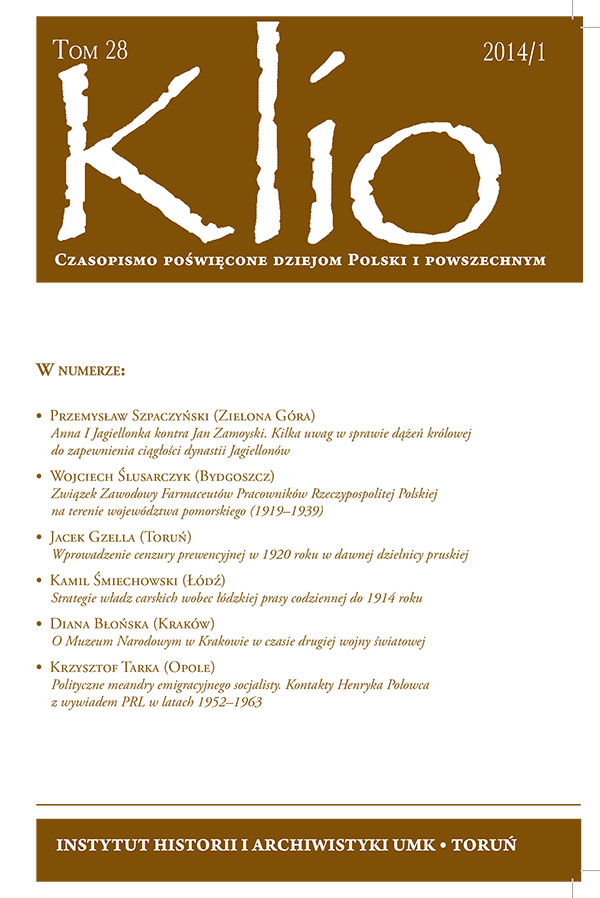
Klio. CPDPiP

Downloads

  • PDF (Język Polski)

Published

2014-06-06

How to Cite

1.
GZELLA, Jacek. Wprowadzenie cenzury prewencyjnej w 1920 roku w dawnej dzielnicy pruskiej. Klio. CPDPiP. Online. 6 June 2014. Vol. 28, no. 1, pp. 31-44. [Accessed 19 April 2026]. DOI 10.12775/KLIO.2014.003.
  • ISO 690
  • ACM
  • ACS
  • APA
  • ABNT
  • Chicago
  • Harvard
  • IEEE
  • MLA
  • Turabian
  • Vancouver
Download Citation
  • Endnote/Zotero/Mendeley (RIS)
  • BibTeX

Issue

Vol. 28 No. 1 (2014)

Section

Artykuły

Stats

Number of views and downloads: 885
Number of citations: 0

Search

Search

Browse

  • Browse Author Index
  • Issue archive

User

User

Current Issue

  • Atom logo
  • RSS2 logo
  • RSS1 logo

Information

  • For Readers
  • For Authors
  • For Librarians

Newsletter

Subscribe Unsubscribe

Language

  • Čeština
  • Deutsch
  • English
  • Français (France)
  • Język Polski
Up

Akademicka Platforma Czasopism

Najlepsze czasopisma naukowe i akademickie w jednym miejscu

apcz.umk.pl

Partners

  • Akademia Ignatianum w Krakowie
  • Akademickie Towarzystwo Andragogiczne
  • Fundacja Copernicus na rzecz Rozwoju Badań Naukowych
  • Instytut Historii im. Tadeusza Manteuffla Polskiej Akademii Nauk
  • Instytut Kultur Śródziemnomorskich i Orientalnych PAN
  • Instytut Tomistyczny
  • Karmelitański Instytut Duchowości w Krakowie
  • Ministerstwo Kultury i Dziedzictwa Narodowego
  • Państwowa Akademia Nauk Stosowanych w Krośnie
  • Państwowa Akademia Nauk Stosowanych we Włocławku
  • Państwowa Wyższa Szkoła Zawodowa im. Stanisława Pigonia w Krośnie
  • Polska Fundacja Przemysłu Kosmicznego
  • Polskie Towarzystwo Ekonomiczne
  • Polskie Towarzystwo Ludoznawcze
  • Towarzystwo Miłośników Torunia
  • Towarzystwo Naukowe w Toruniu
  • Uniwersytet im. Adama Mickiewicza w Poznaniu
  • Uniwersytet Komisji Edukacji Narodowej w Krakowie
  • Uniwersytet Mikołaja Kopernika
  • Uniwersytet w Białymstoku
  • Uniwersytet Warszawski
  • Wojewódzka Biblioteka Publiczna - Książnica Kopernikańska
  • Wyższe Seminarium Duchowne w Pelplinie / Wydawnictwo Diecezjalne „Bernardinum" w Pelplinie

© 2021- Nicolaus Copernicus University Accessibility statement Shop