Skip to main content Skip to main navigation menu Skip to site footer
  • Register
  • Login
  • Language
    • Čeština
    • Deutsch
    • English
    • Français (France)
    • Język Polski
  • Menu
  • Home
  • Current
  • Archives
  • Announcements
  • About
    • About the Journal
    • Submissions
    • Editorial Team
    • Privacy Statement
    • Contact
  • Register
  • Login
  • Language:
  • Čeština
  • Deutsch
  • English
  • Français (France)
  • Język Polski

Klio. CPDPiP

Correspondence of the City of Cracow in the Seventeenth and Eighteenth Century
  • Home
  • /
  • Correspondence of the City of Cracow in the Seventeenth and Eighteenth Century
  1. Home /
  2. Archives /
  3. Vol. 23 No. 4 (2012) /
  4. Artykuły

Correspondence of the City of Cracow in the Seventeenth and Eighteenth Century

Authors

  • Mateusz Wyżga Instytut Historii, Uniwersytet Pedagogiczny w Krakowie

DOI:

https://doi.org/10.12775/KLIO.2012.059

Abstract

Books of correspondence were introduced by Cracow municipal office in 1621. Approximately 90% of the letters are correspondence sent from the city hall. Most of the letters were directed to influential persons, called “patrons”. They were central and province officials, dignitaries of the Church. They were mainly informed about the problems of the city. More than half of the letters were received by clergymen (especially the Bishop of Cracow), castellans, Chancellor of the Crown, provincial governors and the king. The city council also wrote to their relatives. Only 10% of letters were sent to other cities. These were mainly trade related issues. Most of the letters to private persons were not entered into the books. On the other hand registered incoming letters come mostly from the office of the Bishop of Cracow. City of Cracow described in the letters their problems such as tax rates, merchants avoiding to obey the storage law, threats from other armies. City hall referred in the correspondence to their privileges. Most of letters were written in Polish.
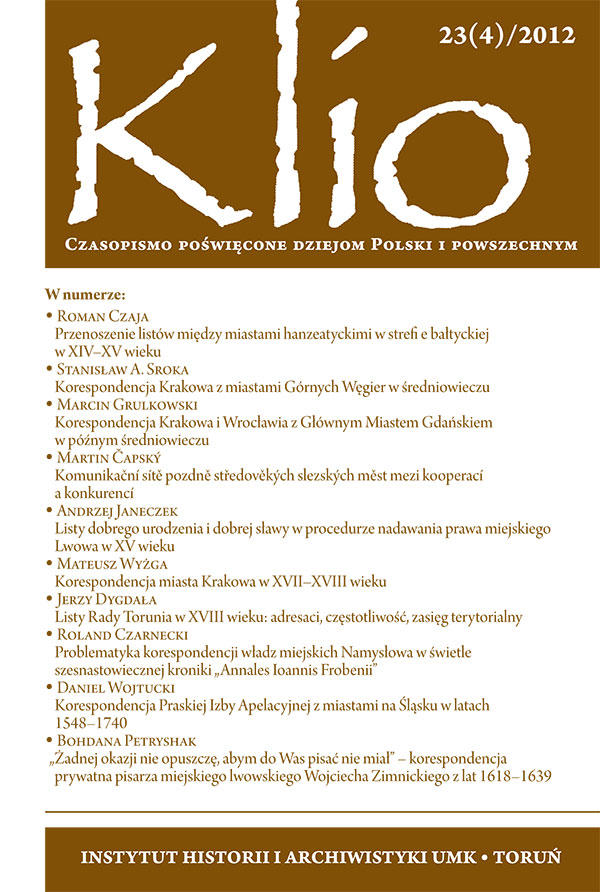
Klio. CPDPiP

Downloads

  • PDF (Język Polski)

Published

2012-12-01

How to Cite

1.
WYŻGA, Mateusz. Correspondence of the City of Cracow in the Seventeenth and Eighteenth Century. Klio. CPDPiP. Online. 1 December 2012. Vol. 23, no. 4, pp. 117-128. [Accessed 20 April 2026]. DOI 10.12775/KLIO.2012.059.
  • ISO 690
  • ACM
  • ACS
  • APA
  • ABNT
  • Chicago
  • Harvard
  • IEEE
  • MLA
  • Turabian
  • Vancouver
Download Citation
  • Endnote/Zotero/Mendeley (RIS)
  • BibTeX

Issue

Vol. 23 No. 4 (2012)

Section

Artykuły

Stats

Number of views and downloads: 690
Number of citations: 0

Search

Search

Browse

  • Browse Author Index
  • Issue archive

User

User

Current Issue

  • Atom logo
  • RSS2 logo
  • RSS1 logo

Information

  • For Readers
  • For Authors
  • For Librarians

Newsletter

Subscribe Unsubscribe

Language

  • Čeština
  • Deutsch
  • English
  • Français (France)
  • Język Polski
Up

Akademicka Platforma Czasopism

Najlepsze czasopisma naukowe i akademickie w jednym miejscu

apcz.umk.pl

Partners

  • Akademia Ignatianum w Krakowie
  • Akademickie Towarzystwo Andragogiczne
  • Fundacja Copernicus na rzecz Rozwoju Badań Naukowych
  • Instytut Historii im. Tadeusza Manteuffla Polskiej Akademii Nauk
  • Instytut Kultur Śródziemnomorskich i Orientalnych PAN
  • Instytut Tomistyczny
  • Karmelitański Instytut Duchowości w Krakowie
  • Ministerstwo Kultury i Dziedzictwa Narodowego
  • Państwowa Akademia Nauk Stosowanych w Krośnie
  • Państwowa Akademia Nauk Stosowanych we Włocławku
  • Państwowa Wyższa Szkoła Zawodowa im. Stanisława Pigonia w Krośnie
  • Polska Fundacja Przemysłu Kosmicznego
  • Polskie Towarzystwo Ekonomiczne
  • Polskie Towarzystwo Ludoznawcze
  • Towarzystwo Miłośników Torunia
  • Towarzystwo Naukowe w Toruniu
  • Uniwersytet im. Adama Mickiewicza w Poznaniu
  • Uniwersytet Komisji Edukacji Narodowej w Krakowie
  • Uniwersytet Mikołaja Kopernika
  • Uniwersytet w Białymstoku
  • Uniwersytet Warszawski
  • Wojewódzka Biblioteka Publiczna - Książnica Kopernikańska
  • Wyższe Seminarium Duchowne w Pelplinie / Wydawnictwo Diecezjalne „Bernardinum" w Pelplinie

© 2021- Nicolaus Copernicus University Accessibility statement Shop