Skip to main content Skip to main navigation menu Skip to site footer
  • Register
  • Login
  • Language
    • Čeština
    • Deutsch
    • English
    • Français (France)
    • Język Polski
  • Menu
  • Home
  • Current
  • Archives
  • Announcements
  • About
    • About the Journal
    • Submissions
    • Editorial Team
    • Privacy Statement
    • Contact
  • Register
  • Login
  • Language:
  • Čeština
  • Deutsch
  • English
  • Français (France)
  • Język Polski

Klio. CPDPiP

Wzorce osobowe synow kasztelana krakowskiego Marcina Zborowskiego (Z problematyki obyczajowości szlacheckiej XVI wieku)
  • Home
  • /
  • Wzorce osobowe synow kasztelana krakowskiego Marcina Zborowskiego (Z problematyki obyczajowości szlacheckiej XVI wieku)
  1. Home /
  2. Archives /
  3. Vol. 18 No. 3 (2011) /
  4. Artykuły

Wzorce osobowe synow kasztelana krakowskiego Marcina Zborowskiego (Z problematyki obyczajowości szlacheckiej XVI wieku)

Authors

  • Magdalena Ujma Uniwersytet Zielonogórski. Instytut Historii

DOI:

https://doi.org/10.12775/KLIO.2011.044

Abstract

Marcin Zborowski’s, castellan of Cracow, sons’ personalitypatterns (from research on nobility habits)

(Summary)

The problem of origins of early modern personality patterns has been a research field for historians, historians of Polish literature and pedagogy for long time already. A history of a raise and a fall of social, economic and political career of the Zborowski’s family from Malopolska still provides some controversies, what is the reason of not getting into consideration the context of their public activity: political situation in Commonwealth of Poland. Despite the huge amount of written sources, characteristics of Marcin Zborowski, castellan of Krakow, and his five sons: Piotr, Jan, Andrzej, Krzysztof and Samuel, are still biased with stereotypes of “an admiration of a looser” or “a negation of a career”. In case of Zborowskis as “great victors”, and afterwards – “great losers”, there can be found visible traces to common education and nobles’ way of thinking in 16th century, results of defeating

reformation, as well as long term being in a political opposition to the throne. An everyday life shown quite often a divergence between an ideology and a reality, although many people in 16th century tried to remember about the commonly esteemed patterns of behaviour. Those were situated in the tradition of the family, but the most basic source of a knowledge about them were: religion, education, and good breeding. Zborowskis’ activity, although controversial in many points, was quite typical for nobility. Different noble families tried to maximise their advantages that might result from the end of Jagiellonian House and a change on the throne, what very often determined a collision of law and morality, and wide use of

a demagogy and a propaganda. Despite the differences in personalities, Zborowskis remained in a mainstream of values of a historical period. Reading pro- or contra- stories may nevertheless lead to creation of black-and-white vision of a past, while reality is commonly different, far from perfection and its contradiction, but influenced by popular patterns of behaviour. An explanation of a behaviour, especially controversial or blameworthy from present point of view, can facilitate knowing the historical period.
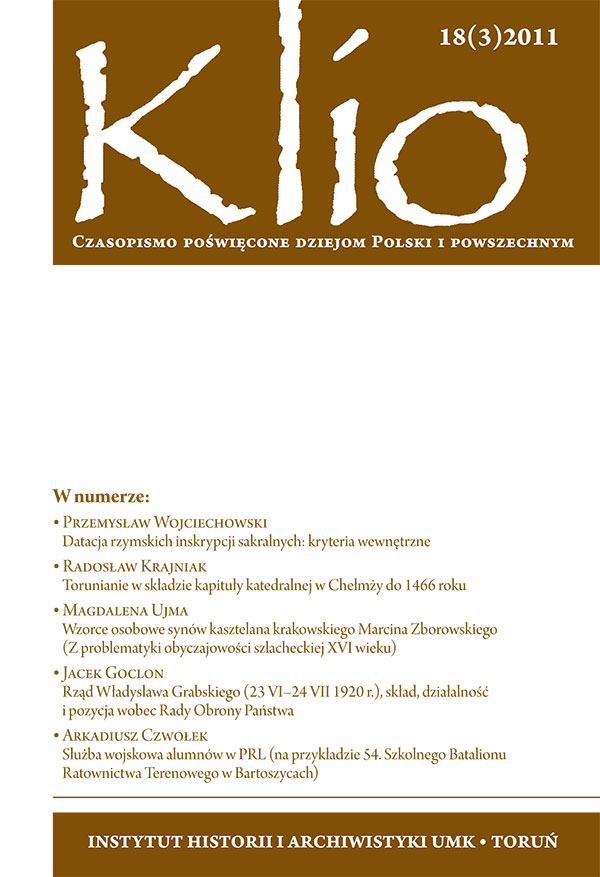
Klio. CPDPiP

Downloads

  • PDF (Język Polski)

Published

2011-09-30

How to Cite

1.
UJMA, Magdalena. Wzorce osobowe synow kasztelana krakowskiego Marcina Zborowskiego (Z problematyki obyczajowości szlacheckiej XVI wieku). Klio. CPDPiP. Online. 30 September 2011. Vol. 18, no. 3, pp. 43-74. [Accessed 19 April 2026]. DOI 10.12775/KLIO.2011.044.
  • ISO 690
  • ACM
  • ACS
  • APA
  • ABNT
  • Chicago
  • Harvard
  • IEEE
  • MLA
  • Turabian
  • Vancouver
Download Citation
  • Endnote/Zotero/Mendeley (RIS)
  • BibTeX

Issue

Vol. 18 No. 3 (2011)

Section

Artykuły

Stats

Number of views and downloads: 1298
Number of citations: 0

Search

Search

Browse

  • Browse Author Index
  • Issue archive

User

User

Current Issue

  • Atom logo
  • RSS2 logo
  • RSS1 logo

Information

  • For Readers
  • For Authors
  • For Librarians

Newsletter

Subscribe Unsubscribe

Language

  • Čeština
  • Deutsch
  • English
  • Français (France)
  • Język Polski
Up

Akademicka Platforma Czasopism

Najlepsze czasopisma naukowe i akademickie w jednym miejscu

apcz.umk.pl

Partners

  • Akademia Ignatianum w Krakowie
  • Akademickie Towarzystwo Andragogiczne
  • Fundacja Copernicus na rzecz Rozwoju Badań Naukowych
  • Instytut Historii im. Tadeusza Manteuffla Polskiej Akademii Nauk
  • Instytut Kultur Śródziemnomorskich i Orientalnych PAN
  • Instytut Tomistyczny
  • Karmelitański Instytut Duchowości w Krakowie
  • Ministerstwo Kultury i Dziedzictwa Narodowego
  • Państwowa Akademia Nauk Stosowanych w Krośnie
  • Państwowa Akademia Nauk Stosowanych we Włocławku
  • Państwowa Wyższa Szkoła Zawodowa im. Stanisława Pigonia w Krośnie
  • Polska Fundacja Przemysłu Kosmicznego
  • Polskie Towarzystwo Ekonomiczne
  • Polskie Towarzystwo Ludoznawcze
  • Towarzystwo Miłośników Torunia
  • Towarzystwo Naukowe w Toruniu
  • Uniwersytet im. Adama Mickiewicza w Poznaniu
  • Uniwersytet Komisji Edukacji Narodowej w Krakowie
  • Uniwersytet Mikołaja Kopernika
  • Uniwersytet w Białymstoku
  • Uniwersytet Warszawski
  • Wojewódzka Biblioteka Publiczna - Książnica Kopernikańska
  • Wyższe Seminarium Duchowne w Pelplinie / Wydawnictwo Diecezjalne „Bernardinum" w Pelplinie

© 2021- Nicolaus Copernicus University Accessibility statement Shop