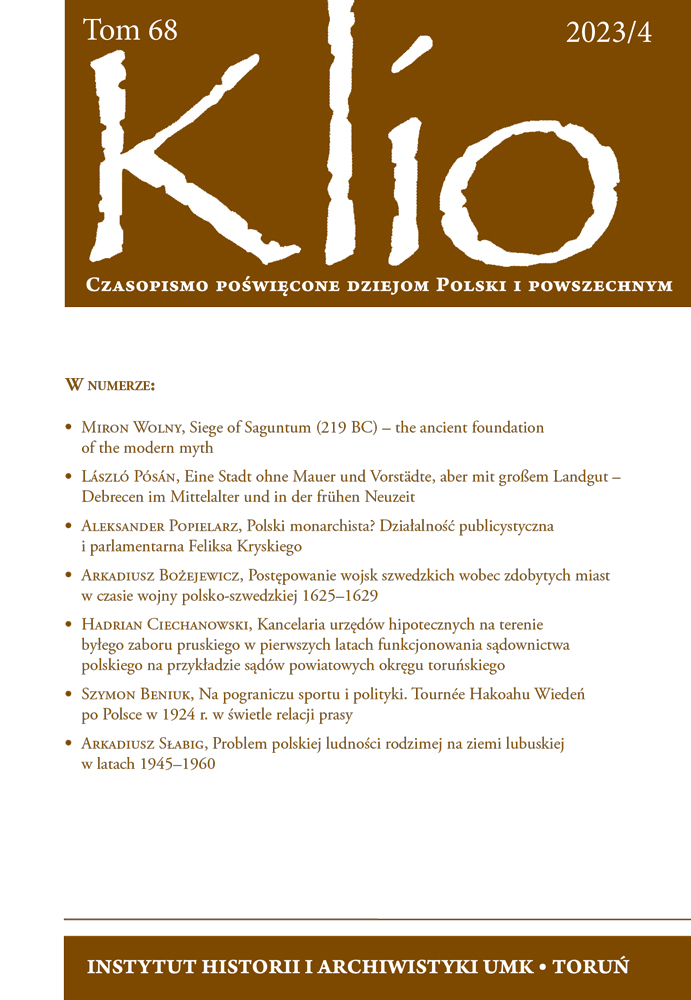
A Siege of Saguntum (219 BC) – the ancient foundation of the modern myth
DOI:
https://doi.org/10.12775/KLIO.2023.028Keywords
Second Punic War, ancient historiography, siege of Saguntum, heroic topos, national mythologyAbstract
The author of the article has attempted to prove that Saguntum has been included in the pantheon of cities which have played an important role in history. Both the siege of the city by Hannibal and the heroic defence of the inhabitants against the Carthaginians were depicted by the ancient sources in both a vivid (but also an exaggerated) fashion. The convention of presenting the fate of the besieged city was driven by the ideological goals
of Roman writing. The siege and the heroic defence which the inhabitants of Saguntum mounted against the invaders became an integral part of the picture, which demonstrated
how the steadfastness of the Romans was greater than that of others. The motif of the heroic defence of Saguntum, deliberately exaggerated in Roman writing, became the
mainstay of conservative and patriotic ideals. The myth created by Roman literary circles saw its original function change in later
References
- Astin A. E., Saguntum and the Origins of the Second Punic War, Latomus 26, 1967, s. 577-596.
- Beck H., The Reasons for the War, w: A Campanion to The Punic Wars, red. D. Hoyos, Malden 2011, s. 225-241.
- Bender P., Untersuchungen zur Vorgeschichte des zweiten punischen Krieges, Hamburg 1954.
- Billows R. A., Antigonos The One-Eyed and The Creation of The Hellenistic State, London 1990.
- Bonquet J., Polybius on the Critical Evaluation of Historians, „Ancient Society”, 13-14, 1982/1983, s. 277-291.
- Carcopino J., Le traité d'Hasdrubal et la responsabilité de la deuxième guerre punique, REA 55 1953, s. 258-293.
- Cowan R., In my beginning is my end. Origins, Cities and Foundations in Flavian Epic, Oxford 2002 (Diss.).
- Curtis M., Introduction to The Transaction Edition, in: W. Lippman, Public Opinion, New Jersey 1991, p. XI-XXXVI.
- Davidson J., Polybius, w: The Roman Historians, ed. A. Feldherr, Cambridge 2009, p. 123-136.
- Domínguez Perez J. C., El potencial económico de Saiganthé como « casus belli » en el estallido de la segunda Guerra Púnica, Latomus 64, 2005, s. 590-600.
- Dominik J. W., The Reception of Silius Italicus in Modern Scholarship, in A. Augoustakis (ed.), Brill’s Companion to Silius Italicus, Leiden/Boston 2010, p. 425-447.
- Duff J. D., Commentary, w: Silius Italicus, Punica, vol. I, trans. J. D. Duff, London 1961.
- Duplá Ansuategui A., The Image of Phoenicians and Carthaginians in Modern Spanish History and Culture, in: R. Rovira Guardiola, ed. The Ancient Mediterranean Sea in Moderm Visual and Performing Art: Sailing in Troubled Waters, Blomsbury 2017, p. 213-230.
- Erbse H., Zur Entstehung des polybianischen Geschichtswerke, RhM 94, 1951, p. 157-179.
- Errington R. M., Rome and Spain before The Second Punic War, Latomus 29, 1970, s. 25-57.
- García Cardiel J., La conquista romana de Hispania en el imaginario pictórico español (1754-1894), „CuPAUAM” 36, 2010, pp. 131-157.
- Hau L. I., Moral History from Herodotus to Diodorus Sicilus, Edinburgh 2016.
- Händl-Sagawe U., Der Beginn des 2. Punischen Krieges. Ein historisch-kritischer Kommentar zu Livius Buch 21, München 1995.
- Harmand B., Une campagne Césarienne: Alésia, Paris 1967.
- Hoyos D., Unplanned Wars: The Origins of the First and Second Punic Wars, Berlin-New York 1998.
- Huss W., Geschichte der Karthager, München 1985.
- Klotz A., Livius und seine Vorgänger, vol. 2, Leipzig-Berlin 1941.
- Koerner R., Polybios als Kritiker früher Historiker, Jena 1957 (Diss.).
- Latacz J., Die Phönizier bei Homer, in: Die Phönizier im Zeitalter Homers, ed. U. Gehring, Mainz 1990, s. 11-21.
- Liedl Ch. G., Appians : Aufbau – Darstelleungtendentzen – Quellen, ANRW II, 34.1, 429-462.
- Lippman M., Public Opinion, New Jersey 1991.
- Marden E. W., Polybios as Military Historian, Entretiens Hardt 20, 1974, p. 267 ff.
- Poznanski L., Essai de reconstruction de traité de tactique de Polybe d’après le livre III des histoires, AC 49, 1980, p. 161-172.
- Quesada Sanz P., En torno al ‘Ultimo día de Sagundo’ de Francisco Daminguo Maqués y el ‘Mosaico de Alejandro’, „Anuario del Departamento de Historia y Teoría del Arte” 7-8, 1995-1996, pp. 223-228.
- Seibert J., Forschungen zu Hannibal, Darmstadt 1993.
- Shipp G. P., Ballista, Glotta 39, 1961, p. 149-152.
- Śnieżewski S., The Poetic Structure of Silius Italicus’ Punica (Books I-V), Classica Cracoviensia 22, 2019, s. 91-118.
- Timpe D., Fabius Pictor und die Anfänge der römischen Historiographie, „ANRW” 1.2, Berlin 1972, s. 928-968.
- Tsirkin J. B., The Phoenicians and Tartessos, Gerión 15, 1997, p. 243-251.
- Walbank F. W., A Historical Commentary on Polybius, vol. I, Oxford 1957.
- Walbank F. W., A Historical Commentary on Polybius, vol. II, Oxford.
Downloads
Published
How to Cite
Issue
Section
License
Copyright (c) 2023 Miron Wolny

This work is licensed under a Creative Commons Attribution-NoDerivatives 4.0 International License.
Stats
Number of views and downloads: 427
Number of citations: 0


