Zum Inhalt springen Zur Hauptnavigation springen Zur Fußzeile springen
  • Registrieren
  • Einloggen
  • Language
    • Čeština
    • Deutsch
    • English
    • Français (France)
    • Język Polski
  • Menu
  • Home
  • Aktuelle Ausgabe
  • Archiv
  • Mitteilungen
  • Über uns
    • Über die Zeitschrift
    • Beitragseinreichung
    • Redaktion
    • Schutz personenbezogener Daten
    • Kontakt
  • Registrieren
  • Einloggen
  • Language:
  • Čeština
  • Deutsch
  • English
  • Français (France)
  • Język Polski

Klio - Czasopismo Poświęcone Dziejom Polski i Powszechnym

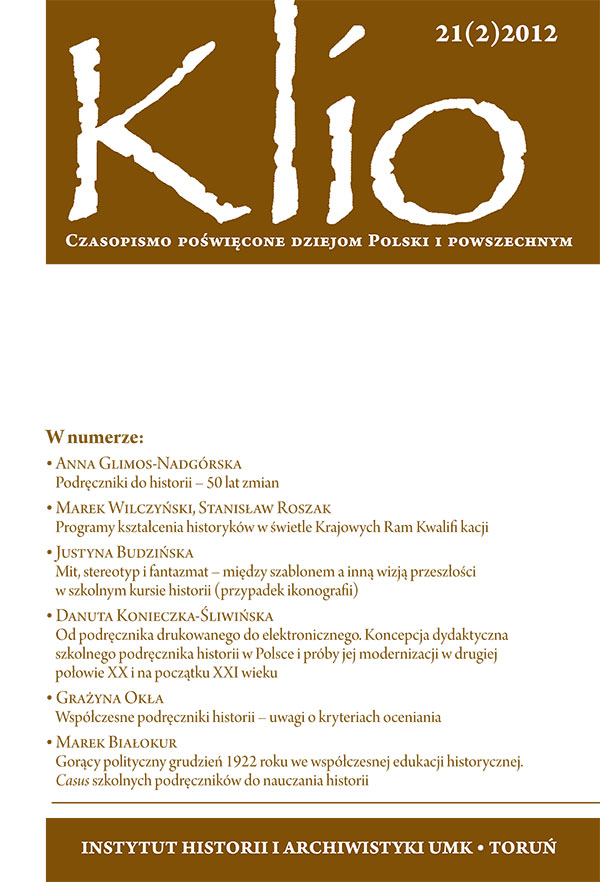
Programy kształcenia historyków w świetle Krajowych Ram Kwalifikacji
  • Home
  • /
  • Programy kształcenia historyków w świetle Krajowych Ram Kwalifikacji
  1. Home /
  2. Archiv /
  3. Bd. 21 Nr. 2 (2012) /
  4. Artykuły

Programy kształcenia historyków w świetle Krajowych Ram Kwalifikacji

Autor/innen

  • Marek Wilczyński Instytut Historii, Uniwersytet Pedagogiczny w Krakowie
  • Stanisław Roszak Instytut Historii i Archiwistyki, Uniwersytet Mikołaja Kopernika w Toruniu

DOI:

https://doi.org/10.12775/KLIO.2012.019

Abstract

In 2012 in Polish higher education a new curriculum was introduced. The new syllabuses are in accordance with the European Qualification Framework. This change means that previous teaching standards established by the Ministry of Education are about to disappear. The authors of the article present a review of the basic legal acts – European and Polish ones, which regulate changes. Stanisław Roszak and Marek Wilczyński show not only theoretical rules for building educational programs on the basis of learning outcomes, but also practical advice with reference to international patterns have been implemented. They point out possibilities created by the act concerning the construction of the new study courses for higher education. The analysis touches on the following aspects: the outcomes of teaching in the humanities (established by the Ministry), the outcomes of teaching in history departments (established by the faculties), the outcomes of the teaching of particular subjects (established by the academics). Besides the theoretical background to the construction of new programmes, specific practical solutions are included in the article, such as a syllabus for ancient history. The second part of the text is devoted to methods of managing and evaluating students’ learning. Methods of evaluation are crucial for a success of the reform. Evaluation is used not only to verify the knowledge and skills of the students. It should also be an important guide in helping to evaluate a teaching programme and the methods used by the teachers. Acquainting with the article will undoubtedly help developing new programs of educating the historians as a starting point for creative evolving of student’s centred learning educational model allowing further employability in changing market conditions.
Klio - Czasopismo Poświęcone Dziejom Polski i Powszechnym

Downloads

  • PDF (Język Polski)

Veröffentlicht

2012-04-26

Zitationsvorschlag

1.
WILCZYŃSKI, Marek und ROSZAK, Stanisław. Programy kształcenia historyków w świetle Krajowych Ram Kwalifikacji. Klio - Czasopismo Poświęcone Dziejom Polski i Powszechnym. Online. 26 April 2012. Vol. 21, no. 2, pp. 31-55. [Accessed 14 Mai 2026]. DOI 10.12775/KLIO.2012.019.
  • ISO 690
  • ACM
  • ACS
  • APA
  • ABNT
  • Chicago
  • Harvard
  • IEEE
  • MLA
  • Turabian
  • Vancouver
Bibliografische Angaben herunterladen
  • Endnote/Zotero/Mendeley (RIS)
  • BibTeX

Ausgabe

Bd. 21 Nr. 2 (2012)

Rubrik

Artykuły

Stats

Number of views and downloads: 501
Number of citations: 0

Search

Search

Browse

  • Autor/innenverzeichnis durchblättern
  • Issue archive

User

User

Aktuelle Ausgabe

  • Atom-Logo
  • RSS2-Logo
  • RSS1-Logo

Informationen

  • Für Leser/innen
  • Für Autor/innen
  • Für Bibliothekar/innen

Newsletter

Subscribe Unsubscribe

Sprache

  • Čeština
  • Deutsch
  • English
  • Français (France)
  • Język Polski
Aufwärts

Akademicka Platforma Czasopism

Najlepsze czasopisma naukowe i akademickie w jednym miejscu

apcz.umk.pl

Partners

  • Akademia Ignatianum w Krakowie
  • Akademickie Towarzystwo Andragogiczne
  • Fundacja Copernicus na rzecz Rozwoju Badań Naukowych
  • Instytut Historii im. Tadeusza Manteuffla Polskiej Akademii Nauk
  • Instytut Kultur Śródziemnomorskich i Orientalnych PAN
  • Instytut Tomistyczny
  • Karmelitański Instytut Duchowości w Krakowie
  • Ministerstwo Kultury i Dziedzictwa Narodowego
  • Państwowa Akademia Nauk Stosowanych w Krośnie
  • Państwowa Akademia Nauk Stosowanych we Włocławku
  • Państwowa Wyższa Szkoła Zawodowa im. Stanisława Pigonia w Krośnie
  • Polska Fundacja Przemysłu Kosmicznego
  • Polskie Towarzystwo Ekonomiczne
  • Polskie Towarzystwo Ludoznawcze
  • Towarzystwo Miłośników Torunia
  • Towarzystwo Naukowe w Toruniu
  • Uniwersytet im. Adama Mickiewicza w Poznaniu
  • Uniwersytet Komisji Edukacji Narodowej w Krakowie
  • Uniwersytet Mikołaja Kopernika
  • Uniwersytet w Białymstoku
  • Uniwersytet Warszawski
  • Wojewódzka Biblioteka Publiczna - Książnica Kopernikańska
  • Wyższe Seminarium Duchowne w Pelplinie / Wydawnictwo Diecezjalne „Bernardinum" w Pelplinie

© 2021- Nicolaus Copernicus University Accessibility statement Shop