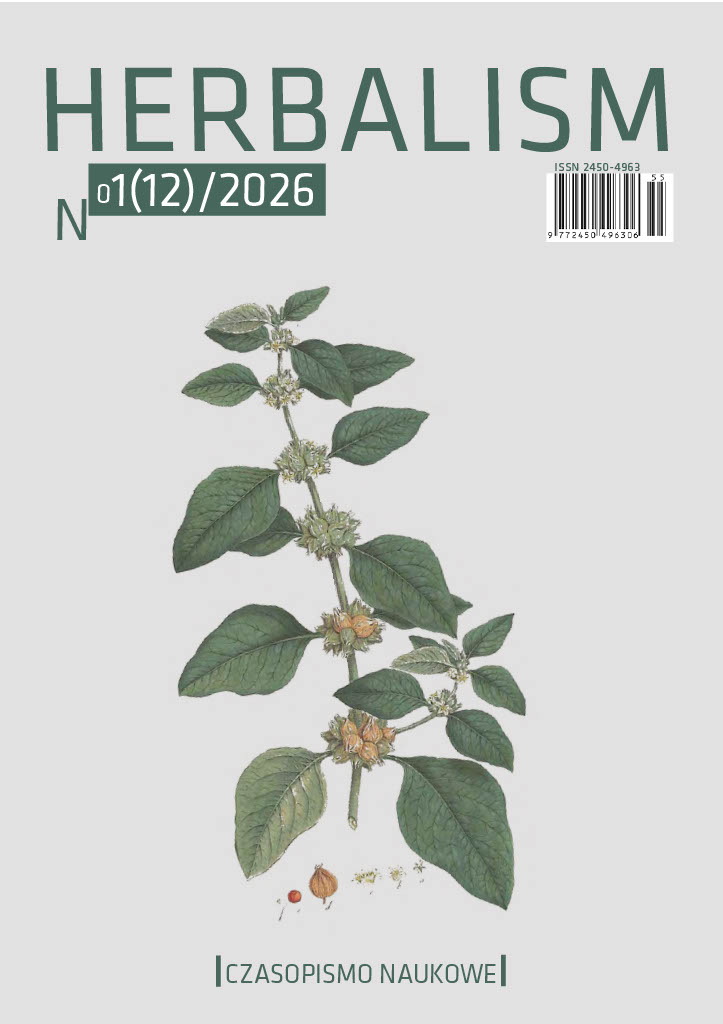
Ashwagandha jako adaptogen terapeutyczny: przegląd potencjalnych zastosowań klinicznych
DOI:
https://doi.org/10.12775/HERB.2026.007Ključne riječi
ashwagandha, Withania somnifera, witanolidy, działanie przeciwstresoweSažetak
Ashwagandha (Withania somnifera) jest rośliną adaptogenną szeroko wykorzystywaną w ajurwedzie, zawierającą liczne związki bioaktywne, spośród których kluczowe znaczenie przypisuje się witanolidom. Praca stanowi przegląd danych przedklinicznych i klinicznych dotyczących potencjalnych zastosowań terapeutycznych ashwagandhy. Omówiono jej aktywność przeciwdrobnoustrojową, działanie kardioprotekcyjne obserwowane w modelach niedokrwienia i reperfuzji oraz możliwą rolę w modulacji osi podwzgórze–przysadka–nadnercza (HPA, ang. Hypothalamic–Pituitary–Adrenal axis) i redukcji markerów stresu. Najlepiej udokumentowanym efektem działania ashwagandhy jest redukcja stresu i lęku oraz poprawa parametrów snu. Przedstawiono również wyniki badań wskazujących na korzystny wpływ ashwagandhy na wydolność (VO₂max), siłę i regenerację u osób aktywnych. Zwrócono również uwagę na potencjał przeciwnowotworowy witanolidów oraz ich działanie przeciwzapalne. Autorzy badań podkreślają obiecujące właściwości ashwagandhy, przy jednoczesnym wskazaniu potrzeby prowadzenia dalszych, dobrze zaprojektowanych badań klinicznych, które mogą pomóc w ocenie jej skuteczności i bezpieczeństwa.
References
[1] Mandlik Ingawale D. S., Namdeo A. G., Pharmacological evaluation of ashwagandha highlighting its healthcare claims, safety, and toxicity aspects, Journal of Dietary Supplements, 2021, 18(2), s. 183–226.
[2] Mukherjee P. K., Banerjee S., Biswas S., Das B., Kar A., Katiyar C. K., Withania somnifera (L.) Dunal – Modern perspectives of an ancient Rasayana from Ayurveda, Journal of Ethnopharmacology, 2021, 264, 2021,113157.
[3] Paul S., Chakraborty S., Anand U., Dey S., Nandy S., Ghorai M., Saha S. C., Patil M. T., Withania somnifera (L.) Dunal (ashwagandha): A comprehensive review on
ethnopharmacology, pharmacotherapeutics, biomedicinal and toxicological aspects, Biomedicine Pharmacotherapy, 202, 143, 112175.
[4] Bisht P., Rawat V., Antibacterial activity of Withania somnifera against Gram-positive isolates from pus samples, Ā yurvedāloka, 2014, 35(3), s. 330–332.
[5] Alam N., Hossain M., Mottalib M. A., Sulaiman S. A., Gan S. H., Khalil M. I., Methanolic extracts of Withania somnifera leaves, fruits and roots possess antioxidant
properties and antibacterial activities, BMC Complementary Alternative Medicine, 2012, 12(1), s. 175–184.
[6] Singh G., Kumar P., Evaluation of antimicrobial efficacy of flavonoids of Withania somnifera L., Indian Journal Pharmaceutical Sciences, 2011, 73(4), s. 473–478.
[7] Sharma U., Velpandian T., Sharma P., Singh S., Evaluation of anti-leishmanial activity of selected Indian plants known to have antimicrobial properties, Parasitology Research, 2009, 105(5), s. 1287–1293.
[8] World Health Organization, Cardiovascular diseases, https://www.who.int/health-topics/cardiovascular-diseases#tab=tab_1 (dostęp: 12.11.2025)
[9] Mohanty I., Arya D. S., Dinda A., Talwar K. K., Joshi S., Gupta S. K., Mechanisms of cardioprotective effect of Withania somnifera in experimentally induced myocardial infarction, Basic Clinical Pharmacology Toxicology, 2004, 94, s. 184–190.
[10] Mohanty I. R., Arya D. S., Gupta S. K., Withania somnifera provides cardioprotection and attenuates ischemia-reperfusion-induced apoptosis, Clinical Nutrition, 2008, 27, s. 635–642.
[11] Walker B. R., Glucocorticoids and cardiovascular disease, European Journal of Endocrinology, 2007, 5(157), s. 545–559.
[12] Tsigos C., Chrousos G. P., Hypothalamic–pituitary–adrenal axis, neuroendocrine factors and stress, Journal of Psychosomatic Research, 2002, 4(53), s. 865–871.
[13] Lopresti A. L., Smith S. J., Malvi H., Kodgule R., An investigation into the stress – relieving and pharmacological actions of an ashwagandha (Withania somnifera)
extract: A randomized, double-blind, placebo-controlled study, Medicine, 2019, 98, e17186.
[14] Salve J., Pate S., Debnath K., Langade D., Adaptogenic and anxiolytic effects of ashwagandha root extract in healthy adults: A double-blind, randomized, placebo-controlled clinical study, Cureus Journal of Medical Science, 2019, 11, e6466.
[15] Majeed M., Nagabhushanam K., Mundkur L., A standardized ashwagandha root extract alleviates stress, anxiety, and improves quality of life in healthy adults by modulating stress hormones: Results from a randomized, double-blind, placebo-controlled study, Medicine, 2023, 102(41), e35521.
[16] Langade D., Kanchi S., Salve J., Debnath K., Ambegaokar D., Efficacy and safety of ashwagandha (Withania somnifera) root extract in insomnia and anxiety: A double-blind, randomized, placebo-controlled study, Cureus Journal of Medical Science, 2019, 11(9), e5797.
[17] Cheah K. L., Norhayati M. N., Husniati Yaacob L., Abdul Rahman R., Effect of ashwagandha (Withania somnifera) extract on sleep: A systematic review and meta-analysis, PLOS ONE, 2021, 16(9), e0257843.
[18] Deshpande A., Irani N., Balkrishnan R., Benny I. R., A randomized, double blind, placebo controlled study to evaluate the effects of ashwagandha (Withania somnifera) extract on sleep quality in healthy adults, Sleep Medicine, 2020, 72, s. 28–36.
[19] Verma N., Gupta S. K., Patil S., Tiwari S., Mishra A. K., Effects of ashwagandha (Withania somnifera) standardized root extract on physical endurance and VO2max in healthy adults performing resistance training: An eight-week, prospective, randomized, double-blind, placebo-controlled study, Randomized Controlled Trial, 2024,
8(12), s. 335.
[20] Pérez-Gómez J., Villafaina S., Adsuar J. C., Merellano-Navarro E., Collado-Mateo D., Effects of ashwagandha (Withania somnifera) on VO2max: A systematic review and meta-analysis., Nutrients, 2020, 12(4), 1119.
[21] Coope O. C., Reales Salguero A., Spurr T., Páez Calvente A., Domenech Farre A., Jordán Fisas E., Lloyd B., Gooderick J., Abad Sangrà M., Roman-Viñas B., Effects of root extract of ashwagandha (Withania somnifera) on perception of recovery and muscle strength in female athletes, European Journal Sport Science, 2025, 25(3), e12265.
[22] Singh N., Yadav S. S., Rao A. S., Nandal A., Kumar S., Ganaie S. A., Narasihman B., Review on anticancerous therapeutic potential of Withania somnifera (L.) Dunal,
Journal Ethnopharmacology, 2021, 24(270), 113704.
[23] Kumar S., Mathew S. O., Aharwal R. P., Tulli H. S., Mohan C. D, Sethi G, Ahn K. S, Webber K, Sandhu S. S, Bishayee A., Withaferin A: A pleiotropic anticancer agent
from the Indian medicinal plant Withania somnifera (L.) dunal, Pharmaceuticals (Basel), 2023, 16(2), s. 160.
[24] Khan A., Rehman A. U., Siddiqui S., Khan J., Massey S., Singh P., Saluja D., Husain S. A., Iqbal M. A., Withaferin A decreases glycolytic reprogramming in breast cancer, Scientific Reports, 2024, 14, 23147.
[25] Biswal B. M., Sulaiman S. A., Ismail H. C., Zakaria H., Musa K. I., Effect of Withania somnifera (ashwagandha) on the development of chemotherapy-induced fatigue and quality of life in breast cancer patients, Integrative Cancer Therapies, 2013, 12(4), s. 312–322.
[26] Sikandan A., Shinomiya T., Nagahara Y., Ashwagandha root extract exerts anti-in-flammatory effects in HaCaT cells by inhibiting the MAPK/NF-κB pathways and
by regulating cytokines, International Journal of Molecular Medicine, 2018, 42(1), 425–434.
[27] Khan M. A., Ahmed R. S., Chandra N., Arora V. K., Ali A., In vivo, extract from Withania somnifera root ameliorates arthritis via regulation of key immune mediators of inflammation in experimental model of arthritis, Anti-Inflammatory & Anti-Allergy Agents in Medicinal Chemistry, 2019, 18(1), s. 55–70.
[28] Ramakanth G. S., Uday Kumar C., Kishan P. V., Usharani P., A randomized, double blind placebo controlled study of efficacy and tolerability of Withaina somni-
fera extracts in knee joint pain, Journal Ayurveda Integrative Medicine, 2016, 7(3), s. 151–157.
[29] Agata K., Kusiak J., Stępień B., Bergier K., Kuźniak E., Bioaktywne metabolity wtórne roślin z rodzaju Physalis, Postepy Hig Med Dosw (online), 2010; 64: 665–673.
Downloads
Objavljeno
How to Cite
Broj časopisa
Rubrika
License

This work is licensed under a Creative Commons Attribution-NoDerivatives 4.0 International License.
Stats
Number of views and downloads: 105
Number of citations: 0


