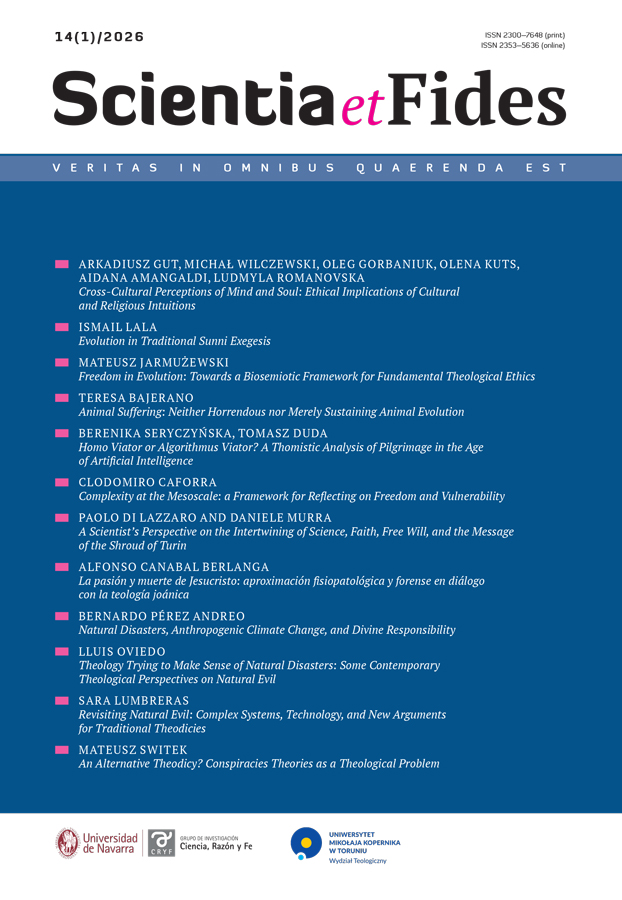
Homo Viator or Algorithmus Viator?
A Thomistic Analysis of Pilgrimage in the Age of Artificial Intelligence
DOI:
https://doi.org/10.12775/SetF.2026.005Keywords
Cyberpilgrimage, Artificial Intelligence, Thomism, Neuroscience, Suffering, Spiritual purificationAbstract
Debates on AI primarily focus on its moral implications and capacity to simulate religious experiences. However, an analysis of pilgrimage offers a unique perspective on broader transformations in religious practice, ranging from traditional spiritual journeys to modern, technology-assisted routes organized by travel agencies. Equipped with technological conveniences, emphasize efficiency and participant satisfaction, raising theological questions about the essence of pilgrimage itself. Used thomistic structure of argumentation (objections, counterarguments, and response) to examine three key issues: (1) whether AI can participate in a pilgrimage in a spiritual sense, (2) whether technological elimination of hardship diminishes the transformative potential of pilgrimage, and (3) whether cyberpilgrimage constitutes a legitimate alternative to physical pilgrimage.
Drawing on classical metaphysics and contemporary AI research, the study argues that AI, lacking a rational soul, free will, and an intrinsic orientation toward transcendence, cannot be considered homo viator. Furthermore, the removal of physical hardship may undermine the ascetic and transformative dimensions of pilgrimage. The analysis of cyberpilgrimage suggests that, while psychologically engaging, virtual experiences do not replace the sacramental and embodied nature of spiritual journeys. This study contributes to the discourse on spirituality in the digital age, proposing a balanced approach that reconciles tradition with technological advancements while reaffirming the relevance of Thomistic anthropology in addressing contemporary challenges.
References
Aquinas, Thomas. 2012. Summa Theologica. Translated by Fathers of the English Dominican Province. Notre Dame: Christian Classics.
Alkhouri, Khader I. 2024. “The Role of Artificial Intelligence in the Study of the Psychology of Religion.” Religions 15 (3): 290. https://doi.org/10.3390/rel15030290.
Augustine. Confessions. 2008. Translated by Henry Chadwick. Oxford: Oxford University Press.
Bailey, Anne E. 2023. “Journey or Destination? Rethinking Pilgrimage in the Western Tradition.” Religions 14 (9): 1157. https://doi.org/10.3390/rel14091157.
Baudrillard, Jean. 1994. Simulacra and Simulation. Translated by Sheila Faria Glaser. Ann Arbor: University of Michigan Press. (Original work published 1981).
Beit-Hallahmi, Benjamin, and Michael Argyle. 2014. The psychology of religious behaviour, belief and experience. London: Routledge.
Bilagher, Moritz Ernst Maria. 2022. “From Absolute Mind to Zombie: Is Artificial Intelligence Possible?” Scientia et Fides 10 (1): 155–76. https://doi.org/10.12775/SetF.2022.008.
Bostrom, Nick. 2014. Superintelligence: Paths, Dangers, Strategies. Oxford: Oxford University Press.
Brumec, Snežana. 2021. “The Camino de Santiago in late modernity: Examining transformative aftereffects of the pilgrimage experience.” International Journal of Religious Tourism and Pilgrimage 9 (6): 58–71. https://doi.org/10.21427/ganh-va40.
Campbell, Heidi A., and Giulia Evolvi. 2020. “Contextualizing current digital religion research on emerging technologies.” Human Behavior and Emerging Technologies 2 (1): 5–17. https://doi.org/10.1002/hbe2.149.
Chalmers, David, J. 2006. “Strong and weak emergence.” The re-emergence of emergence 675: 244–56.
Clark, Andy. 2018. “A nice surprise? Predictive processing and the active pursuit of novelty.” Phenomenology and the Cognitive Sciences 17 (3): 521–34. https://doi.org/10.1007/s11097-017-9525-z.
Coleman, Simon and John Eade. 2004. Reframing Pilgrimage: Cultures in Motion. Rarnham: Ashgate Publishing.
Collins-Kreiner, Noga. 2016. “The lifecycle of concepts: the case of ‘Pilgrimage Tourism’.” Tourism Geographies 18 (3): 322–34. https://doi.org/10.1080/14616688.2016.1155077.
Davies, Oliver. 2016. A Theology of Compassion: Metaphysics of Difference and the Renewal of Tradition. Eugene: Wipf and Stock Publishers.
Doburzyński, Dariusz. 2021. Znak drogi. Teologia pielgrzymowania z perspektywy Camino de Santiago [Sign of the Way. A theology of pilgrimage from the perspective of the Camino de Santiago]. Toruń: Wydawnictwo Naukowe UMK.
Dunn-Hensley, Susan, M. 2020. “Virtual pilgrimage in a time of pandemic: lessons from the Shrine of Our Lady of Walsingham.” International Journal of Religious Tourism and Pilgrimage 8 (7): 13. https://doi.org/10.21427/ncaj-y766.
Egan, Keith. 2010. “Walking Back to Happiness? Modern Pilgrimage and the Expression of Suffering on Spain’s Camino de Santiago.” Journeys 11 (1): 107–32. https://doi.org/10.3167/jys.2010.110106.
Fel, Stanisław, and Jarosław Kozak. 2025. “Religion and Emotions Towards Artificial Intelligence: Christians, Non-Christians and Non-Believers.” Scientia et Fides 13 (1): 75–103. https://doi.org/10.12775/SetF.2025.005.
Floridi, Luciano. 2014. The Fourth Revolution: How the Infosphere is Reshaping Human Reality. Oxford: Oxford University Press.
Fodor, Jerry A. 1975. The Language of Thought. Cambridge: Harvard University Press.
Foucault, Michel. 1988. “Technologies of the self.” In Technologies of the self: A seminar with Michel Foucault, edited by Luther H. Martin, Huck Gutman, and Patrick H. Hutton, 16–49. Amherst: University of Massachusetts Press.
Friston, Karl J. 2019. “Waves of prediction.” PLoS biology 17 (10): e3000426. https://doi.org/10.1371/journal.pbio.3000426.
Garner, Stephen. 2021. “Theology and the new media.” In Digital Religion: Understanding Religious Practice in Digital Media, edited by Heidi A. Campbell and Ruth Tsuria, 266–81. London: Routledge.
Geraci, Robert. M. 2014. Virtually Sacred: Myth and Meaning in World of Warcraft and Second Life. Oxford: Oxford University Press.
Glicksohn, Joseph, and Tal Dotan Ben-Soussan. 2020. „Immersion, absorption, and spiritual experience: some preliminary findings.” Frontiers in Psychology 11: 2118. https://doi.org/10.3389/fpsyg.2020.02118.
Graves, Mark. 2022. “Theological Foundations for Moral Artificial Intelligence?” Journal of Moral Theology 11 (1): 182–221. https://doi.org/10.55476/001c.34130.
Hill-Smith, Connie. 2011. “Cyberpilgrimage: The (virtual) reality of online pilgrimage experience.” Religion Compass 5 (6): 236–46. https://doi.org/10.1111/J.1749-8171.2011.00277.X.
Hoover, Stewart M. 2006. Religion in the media age. London: Routledge. Kaelber, Lutz. 2006. “Paradigms of travel: From medieval pilgrimage to the postmodern virtual tour.” In Tourism, religion and spiritual journeys, edited by Dallen J. Timothy and Daniel H. Olsen, 49–63. London: Routledge.
Komuda, Radosław, Lluis Oviedo Torró, and Sara Lumbreras. 2024. “Artificial Intelligence (AI) and Christian Anthropology: Where the Concerns Lie.” ET studies 15 (1): 3–27. https://doi.org/10.2143/ETS.15.1.3293064.
Komyathy, Brian. 2022. “A Review of the State of Recent Santiago de Compostela Tourism Research (2016–2020).” Social Contexts 10 (1): 26–43. http://doi.org/10.17951/ks.2022.10.1.26-43.
Lake, Brenden M., et al. 2017. “Building machines that learn and think like people.” Behavioral and brain sciences 40: e253.
Latour, Bruno. 2009. “Will non-humans be saved? An argument in ecotheology.” Journal of the Royal Anthropological Institute 15 (3): 459–75. https://doi.org/10.1111/j.1467-9655.2009.01568.x.
Lois-González, Rubén C., and Xosé M. Santos. 2015. “Tourists and pilgrims on their way to Santiago. Motives, Caminos and final destinations.” Journal of Tourism and Cultural Change 13 (2): 149–64. https://doi.org/10.1080/14766825.2014.918985.
Luhrmann, Tanya M. 2012. When God talks back: Understanding the American evangelical relationship with God. New York: Knopf.
Lumbreras, Sara., and Eduardo Garrido-Merchán. 2024. “Insights from Saint Teresa and Saint Augustine on Artificial Intelligence: Discussing Human Interiority.” Scientia et Fides 12 (2): 265–95. https://doi.org/10.12775/SetF.2024.025.
MacWilliams, Mark. W. 2002. “Virtual pilgrimages on the internet.” Religion 32 (4): 315–35. https://doi.org/10.1006/reli.2002.0408.
MacWilliams, Mark. W. 2013. “Virtual Pilgrimage to Ireland’s Croagh Patrick.” In Religion Online: Finding Faith on the Internet, edited by Lorne L. Dawson and Douglas E. Cowan, 223–38. London: Routledge.
Morinis, Alan, and Victor Turner. 1992. Sacred Journeys: The Anthropology of Pilgrimage. Greenwood Press.
O’Leary, Stephen D. 2013. “Cyberspace as Sacred Space: Communicating Religion on Computer Networks.” In Religion Online, 37–58. London: Routledge.
Oviedo, Lluís. 2022. “Artificial Intelligence and Theology: Looking for a Positive—But Not Uncritical—Reception.” Zygon 57 (4): 938–52. https://doi.org/10.1111/zygo.12832.
Popov, Evgeniy A. 2024. “The Theme of Suffering in the Work of M. Foucault.” RUDN Journal of Philosophy 28 (2): 434–49. https://doi.org/10.22363/2313-2302-2024-28-2-434-449.
Putnam, Hilary. 1967. “Psychological predicates.” In Art, Mind, and Religion, edited by W. H. Capitan and D. D. Merrill, 37–48. Pittsburgh: University of Pittsburgh Press.
Puzio, Anna. 2023. “Robot, let us pray! Can and should robots have religious functions? An ethical exploration of religious robots.” AI & Society: 1–17. https://doi.org/10.1007/s00146-023-01812-z.
Reader, Ian, and Tony Walter. 2016. Pilgrimage in Popular Culture. Berlin: Springer.
Roszak, Piotr, and Saša Horvat. 2024. Overcoming Reductionism and Crafting a New Synthesis: Theodicy Confronting Pain and Suffering (Vol. 14). Berlin–Heidelberg: Springer Nature.
Searle, Jonh. R. 1982. “The Chinese room revisited.” Behavioral and brain sciences 5 (2): 345–48.
Seryczyńska, Berenika. 2025. Terapeutyczny wymiar pielgrzymowania w kontekście Camino de Santiago [The therapeutic dimension of pilgrimage in the context of the Camino de Santiago]. Toruń: Wydawnictwo Naukowe UMK.
Sprevak, Mark, and Ryan Smith. 2023. “An introduction to predictive processing models of perception and decision-making.” Topics in Cognitive Science 00: 1–28. https://doi.org/10.1111/tops.12704.
Tran, Mai K., and Andrew Davies. 2025. „The hybrid authenticity of virtual pilgrimage.” Marketing Theory 25 (1): 139–63. https://doi.org/10.1177/1470593124127076.
Tononi, Giulio, Melanie Boly, Marcello Massimini, and Christof Koch. 2016. “Integrated information theory: from consciousness to its physical substrate.” Nature reviews neuroscience 17 (7): 450–61.
Turner, Victor W., and Edith Turner. 2011. Image and Pilgrimage in Christian Culture: Anthropological Perspectives. New York: Columbia University Press.
Tzanelli, Rodanthi. 2020. “Virtual pilgrimage: An irrealist approach.” Tourism Culture & Communication 20 (4): 235–40. https://doi.org/10.3727/109830420X15991011535517.
Vallor, Shannon. 2015. “Moral deskilling and upskilling in a new machine age: Reflections on the ambiguous future of character.” Philosophy & Technology 28 (1): 107–24. http://doi.org/10.1007/s13347-014-0156-9.
Whalen, Brett Edward. 2019. Pilgrimage in the Middle Ages: A Reader. Toronto: University of Toronto Press.
Downloads
Published
How to Cite
Issue
Section
License
Copyright (c) 2026 Berenika Seryczyńska, Tomasz Duda

This work is licensed under a Creative Commons Attribution-NoDerivatives 4.0 International License.
CC BY ND 4.0. The Creator/Contributor is the Licensor, who grants the Licensee a non-exclusive license to use the Work on the fields indicated in the License Agreement.
- The Licensor grants the Licensee a non-exclusive license to use the Work/related rights item specified in § 1 within the following fields: a) recording of Work/related rights item; b) reproduction (multiplication) of Work/related rights item in print and digital technology (e-book, audiobook); c) placing the copies of the multiplied Work/related rights item on the market; d) entering the Work/related rights item to computer memory; e) distribution of the work in electronic version in the open access form on the basis of Creative Commons license (CC BY-ND 3.0) via the digital platform of the Nicolaus Copernicus University Press and file repository of the Nicolaus Copernicus University.
- Usage of the recorded Work by the Licensee within the above fields is not restricted by time, numbers or territory.
- The Licensor grants the license for the Work/related rights item to the Licensee free of charge and for an unspecified period of time.
FULL TEXT License Agreement
Stats
Number of views and downloads: 516
Number of citations: 0


