Skip to main content Skip to main navigation menu Skip to site footer
  • Register
  • Login
  • Language
    • Deutsch
    • English
    • Español (España)
    • Français (France)
    • Italiano
    • Język Polski
  • Menu
  • Home
  • Current
  • Archives
  • About
    • About the Journal
    • Submissions
    • Editorial Team
    • Privacy Statement
    • Contact
  • Register
  • Login
  • Language:
  • Deutsch
  • English
  • Español (España)
  • Français (France)
  • Italiano
  • Język Polski

Litteraria Copernicana

AT THE INTERSECTION OF GENRES: SAMURAI FILMS OF HIDEO GOSHA
  • Home
  • /
  • AT THE INTERSECTION OF GENRES: SAMURAI FILMS OF HIDEO GOSHA
  1. Home /
  2. Archives /
  3. Vol. 14 No. 2 (2014): Japonia /
  4. Studies

AT THE INTERSECTION OF GENRES: SAMURAI FILMS OF HIDEO GOSHA

Authors

  • Michał Bobrowski Uniwersytet Jagielloński

DOI:

https://doi.org/10.12775/LC.2014.033

Keywords

Hideo Gosha, samurai film, western

Abstract

The paper is dedicated to the intertextual and polemic threads in jidai-geki films of Hideo Gosha – especially The Sword of the Beast (Kedamono no ken, 1965), The Secret of the Urn (Tange Sazen: Hien iaigiri, 1966) and Official Gold (Goyokin, 1969). Those works are treated here as emblematic of the transformations which occurred in the Japanese genre cinema of 1960s, when the samurai film (similarly to its American counterpart, the western) entered the phase of revision and reinterpretation of its fundamental ideological, aesthetic and philosophical values. This tendency, which had been anticipated by pre-war dissidents of the samurai films, such as Buntaro Futagawa or Sadao Yamanaka, and elevated by Masaki Kobayashi in 1960s, became a point of departure for further explorations for directors like Kihachi Okamoto, Eiichi Kudo or, last but not least, Hideo Gosha. Gosha’s works are characterised by a certain type of double-coding: his well-crafted, attractive adventure stories have all the features that distinguish the so-called “audience-friendly” films – and yet, on the higher level of interpretation, they appear as high quality genre pastiches, which deconstruct the national stereotypes imprinted in genre typing.
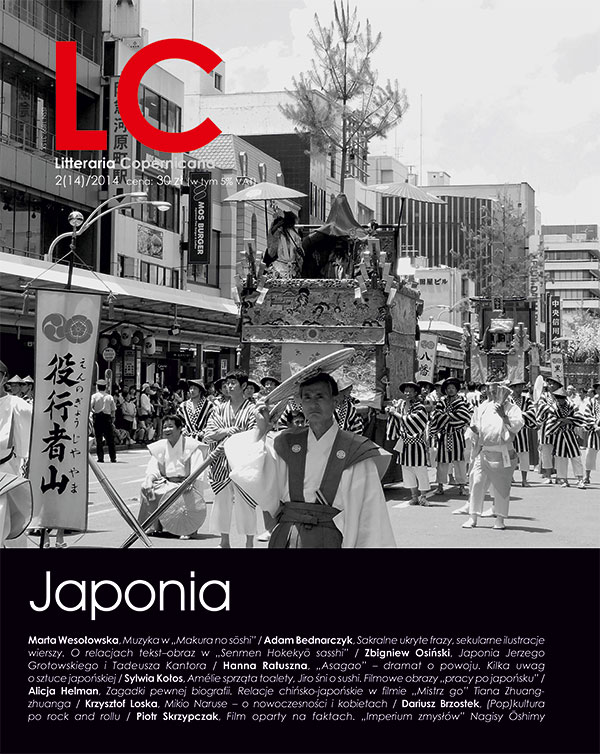
Litteraria Copernicana

Downloads

  • PDF (Język Polski)

Published

2014-12-28

How to Cite

1.
BOBROWSKI, Michał. AT THE INTERSECTION OF GENRES: SAMURAI FILMS OF HIDEO GOSHA. Litteraria Copernicana. Online. 28 December 2014. Vol. 14, no. 2, pp. 208-223. [Accessed 10 April 2026]. DOI 10.12775/LC.2014.033.
  • ISO 690
  • ACM
  • ACS
  • APA
  • ABNT
  • Chicago
  • Harvard
  • IEEE
  • MLA
  • Turabian
  • Vancouver
Download Citation
  • Endnote/Zotero/Mendeley (RIS)
  • BibTeX

Issue

Vol. 14 No. 2 (2014): Japonia

Section

Studies

Stats

Number of views and downloads: 1978
Number of citations: 0

Search

Search

Browse

  • Browse Author Index
  • Issue archive

User

User

Current Issue

  • Atom logo
  • RSS2 logo
  • RSS1 logo

Information

  • For Readers
  • For Authors
  • For Librarians

Newsletter

Subscribe Unsubscribe

Language

  • Deutsch
  • English
  • Español (España)
  • Français (France)
  • Italiano
  • Język Polski

Tags

Search using one of provided tags:

Hideo Gosha, samurai film, western
Up

Akademicka Platforma Czasopism

Najlepsze czasopisma naukowe i akademickie w jednym miejscu

apcz.umk.pl

Partners

  • Akademia Ignatianum w Krakowie
  • Akademickie Towarzystwo Andragogiczne
  • Fundacja Copernicus na rzecz Rozwoju Badań Naukowych
  • Instytut Historii im. Tadeusza Manteuffla Polskiej Akademii Nauk
  • Instytut Kultur Śródziemnomorskich i Orientalnych PAN
  • Instytut Tomistyczny
  • Karmelitański Instytut Duchowości w Krakowie
  • Ministerstwo Kultury i Dziedzictwa Narodowego
  • Państwowa Akademia Nauk Stosowanych w Krośnie
  • Państwowa Akademia Nauk Stosowanych we Włocławku
  • Państwowa Wyższa Szkoła Zawodowa im. Stanisława Pigonia w Krośnie
  • Polska Fundacja Przemysłu Kosmicznego
  • Polskie Towarzystwo Ekonomiczne
  • Polskie Towarzystwo Ludoznawcze
  • Towarzystwo Miłośników Torunia
  • Towarzystwo Naukowe w Toruniu
  • Uniwersytet im. Adama Mickiewicza w Poznaniu
  • Uniwersytet Komisji Edukacji Narodowej w Krakowie
  • Uniwersytet Mikołaja Kopernika
  • Uniwersytet w Białymstoku
  • Uniwersytet Warszawski
  • Wojewódzka Biblioteka Publiczna - Książnica Kopernikańska
  • Wyższe Seminarium Duchowne w Pelplinie / Wydawnictwo Diecezjalne „Bernardinum" w Pelplinie

© 2021- Nicolaus Copernicus University Accessibility statement Shop