Skip to main content Skip to main navigation menu Skip to site footer
  • Register
  • Login
  • Language
    • Deutsch
    • English
    • Español (España)
    • Français (France)
    • Italiano
    • Język Polski
  • Menu
  • Home
  • Current
  • Archives
  • About
    • About the Journal
    • Submissions
    • Editorial Team
    • Privacy Statement
    • Contact
  • Register
  • Login
  • Language:
  • Deutsch
  • English
  • Español (España)
  • Français (France)
  • Italiano
  • Język Polski

Litteraria Copernicana

MUSIC IN THE PILLOW BOOK
  • Home
  • /
  • MUSIC IN THE PILLOW BOOK
  1. Home /
  2. Archives /
  3. Vol. 14 No. 2 (2014): Japonia /
  4. Studies

MUSIC IN THE PILLOW BOOK

Authors

  • Marta Wesołowska Katedra Orientalistyki Uniwersytetu im. Adama Mickiewicza w Poznaniu

DOI:

https://doi.org/10.12775/LC.2014.020

Keywords

Japanese music, gagaku, Makura no sōshi, Sei Shōnagon

Abstract

The article focuses on the problem of music and musicality in The Pillow Book (Makura no sōshi) written by Sei Shōnagon in the 10th century. It has been proved that Sei Shōnagon exposed many aspects of the problem of music in Japanese literature of the Heian period (794-1185) – the time of the greatest heyday of aristocratic culture as well as the development of Japanese court music gagaku. Unlike any European work of this period, music as art performed an important role in aristocratic society, influencing predominantly themes and composition of the created literature. Apart from many biological-cultural factors being shown in Japanese sensitivity and penchant for nature’s music (Tsunoda Tadanobu’s theory) as well as specific musicality of Japanese language, this work shows unique musical character of Sei Shonagon’s writing, expressed on several levels: the level of thematizing music through introducing description of holidays or popular instruments of that time (biwa, hichiriki, koto etc.); the level of verbal music through description of the sounds, involving sounds heard during Buddhist and Shinto ceremonies, tones of particular instruments, voices of human and nature, mechanical sounds and artificial ones; the level of music visualization based on detailed description of musical instruments or performance without relating to their soundsphere; musicality on the emotional level manifested in showing strong feelings and emotions provoked by the music heard, and the symbolic level manifested by assigning specific qualities of symbolism to certain musical elements (flute, rain). The analysis of the above aspects was carried out in regard to the musical contexts, especially the popularity of gagaku court music and the musical education of the ladies-in-waiting in Japan of the Heian period.
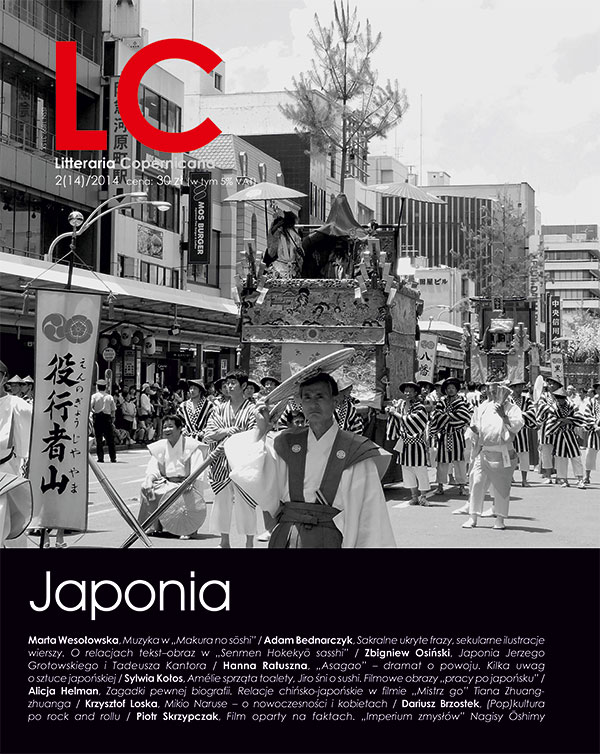
Litteraria Copernicana

Downloads

  • PDF (Język Polski)

Published

2014-12-30

How to Cite

1.
WESOŁOWSKA, Marta. MUSIC IN THE PILLOW BOOK. Litteraria Copernicana. Online. 30 December 2014. Vol. 14, no. 2, pp. 12-29. [Accessed 3 March 2026]. DOI 10.12775/LC.2014.020.
  • ISO 690
  • ACM
  • ACS
  • APA
  • ABNT
  • Chicago
  • Harvard
  • IEEE
  • MLA
  • Turabian
  • Vancouver
Download Citation
  • Endnote/Zotero/Mendeley (RIS)
  • BibTeX

Issue

Vol. 14 No. 2 (2014): Japonia

Section

Studies

Stats

Number of views and downloads: 938
Number of citations: 0

Search

Search

Browse

  • Browse Author Index
  • Issue archive

User

User

Current Issue

  • Atom logo
  • RSS2 logo
  • RSS1 logo

Information

  • For Readers
  • For Authors
  • For Librarians

Newsletter

Subscribe Unsubscribe

Language

  • Deutsch
  • English
  • Español (España)
  • Français (France)
  • Italiano
  • Język Polski

Tags

Search using one of provided tags:

Japanese music, gagaku, Makura no sōshi, Sei Shōnagon
Up

Akademicka Platforma Czasopism

Najlepsze czasopisma naukowe i akademickie w jednym miejscu

apcz.umk.pl

Partners

  • Akademia Ignatianum w Krakowie
  • Akademickie Towarzystwo Andragogiczne
  • Fundacja Copernicus na rzecz Rozwoju Badań Naukowych
  • Instytut Historii im. Tadeusza Manteuffla Polskiej Akademii Nauk
  • Instytut Kultur Śródziemnomorskich i Orientalnych PAN
  • Instytut Tomistyczny
  • Karmelitański Instytut Duchowości w Krakowie
  • Ministerstwo Kultury i Dziedzictwa Narodowego
  • Państwowa Akademia Nauk Stosowanych w Krośnie
  • Państwowa Akademia Nauk Stosowanych we Włocławku
  • Państwowa Wyższa Szkoła Zawodowa im. Stanisława Pigonia w Krośnie
  • Polska Fundacja Przemysłu Kosmicznego
  • Polskie Towarzystwo Ekonomiczne
  • Polskie Towarzystwo Ludoznawcze
  • Towarzystwo Miłośników Torunia
  • Towarzystwo Naukowe w Toruniu
  • Uniwersytet im. Adama Mickiewicza w Poznaniu
  • Uniwersytet Komisji Edukacji Narodowej w Krakowie
  • Uniwersytet Mikołaja Kopernika
  • Uniwersytet w Białymstoku
  • Uniwersytet Warszawski
  • Wojewódzka Biblioteka Publiczna - Książnica Kopernikańska
  • Wyższe Seminarium Duchowne w Pelplinie / Wydawnictwo Diecezjalne „Bernardinum" w Pelplinie

© 2021- Nicolaus Copernicus University Accessibility statement Shop