Ir al contenido principal Ir al menú de navegación principal Ir al pie de página del sitio
  • Registrarse
  • Entrar
  • Language
    • Deutsch
    • English
    • Español (España)
    • Français (France)
    • Italiano
    • Język Polski
  • Menu
  • Inicio
  • Actual
  • Archivos
  • Acerca de
    • Sobre la revista
    • Envíos
    • Equipo editorial
    • Declaración de privacidad
    • Contacto
  • Registrarse
  • Entrar
  • Language:
  • Deutsch
  • English
  • Español (España)
  • Français (France)
  • Italiano
  • Język Polski

Litteraria Copernicana

Dialektyka ruchu i pożądania w opowiadaniu W przedziale Stefana Grabińskiego
  • Inicio
  • /
  • Dialektyka ruchu i pożądania w opowiadaniu W przedziale Stefana Grabińskiego
  1. Inicio /
  2. Archivos /
  3. Vol. 11 Núm. 1 (2013): Grabiński /
  4. Studia i rozprawy

Dialektyka ruchu i pożądania w opowiadaniu W przedziale Stefana Grabińskiego

Autores/as

  • Marek Kochanowski Zakład Literatury Pozytywizmu i Młodej Polski Uniwersytetu w Białymstoku

DOI:

https://doi.org/10.12775/LC.2013.008

Resumen

Dialectics of motion and desire in A short story by Stefan Grabiński entitled W przedziale [In the compartment ]

Abstract

W przedziale [In the Compartment] is the third story in a collection by Stefan Grabiński entitled Demon ruchu [The Motion Demon]. The principal theme of this piece is the demonstration of the destructive force of brutal eroticism and crime that is a result of a fight for a woman played out in a compartment of a moving train. The actions of the main characters are motivated by the movement of the train, which in the text becomes independent of people and becomes the director of the actions of main protagonists. The article signals also a relationship between semantics of this story and an essay by Sigmund Freud, The Uncanny. The Freudian concept of the uncanny signifies the unknown, the inconvenient, the odd, something that comes to light particularly in various moments of “involuntary repetition”. In extreme cases, according to the narrator, human actions reveal a strong unidentified power that makes our capability of normative thinking insufficient to objectively assess a situation. The symbol of this eternal power can be a train, understood as an “icon of modernity”. The train motion turns protagonists into fragmentary characters broken down into basic units of stimuli, experiences and desires. Initiation into the sphere of what is hidden takes place in the story through motion, a demonic action of the machine that at the beginning of the twentieth century was not only seen as the symbol of advancement and technology, but was also associated with madness and death. Equally important in the analysed text is the compartment space that is a metaphorical place where an ideal machine is united with random emotions of its passengers.
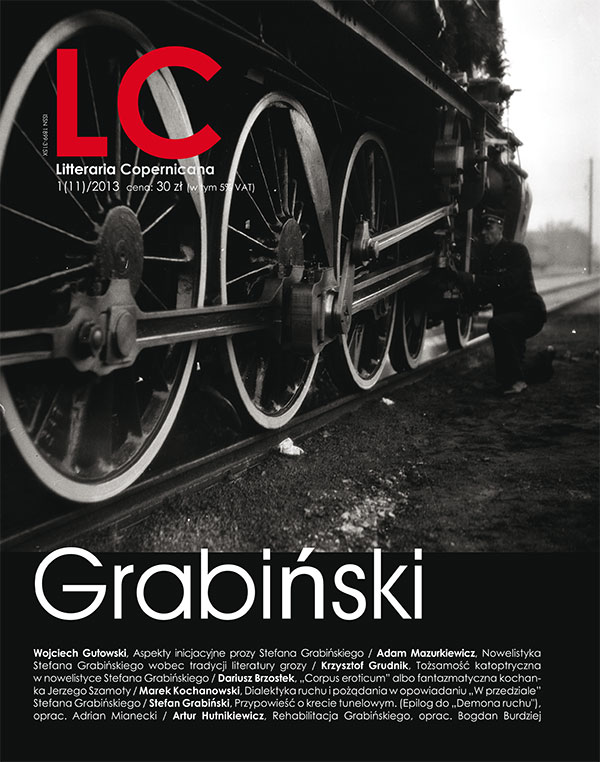
Litteraria Copernicana

Descargas

  • PDF (Język Polski)

Publicado

2013-06-08

Cómo citar

1.
KOCHANOWSKI, Marek. Dialektyka ruchu i pożądania w opowiadaniu W przedziale Stefana Grabińskiego. Litteraria Copernicana. Online. 8 junio 2013. Vol. 11, no. 1, p. 154. [Accessed 10 junio 2026]. DOI 10.12775/LC.2013.008.
  • ISO 690
  • ACM
  • ACS
  • APA
  • ABNT
  • Chicago
  • Harvard
  • IEEE
  • MLA
  • Turabian
  • Vancouver
Descargar cita
  • Endnote/Zotero/Mendeley (RIS)
  • BibTeX

Número

Vol. 11 Núm. 1 (2013): Grabiński

Sección

Studia i rozprawy

Stats

Number of views and downloads: 912
Number of citations: 0

Search

Search

Browse

  • Examinar índice de autores/as
  • Issue archive

User

User

Número actual

  • Logo Atom
  • Logo RSS2
  • Logo RSS1

Información

  • Para lectores/as
  • Para autores/as
  • Para bibliotecarios/as

Newsletter

Subscribe Unsubscribe

Idioma

  • Deutsch
  • English
  • Español (España)
  • Français (France)
  • Italiano
  • Język Polski
Arriba

Akademicka Platforma Czasopism

Najlepsze czasopisma naukowe i akademickie w jednym miejscu

apcz.umk.pl

Partners

  • Akademia Ignatianum w Krakowie
  • Akademickie Towarzystwo Andragogiczne
  • Fundacja Copernicus na rzecz Rozwoju Badań Naukowych
  • Instytut Historii im. Tadeusza Manteuffla Polskiej Akademii Nauk
  • Instytut Kultur Śródziemnomorskich i Orientalnych PAN
  • Instytut Tomistyczny
  • Karmelitański Instytut Duchowości w Krakowie
  • Ministerstwo Kultury i Dziedzictwa Narodowego
  • Państwowa Akademia Nauk Stosowanych w Krośnie
  • Państwowa Akademia Nauk Stosowanych we Włocławku
  • Państwowa Wyższa Szkoła Zawodowa im. Stanisława Pigonia w Krośnie
  • Polska Fundacja Przemysłu Kosmicznego
  • Polskie Towarzystwo Ekonomiczne
  • Polskie Towarzystwo Ludoznawcze
  • Towarzystwo Miłośników Torunia
  • Towarzystwo Naukowe w Toruniu
  • Uniwersytet im. Adama Mickiewicza w Poznaniu
  • Uniwersytet Komisji Edukacji Narodowej w Krakowie
  • Uniwersytet Mikołaja Kopernika
  • Uniwersytet w Białymstoku
  • Uniwersytet Warszawski
  • Wojewódzka Biblioteka Publiczna - Książnica Kopernikańska
  • Wyższe Seminarium Duchowne w Pelplinie / Wydawnictwo Diecezjalne „Bernardinum" w Pelplinie

© 2021- Nicolaus Copernicus University Accessibility statement Shop