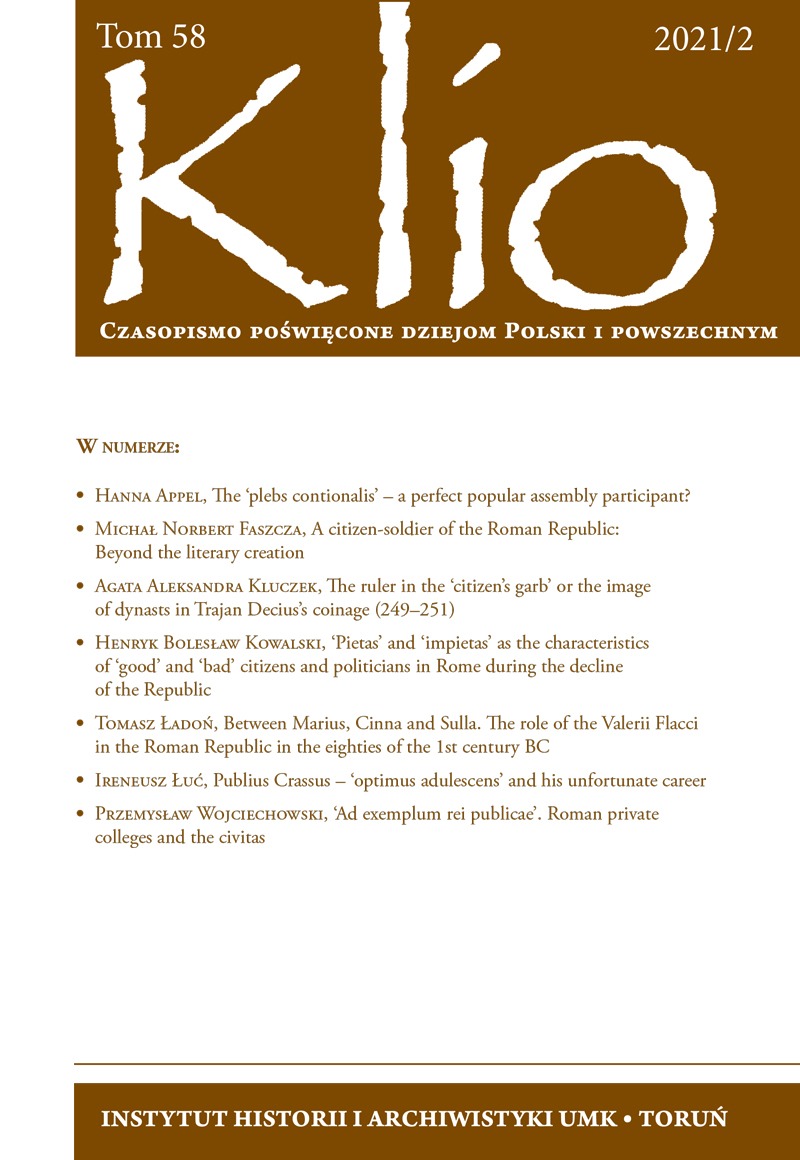
The ruler in the "citizen’s garb" or the image of dynasts in Trajan Decius’s coinage (249–251)
DOI:
https://doi.org/10.12775/KLIO.2021.012Słowa kluczowe
Roman imperial coins, Roman provincial coins, dynasty, Roman emperor, Trajan DeciusAbstrakt
The article engages the problems of the promoting of the members of Trajan Decius’s family in the representations featured on medallions and coins (249–251). It focuses on the representations which feature two and three representatives of the dynasty. Such shared representations manifested the stability of the rule of the dynasty, the collaboration of the members of the dynasty and the resulting benefits for the empire and its inhabitants, which is indicated by the following ideas: concordia, pietas, liberalitas, promoted by the mint in Rome. The thing that links the imperial coinage with the provincial one is the representation of rules in togae, seated in sellae curules. Such an image of the members of the dynasty was utilised in the coins from Anazarbus. This is testimony to the significance of the imperial representations in the practical sphere, especially in the rivalry of the provincial elites for position in the region of the empire.Bibliografia
Abdy R.A., Harling N., Two Important New Roman Coins, “Numismatic Chronicle” 2005, 165, pp. 175–176.
Alföldi A., Die monarchische Repräsentation im römischen Kaiserreiche, Darmstadt 1980.
Birley A.R., Decius reconsidered, [in:] Les empereurs illyriens, éd. E. Frézouls, H. Jouffroy, Strasbourg 1998, pp. 57–80.
BMCG – A Catalogue of the Greek Coins in the British Museum, eds. R.S. Poole et al., London 1873 ff.
Burrell B., Neokoroi. Greek cities and Roman emperor, Leiden 2004.
CIL – Corpus Inscriptionum Latinarum, ed. Th. Mommsen et al., Berolini 1863 ff.
Dąbrowa E., Coinage of the Cilician Cities as a Mirror of Historical and Cultural Changes (V c. BCE – III c. CE), “Studies in Ancient Art and Civilization” 2019, 23, pp. 113–135.
Gerhardt Th., Die Städte, [in:] Die Zeit der Soldaten-Kaiser. Krise und Transformation der Römischen Reiches im 3. Jahrhundert n.Chr. (235–284), hrsgg. K.-P. Johne unter Mitwirkung von U. Hartmann und Th. Gerhardt, Berlin 2008, pp. 691–712.
Grozdanova L., The Roman Emprerors against the Goths of Cniva: Political mythology, historical documents and retrievable reality, Sofia 2019.
Hamberg P.G., Studies in Roman Imperial Art, with Special Reference to the State Reliefs of the Second Century, Uppsala–København 1945.
Harl K.W., Civic Coins and Civic Politics in the Roman East A.D.180–235, Berkeley–Los Angeles–London 1987.
Hekster O., Hadrian ant the Limits to Power, “Journal of Ancient History and Archaeology” 2020, 7.1, pp. 277–287.
Horster M., Coinage and images of the imperial family: local identity and Roman rule, „Journal of Roman Archaeology” 2013, 26, pp. 243–261.
Horster M., The emperor’s family on coins (third century): ideology of stability in times of unrest, [in:] Impact of Empire, 7: Crises and the Roman Empire, eds. O. Hekster, G. De Kleijn, D. Slootjes, Leiden–Boston 2007, pp. 291–309.
Huttner U., Von Maximinus Thrax bis Aemilianus, [in:] Die Zeit der Soldaten-Kaiser. Krise und Transformation der Römischen Reiches im 3. Jahrhundert n.Chr. (235–284), hrsgg. von K.-P. Johne unter Mitwirkung von U. Hartmann und Th. Gerhardt, Berlin 2008, pp. 161–221.
Huttner U., Zwischen Traditionalismus und Totalitarismus. Zur Ideologie und Praxis der Regierung des Kaisers Decius, [in:] Deleto paene imperio Romano. Transformationsprozesse des Römischen Reiches im 3. Jahrhundert und ihre Rezeption in der Neuzeit, hrsgg. K.-P. Johne, T. Gerhardt, U. Hartmann, Stuttgart 2006, pp. 37–56.
Kadman L., The Coins of Caesarea Maritima, Jerusalem 1957.
Klose D.O.A., Festivals and Games in the Cities of the East during the Roman Empire, [in:] Coinage and Identity in the Roman Provinces, eds. Ch. Howgego, V. Heuchert, A. Burnett, Oxford–New York 2005, pp. 125–133.
Kluczek A.A., Obywatel i władca. Propaganda idei restytucyjnej w ikonografii monetarnej (I w. p.n.e.–I w. n.e.), “Klio. Czasopismo poświęcone dziejom Polski i powszechnym” 2018, 47.4, pp. 111–130.
Kluczek A.A., Barbarians on the coins of Trajan Decius (249–251), “Studia Ceranea. Journal of the Waldemar Ceran Research Centre for the History and Culture of the Mediterranean Area and South-East Europe” 2020, 10 (forthcoming).
Manders E., Coining Images of Power: Patterns in the Representation of Roman Emperors on Imperial Coinage, A.D. 193–284, Leiden–Boston 2012.
Mantovani D., Leges et iura p(opuli) R(omani) restituit: principe e diritto in un aureo di Ottaviano, “Athenaeum” 2008, 96, pp. 5–54.
MedR – Gnecchi F., I medaglioni romani, descritti ed illustrati, Milano 2012.
Meshorer Y., The Coinage of Aelia Capitolina, Jerusalem 1989.
MIR 14 – Woytek B., Die Reichsprägung des Kaisers Traianus (98–117), Wien 2010.
Nolle J., Zellner H., Von Anazarbos nach Mopsuhestia. Historische Anmerkungen zu zwei unpublizierten Stadtprägungen der Römischen Kaiserzeit aus Kilikien, “Jahrbuch für Numismatik und Geldgeschichte” 1995, 45, pp. 39–49.
Potter D., Decius and Valerian, [in:] Imagining Emperors in the Later Roman Empire, ed. by D.W.P. Burgersdijk and A.J. Ross, Leiden 2018, pp. 18–37.
Puglisi M., Origine e tradizione iconica di un’immagine monetale: la ‘sella curulis’: proposta di strutturazione di un lemma, [in:] L’immaginario e il potere nell’iconografia monetale, a cura di L. Travaini, A. Bolis, Milano 2004, pp. 55–77.
Reekmans L., La „dextrarum iunctio” dans l’iconographie romaine et paléochrétienne, “Bulletin de l’Institut Historique Belge de Rome” 1958, 31, pp. 23–95.
RIC – The Roman Imperial Coinage, eds. H. Mattingly et al., London 1967–1994.
RIC 2.1 – The Roman Imperial Coinage, 2.1, by I.A. Carradice, T.V. Buttrey, London 2007.
RIC 2.3 – The Roman Imperial Coinage, 2.3, by R. Abdy, P. Mittag, London 2019.
Rich J.W., Williams J.H.C., Leges et Iura P.R. Restituit: A New Aureus of Octavian and the Settlement of 28–27 BC, “Numismatic Chronicle” 1999, 159, pp. 169–213.
RMed – Mittag P.F., Römische Medaillons. Caesar bis Hadrian, Stuttgart 2010.
RPC – Roman Provincial Coinage, by A. Burnett, M. Amandry, P.P. Ripollès et al., London–Paris 1992 ff.
RRC – Crawford M.H., Roman Republican Coinage, Cambridge 1974.
Schäfer Th., Imperii insignia. Sella curulis und fasces. Zum Repräsentation römische Magistrate, Mainz 1989.
SNG vA – Sylloge Nummorum Graecorum Deutschland: Sammlung von Aulock, bearb. G. Kleiner et al., Berlin 1957–1968.
Vout C., The Myth of the Toga: Understanding the History of Roman Dress, “Greece & Rome” 1996, 43.2, pp. 204–220.
Wanscher O., Sella Curulis. The Folding Stool: An Ancient Symbol of Dignity, Copenhagen 1980.
Ziegler R., Ergänzungen zum Münzcorpus der Stadt Anazarbos in Kilikien, “Jahrbuch für Numismatik und Geldgeschichte” 1998/1999, 48/49, pp. 101–132.
Ziegler R., Das Koinon der drei Eparchien Kilikien, Isaurien und Lykaonien im späten 2. und frühen 3. Jahrhundert n. Chr., [in:] Studien zum antiken Kleinasien IV, Bonn 1999, pp. 137–152.
Ziegler R., Kaiser, Heer und städtisches Geld: Untersuchungen zur Münzprägung von Anazarbos und anderer ostkilikischer Städte, Wien 1993.
Ziegler R., Städtische Prestige und kaiserliche Politik. Studien zum Festwesen in Ostkilikien im 2. und 3. Jahrhundert n. Chr., Düsseldorf 1985.
Pobrania
Opublikowane
Jak cytować
Numer
Dział
Licencja
Prawa autorskie (c) 2021 Agata Aleksandra Kluczek

Utwór dostępny jest na licencji Creative Commons Uznanie autorstwa – Bez utworów zależnych 4.0 Międzynarodowe.
Statystyki
Liczba wyświetleń i pobrań: 622
Liczba cytowań: 0


