Przejdź do sekcji głównej Przejdź do głównego menu Przejdź do stopki
  • Zarejestruj
  • Zaloguj
  • Język
    • Čeština
    • Deutsch
    • English
    • Français (France)
    • Język Polski
  • Menu
  • Strona domowa
  • Aktualny numer
  • Archiwum
  • Ogłoszenia
  • O czasopiśmie
    • O czasopiśmie
    • Przesyłanie tekstów
    • Zespół redakcyjny
    • Polityka prywatności
    • Kontakt
  • Zarejestruj
  • Zaloguj
  • Język:
  • Čeština
  • Deutsch
  • English
  • Français (France)
  • Język Polski

Klio - Czasopismo Poświęcone Dziejom Polski i Powszechnym

Gens Claudia i rzymski kult Wielkiej Macierzy – Kybele
  • Strona domowa
  • /
  • Gens Claudia i rzymski kult Wielkiej Macierzy – Kybele
  1. Strona domowa /
  2. Archiwum /
  3. Tom 30 Nr 3 (2014) /
  4. Artykuły

Gens Claudia i rzymski kult Wielkiej Macierzy – Kybele

Autor

  • Agnieszka Dziuba Katolicki Uniwersytet Lubelski Jana Pawła II, Katedra Filologii Łacińskiej

DOI:

https://doi.org/10.12775/KLIO.2014.046

Abstrakt

GensClaudia and the Roman cult
of Magna Mater (Cybele)
(Summary)

Eminent historian of ancient Rome, Professor Maria Jaczynowska, was a teacher of many generations of not only historians, but also classical philologists. This
article is written by classical philologist who is grateful for Professor’s research effort. The inspiration is recognized by the outstanding Scientist Jaczynowska topic of Claudii in the Roman cult of Magna Mater (Cybele). It has been described so far in only one Polish monograph “Religions of the Roman world” published in Warsaw in 1987. The purpose of this article is to make a fine complement to observations done by Professor Jaczynowska in aspect of philological research, which for obvious reasons could not be included in Her book. Analysis of extant literary sources in the context of references to the role of representatives of the family Claudii in bringing Cybele to Rome in 204, and Ludi Megalenses of 56 BC, brings us to interesting conclusions. The texts of Cicero, Livy, Ovid, Valerius Maximus, Tacitus, Statius and a minor mention in other ancient writers works, let us draw a conclusion about undeniable ties between gens Claudia and the cult of the goddess of Pesinunt. The reason is that the matron, who was delegated to welcome the Magna Mater to Rome was Claudia Quinta, the grandchild of censor Appius Claudius Caecus. Undoubtedly, the historical fact
evolved since the days of the Republic till the second century of Empire into the literary legend of the “miracle of the goddess” who gave “proof of innocence” to the dishonored patrician. Another “miracle” is associated with a standing in the temple of the goddess statue of matron. Interesting is also the evolutionof a priest position to Brogitar by Publius Clodius and the riots called by him during Ludi Megalenses in 56 BC is, as historians say, the element of rhetorical invective on the tribune hated by Cicero. of Claudia who was described in Republican texts as a matron, and in imperial times as a vestal virgin. The Legend of Claudia Quintais the strongest proof that the gens Claudia was described in the sources as closely associated with the cult of Cybele. However, references in the works of Cicero regarding the sale of a priest position to Brogitar by Publius Clodius and the riots called by him during Ludi Megalenses in 56 BC is, as historians say, the element of rhetorical invective on the tribune hated by Cicero.
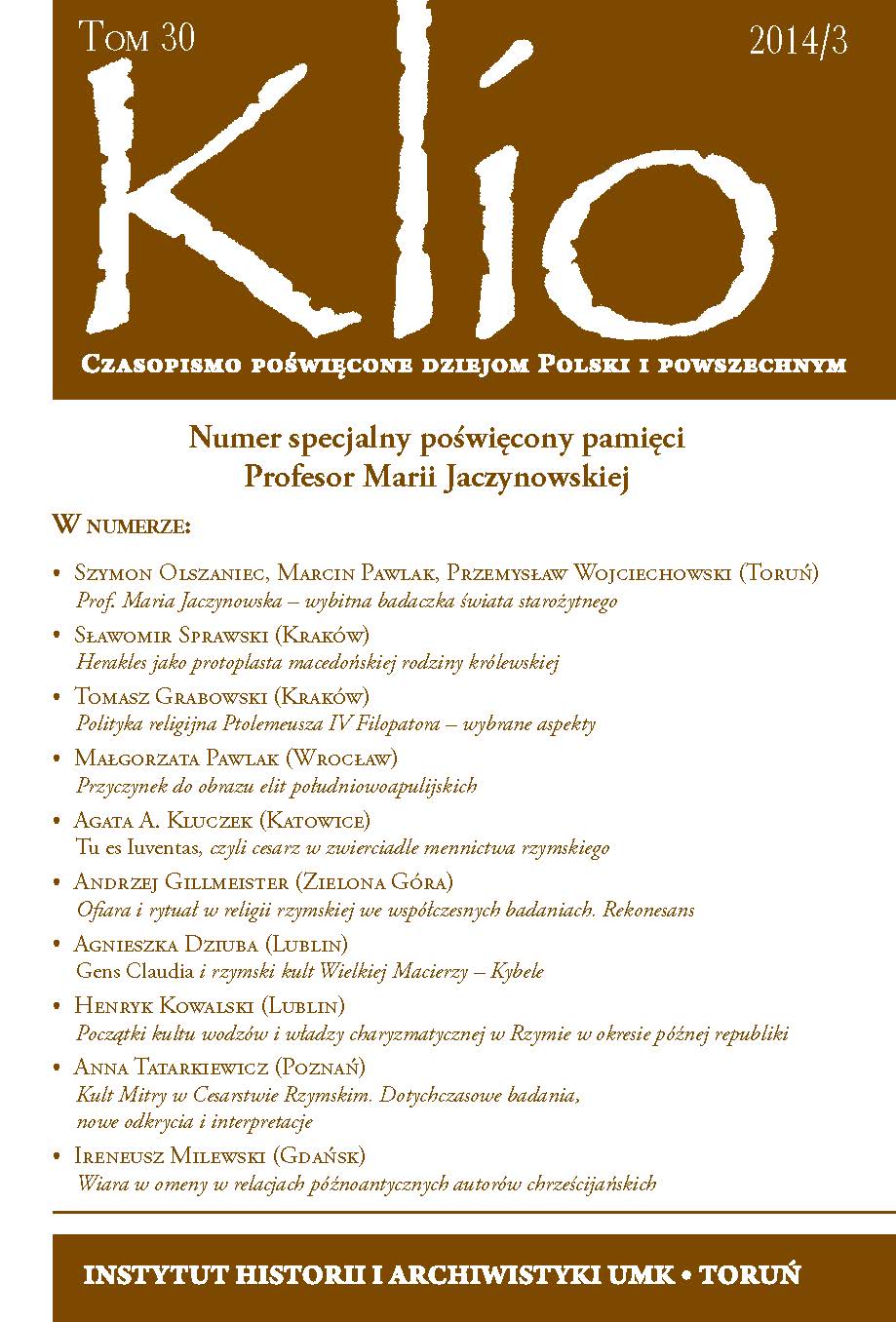
Klio - Czasopismo Poświęcone Dziejom Polski i Powszechnym

Pobrania

  • PDF

Opublikowane

2015-02-12

Jak cytować

1.
DZIUBA, Agnieszka. Gens Claudia i rzymski kult Wielkiej Macierzy – Kybele. Klio - Czasopismo Poświęcone Dziejom Polski i Powszechnym [online]. 12 luty 2015, T. 30, nr 3, s. 85–99. [udostępniono 11.4.2026]. DOI 10.12775/KLIO.2014.046.
  • PN-ISO 690 (Polski)
  • ACM
  • ACS
  • APA
  • ABNT
  • Chicago
  • Harvard
  • IEEE
  • MLA
  • Turabian
  • Vancouver
Pobierz cytowania
  • Endnote/Zotero/Mendeley (RIS)
  • BibTeX

Numer

Tom 30 Nr 3 (2014)

Dział

Artykuły

Statystyki

Liczba wyświetleń i pobrań: 1441
Liczba cytowań: 0

Wyszukiwanie

Wyszukiwanie

Przeglądaj

  • Indeks autorów
  • Lista archiwalnych numerów

Użytkownik

Użytkownik

Aktualny numer

  • Logo Atom
  • Logo RSS2
  • Logo RSS1

Informacje

  • dla czytelników
  • dla autorów
  • dla bibliotekarzy

Newsletter

Zapisz się Wypisz się

Język / Language

  • Čeština
  • Deutsch
  • English
  • Français (France)
  • Język Polski
W górę

Akademicka Platforma Czasopism

Najlepsze czasopisma naukowe i akademickie w jednym miejscu

apcz.umk.pl

Partnerzy platformy czasopism

  • Akademia Ignatianum w Krakowie
  • Akademickie Towarzystwo Andragogiczne
  • Fundacja Copernicus na rzecz Rozwoju Badań Naukowych
  • Instytut Historii im. Tadeusza Manteuffla Polskiej Akademii Nauk
  • Instytut Kultur Śródziemnomorskich i Orientalnych PAN
  • Instytut Tomistyczny
  • Karmelitański Instytut Duchowości w Krakowie
  • Ministerstwo Kultury i Dziedzictwa Narodowego
  • Państwowa Akademia Nauk Stosowanych w Krośnie
  • Państwowa Akademia Nauk Stosowanych we Włocławku
  • Państwowa Wyższa Szkoła Zawodowa im. Stanisława Pigonia w Krośnie
  • Polska Fundacja Przemysłu Kosmicznego
  • Polskie Towarzystwo Ekonomiczne
  • Polskie Towarzystwo Ludoznawcze
  • Towarzystwo Miłośników Torunia
  • Towarzystwo Naukowe w Toruniu
  • Uniwersytet im. Adama Mickiewicza w Poznaniu
  • Uniwersytet Komisji Edukacji Narodowej w Krakowie
  • Uniwersytet Mikołaja Kopernika
  • Uniwersytet w Białymstoku
  • Uniwersytet Warszawski
  • Wojewódzka Biblioteka Publiczna - Książnica Kopernikańska
  • Wyższe Seminarium Duchowne w Pelplinie / Wydawnictwo Diecezjalne „Bernardinum" w Pelplinie

© 2021- Uniwersytet Mikołaja Kopernika w Toruniu Deklaracja dostępności Sklep wydawnictwa