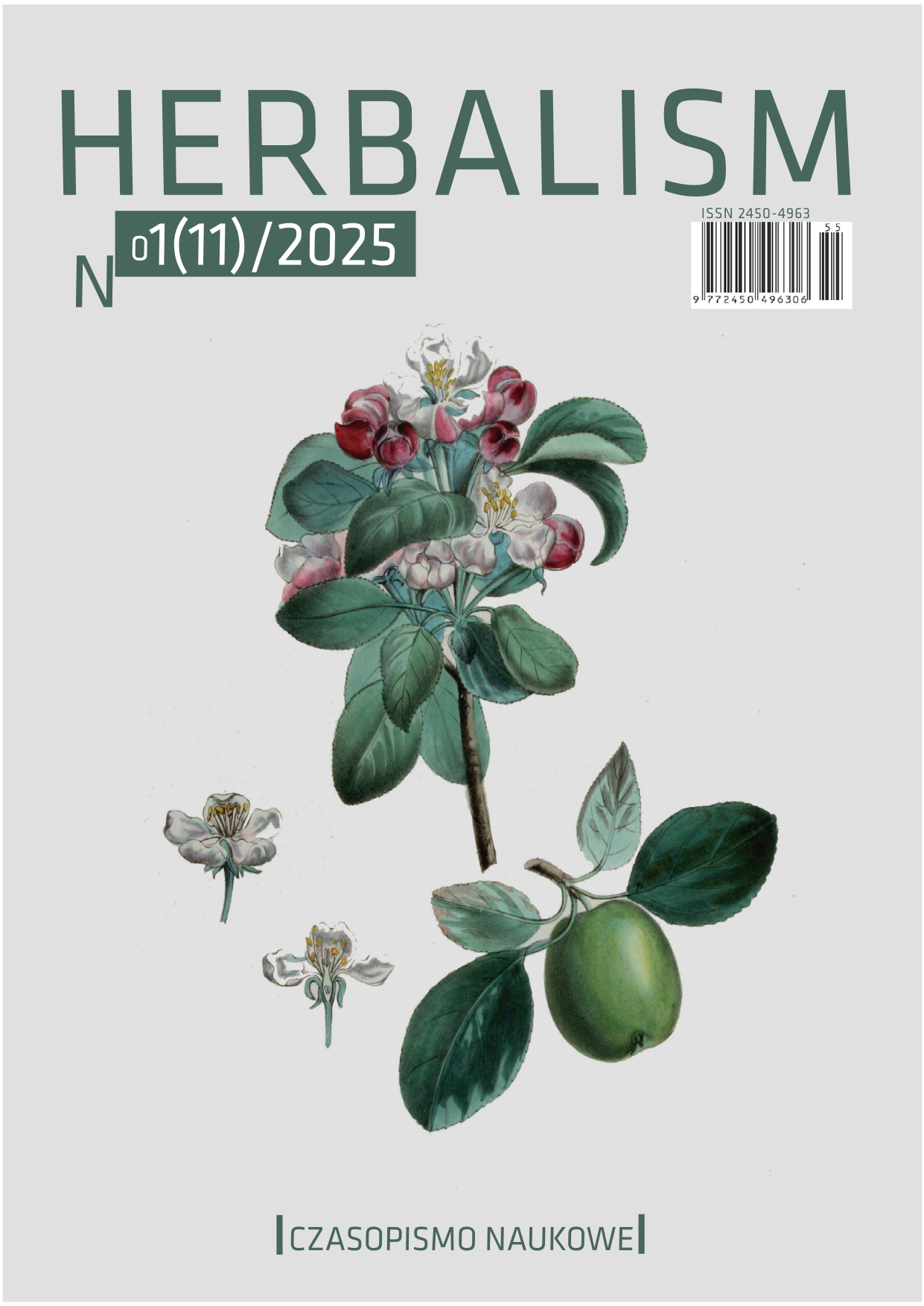
Liście jabłoni jako źródło składników bioaktywnych
DOI:
https://doi.org/10.12775/HERB.2025.004Schlagworte
liście jabłoni, ‘Idared’, ‘Oliwka Inflancka, składniki bioaktywneAbstract
Malus domestica L. należy do najpopularniejszych roślin sadowniczych w strefie klimatu umiarkowanego. Celem niniejszej pracy była ocena liści jabłoni dwóch odmian: ‘Idared’ i ‘Oliwka Inflancka’ zebranych w trzech terminach (wiosna, lato, jesień), jako potencjalne-
go źródła związków bioaktywnych z możliwością zastosowania w produkcji kosmetyków. W liściach oznaczono zawartość polifenoli ogółem, fenylopropanoidów, flawonoli, antocyjanów, a także oznaczono aktywność przeciwutleniającą względem rodnika ABTS oraz
zdolność redukcji jonów żelaza (FRAP). Liście jabłoni odmiany ‘Idared’ na ogół zawierały większą liczbę oznaczanych składników bioaktywnych oraz cechowały się większą aktywnością przeciwutleniającą w porównaniu do liści jabłoni odmiany ‘Oliwka Inflancka’. Liście pozyskane jesienią na ogół były zasobniejsze w oznaczane składniki bioaktywne i cechowały się większą aktywnością przeciwutleniającą w porównaniu do liści pozyskanych w pozostałych porach roku.
Literaturhinweise
[1] Ivanova T., Popova V., Mazova N., Stoyanova A., i Damyanova S., Extracts from physalis leaves (Physalis peruviana L.) for prospective application in medicine and cosmetics, Ukrainian Food Journal, 2019, 8(1), s. 34–44.
[2] Ziemlewska A., Zagórska-Dziok M., i Nizioł-Łukaszewska Z., Assessment of cytotoxicity and antioxidant properties of berry leaves as by-products with potential application in cosmetic and pharmaceutical products, Scientific Reports, 2021, 11(1), s. 3240.
[3] Wojdyło A., Nowicka P., Turkiewicz I.P., Tkacz K., i Hernandez F., Comparison of bioactive compounds and health promoting properties of fruits and leaves of apple, pear and quince, Scientific Reports, 2021, 11(1), s. 20253.
[4] Do Thi N., Hwang E.S., Anti-cancer and anti-inflammatory activities of aronia (Aronia melanocarpa) leaves, Asian Pacific Journal of Tropical Biomedicine, 2018, 8(12), s. 586–592.
[5] Skupień K., Kostrzewa-Nowak D., Oszmiański J., I Tarasiuk J., In vitro antileukaemic activity of extracts from chokeberry (Aronia melanocarpa [Michx] Elliott) and mulberry (Morus alba L.) leaves against sensitive and multidrug resistant HL60 cells, Phytotherapy Research, 2008, 22, s. 689–694.
[6] Khademi F., Danesh B., Mohammad Nejad D., Ghorbani M., Soleimani Rad J., Effects of quince leaf extract on biochemical markers and coronary histopathological changes in rabbits, Arya Atherosclerosis, 2013, 9(4), s. 223–231.
[7] Qadir M.I., Ali M., Ibrahim Z., Anti-cancer activity of Morus nigra leaves extract, Bangladesh Journal of Pharmacology, 2014, 9(4), s. 496–97.
[8] Starzec A., Raj D., Fecka I., Właściwości prozdrowotne owoców jabłoni domowej w świetle najnowszych badań naukowych (Malus x domestica Borkh.), Farmacja Polska, 2020, 76(3), s. 137–148.
[9] Sałyga S., Jakie odmiany jabłek dominują w polskich chłodniach?, 2023, sadyogrody.pl (dostęp 25.09.24).
[10] Liaudanskas M., Viškelis P., Raudonis R., Kviklys D., Uselis N., Janulis V., Phenolic composition and antioxidant activity of Malus domestica leaves, the Scientific World Journal, 2014, 1, s. 306217.
[11] Sobhy R., Öz F., Lorenzo J.M., Bakry A.M., Mohamed A., Bioactive components and health promoting effect of berry by-products, In Berry Bioactive Compound By-Products, 2023, s. 73–95.
[12] Singleton V.L., Orthofer R., Lamuela-Raventós R.M., Analysis of total phenols and other oxidation substrates and antioxidants by means of Folin-Ciocalteu reagent, [w:] Methods in Enzymology, 1999, 299, s. 152–178.
[13] Fukumoto L.R., Mazza G., Assessing antioxidant and prooxidant activities of phenolic compounds, Journal of Agricultural and Food Chemistry, 2000, 48(8), s. 3597–3604.
[14] Benzie I.F., Strain J.J., The ferric reducing ability of plasma (FRAP) as a measure of “antioxidant power”: the FRAP assay., Analytical Biochemistry, 1996, 239(1), s. 70–76.
[15] Re R., Pellegrini N., Proteggente A., Pannala A., Yang M., i Rice-Evans C., Antioxidant activity applying an improved ABTS radical cation decolorization assay, Free Radical Biology and Medicine, 1999, 26(9–10), s. 1231–1237.
[16] Rana S., Kumar S., Rana A., Sharma V., Katoch P., Padwad Y., Bhushan S., Phenolic constituents from apple tree leaves and their in vitro biological activity, Industrial Crops and Products, 2016, 90, s. 118–125.
[17] Wojdyło A., Oszmiański J., Antioxidant activity modulated by polyphenol contents in apple and leaves during fruit development and ripening, Antioxidants, 2020, 9(7), s. 567.
[18] Teleszko M., Wojdyło A., Comparison of phenolic compounds and antioxidant potential between selected edible fruits and their leaves, Journal of Functional Foods, 2015, 14, s. 736–746.
[19] Efenberger-Szmechtyk M., Nowak A., I Czyżowska A., Aktywność przeciwbakteryjna ekstraktów polifenolowych pozyskanych z liści jabłoni, Rola Procesów Technologicznych w Kształtowaniu Jakości Żywności, 2016, 68.
[20] Wojdyło A., Nowicka P., Turkiewicz I.P., Tkacz K., Hernandez F., Comparison of bioactive compounds and health promoting properties of fruits and leaves of apple, pear and quince, Scientific Reports, 2021, 11(1), s. 20253.
Downloads
Veröffentlicht
Zitationsvorschlag
Ausgabe
Rubrik
Lizenz
Copyright (c) 2025 Małgorzata Tabaszewska, Radosława Skoczeń-Słupska, Patrycja Wójcik, Grzegorz Tokarczyk

Dieses Werk steht unter der Lizenz Creative Commons Namensnennung - Keine Bearbeitungen 4.0 International.
Stats
Number of views and downloads: 105
Number of citations: 0


